Ancient Nutra Wellness Team · 30 July 2026 · 5 min read
5 daily-use seeds and what each one actually does
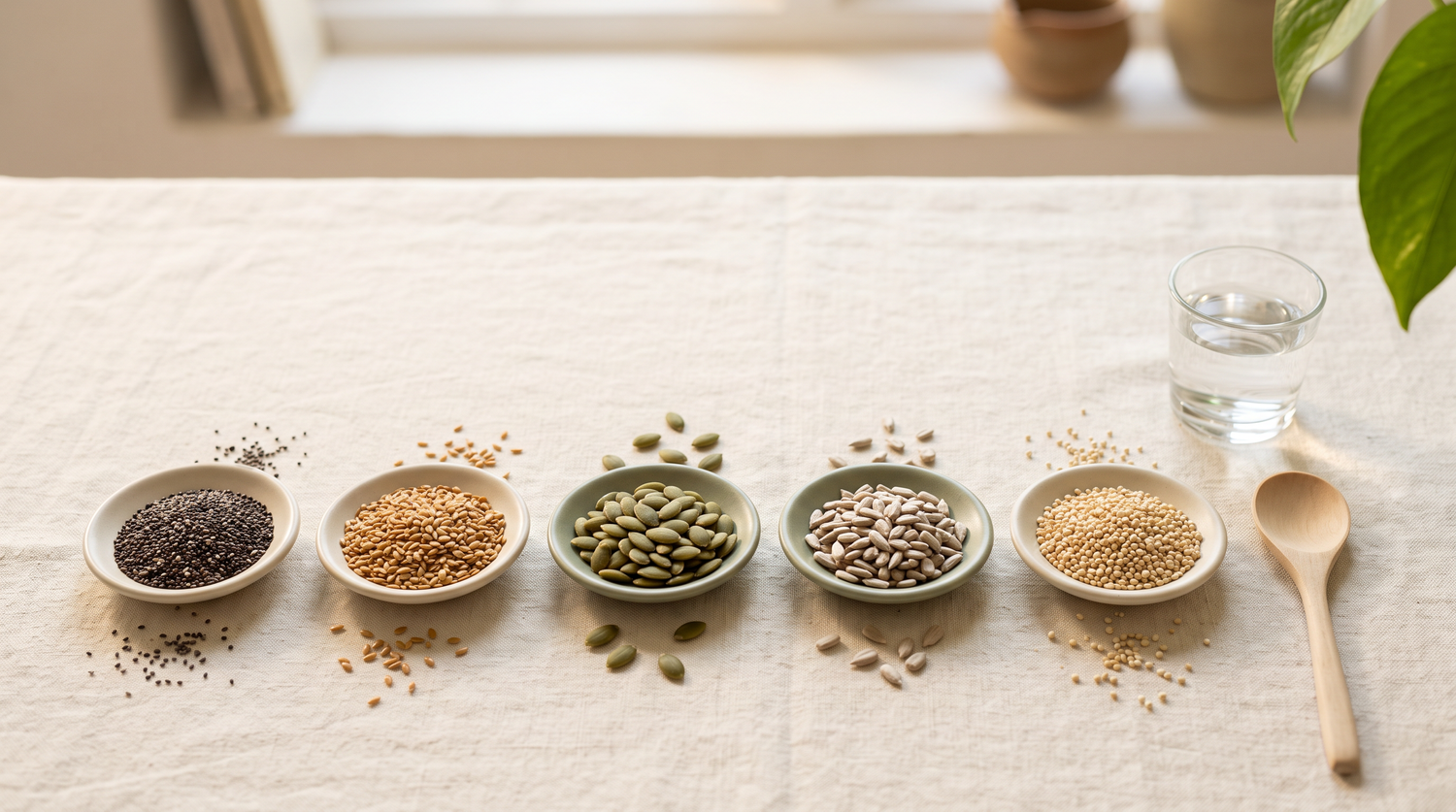
- Seeds are not interchangeable. Chia is the fiber and fullness seed, flax covers plant omega-3, pumpkin is the magnesium seed, sunflower is the vitamin E snack, and quinoa is the one that behaves like a grain and carries complete protein.
- One ounce of pumpkin seeds carries about 156 mg of magnesium, roughly 37 percent of a day's requirement, which is why it suits the evening rather than the morning.
- Pick by the job, not by the trend. Two tablespoons of chia alone bring close to 10 grams of fiber against a 25 to 38 gram daily target.
- Anyone who does not want five separate jars can rotate a pre-blended mix and keep one jar on the counter instead.
Most kitchens end up with a shelf of seed jars bought at different times for different reasons, and by month three nobody remembers which one was for what. They all look similar in a bowl, so they get used interchangeably, which wastes the specific thing each was worth buying for. Seeds are cheap, shelf-stable, and genuinely useful, but only if the right one lands in the right meal. Here is what each of the five that get used daily is good at, and the slot in the day where each earns its place.
Start with chia when the goal is fiber and staying full
Chia is the seed to reach for when the problem is hunger between meals or a diet that is short on fiber. Two tablespoons carry close to 10 grams of fiber, which is a meaningful share of the 25 to 38 grams a day most adults are advised to hit and rarely do. Chia is also the only one of the five that gels: soaked in water, milk, or curd for ten minutes it swells into a soft pudding texture, and that bulk is what makes a small breakfast feel like a real one.
Practically, that means chia belongs in liquids. Stir Ancient Nutra's Chia Seeds into overnight oats, into a glass of water with lime in the afternoon, or into curd with a spoon of treacle. Chia does not need grinding, which is the other reason it gets used more than the rest.
Reach for flax when there is no fish in the week
Flax is the plant omega-3 seed. It is the one that matters most to anyone eating vegetarian, or to households where fish only appears once or twice a week. Flax also carries lignans, the plant compounds it is studied for beyond its fat content.
The one rule with flax is that it has to be ground. Whole flax seeds are small, hard, and slippery enough to pass through largely intact, so the useful part never gets released. Grinding a week's worth in a dry grinder and keeping it in the fridge takes two minutes. Ancient Nutra's Flax Seeds work stirred into kanda, folded into roti dough, or spooned over rice at the end of cooking. There is a fuller breakdown of the absorption question in the guide to the plant omega-3 vegetarians actually absorb.
Use pumpkin seeds for magnesium and the evening wind-down
Pumpkin seeds are the magnesium seed, and by a wide margin. One ounce, about a small handful, delivers roughly 156 mg of magnesium, close to 37 percent of an adult's daily requirement. Very few everyday foods come near that in a portion that small.
That single fact decides when to eat them. Magnesium is involved in muscle relaxation and normal sleep, so a handful of Ancient Nutra's Pumpkin Seeds after dinner is a better use of them than scattering them over a morning bowl. They also toast well in a dry pan for two minutes, which is worth doing, because warm pumpkin seeds get eaten and cold ones sit in the jar.
Keep sunflower seeds for the snack slot
Sunflower kernels are the vitamin E seed, and they are the cheapest of the five, which makes them the practical choice for the 4 p.m. gap when the alternative is a packet of biscuits. Vitamin E is fat-soluble, and sunflower kernels arrive with their own fat, so nothing else has to be added for the nutrient to be usable.
Ancient Nutra's Sunflower Seeds need no soaking, no grinding, and no cooking, which is why they end up in a small container in a bag rather than on the counter. The full case for that habit sits in the piece on the small daily snack that covers vitamin E.
Cook quinoa when the meal needs protein, not a topping
Quinoa is the odd one out. It behaves like a grain, gets cooked like rice, and fills a bowl rather than dusting one. It is also the only seed of the five that supplies all nine essential amino acids, which is what earns it the "complete protein" label and makes it useful on a plate with no meat, fish, or egg.
Rinse it, cook it two parts water to one part seed for about fifteen minutes, and treat it exactly as rice: under a curry, in a salad with lime and coriander, or cooled and packed for lunch. Ancient Nutra's Quinoa Seeds belong in the rice cupboard rather than with the seed jars, where they tend to get forgotten.
Whole seeds with a clean, uniform colour and no dusty or oily film in the bag. Seeds carry natural oils, so anything that smells flat or faintly bitter has been open too long. Buy in 100 g quantities rather than bulk kilos, keep the jar out of direct sun, and grind flax only in the amount needed for the week. Ancient Nutra's Chia Seeds are packed in 100 g so a jar gets finished while it is fresh.
Rotate instead of choosing, if five jars is too many
Nobody needs all five open at once. Ancient Nutra's 4-in-1 Super Seeds Mix puts flax, chia, pumpkin, and sunflower in a single jar for exactly this reason, which suits a household that wants the spread without the shelf. There are five ways to use it in the piece on super seeds beyond the smoothie.
The bottom line
Five seeds, five different jobs: chia for fiber and fullness, flax for plant omega-3, pumpkin for magnesium in the evening, sunflower for a cheap vitamin E snack, quinoa for complete protein in a bowl. Anyone starting from zero should start with chia, because it is the one that changes how a breakfast feels on day one, and add the others as the gaps become obvious.

Chia Seeds 100g
Close to 10 grams of fiber in two tablespoons, and it gels in any liquid without grinding.
Shop Chia SeedsSources and further reading
- Dietary fiber: essential for a healthy diet, Mayo Clinic.
- Magnesium fact sheet for consumers, NIH Office of Dietary Supplements.
Written by the Ancient Nutra Wellness Team. The team researches, sources, and tests every ingredient before it earns a place in an Ancient Nutra blend. Questions? Email info@ancientnutra.com or message Ancient Nutra on Instagram.
Medical disclaimer: This article is for educational purposes only and is not medical advice. Statements have not been evaluated by the FDA. Ancient Nutra products are not intended to diagnose, treat, cure, or prevent any disease. Speak with a qualified healthcare provider before starting any new supplement, especially if you take prescription medication or have a medical condition.