Ancient Nutra Wellness Team · 30 July 2026 · 6 min read
Sunflower seeds: the small daily snack that covers vitamin E
Key takeaways
- One ounce of sunflower seeds, roughly a small handful, carries about 7.4mg of vitamin E, close to 49% of the 15mg daily value.
- The same handful brings around 22mcg of selenium (about 41% DV), 5.5g of protein, and 3g of fibre for roughly 165 calories.
- A handful a day is the sensible dose. Sunflower seeds are calorie dense, so a bowl in front of a screen is where the plan goes wrong.
Sunflower seeds sit in the snack aisle beside things that cost three times as much and do considerably less. They get treated as filler: the thing sprinkled over a salad, the thing left at the bottom of a trail mix bag, the thing bought for the children. That is a strange fate for a food that carries more vitamin E per handful than almost anything else on a normal shopping list. One ounce covers about half a day's worth. For most people, nothing else in the daily rotation is doing that job.
What a handful of sunflower seeds actually delivers
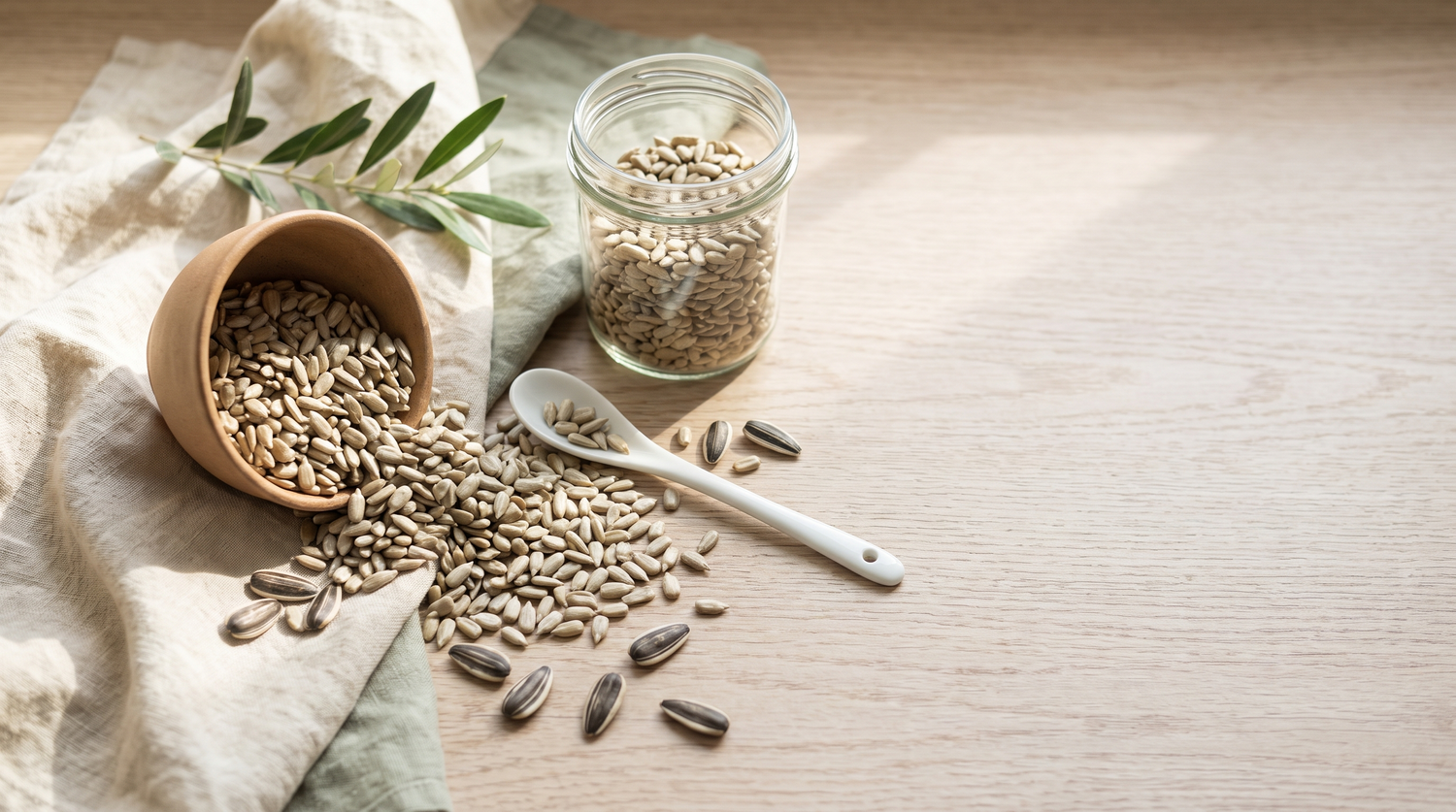
Sunflower seeds are the kernels of Helianthus annuus, the tall yellow-headed annual grown across the world as an oilseed crop. The part worth eating is the soft grey-green kernel inside the striped shell. They are eaten raw, dry roasted, blitzed into butter, or pressed for oil, and they have been a staple snack food far longer than the supplement aisle has existed.
The headline nutrient is vitamin E. One ounce, about 28g or a small cupped handful of dry roasted kernels, provides roughly 7.4mg of alpha-tocopherol, which is close to 49% of the 15mg daily value for adults, according to the NIH Office of Dietary Supplements. Raw kernels run higher still, closer to 10mg per ounce in USDA's food composition data. Very few foods are in that range. Almonds are the nearest common competitor and they sit well below it.
That matters because vitamin E is one of the nutrients people quietly miss. Three national dietary surveys in the United States found that most people take in less than the recommended amount, and there is no reason to assume the picture is dramatically better elsewhere. Vitamin E is a fat-soluble antioxidant, which in plain language means it sits in cell membranes and takes the hit from oxidative damage before the membrane does. It is not a stimulant. Nobody feels a dose of vitamin E. It is maintenance work.
The rest of the profile is quietly good too. That same ounce carries about 22mcg of selenium, roughly 41% of the daily value, plus 5.5g of protein and 3g of fibre for about 165 calories. Sunflower seeds also contain phytosterols, plant compounds that compete with cholesterol for absorption in the gut, which is part of why Cleveland Clinic puts them in the heart-friendly snack column.
Who gets the most out of a daily handful
Sunflower seeds are broadly useful, but a few groups get more from them than others.
- People on a low-fat diet. Vitamin E is fat soluble and travels in the fatty parts of food. Cut the fat hard enough and the vitamin E goes with it. A handful of seeds puts it back without a lot of thought.
- Anyone who snacks out of a packet at 4pm. This is the straightest swap in the pantry. Same handful, same crunch, considerably more nutrition and a lot less refined starch.
- Vegetarians and vegans. Seeds carry protein, magnesium, and selenium in one small package, and selenium in particular is easy to under-eat on a plant-based plate.
- Older adults eating smaller meals. When total food volume drops, nutrient density per bite starts to matter more than it used to. Seeds are dense in the useful sense.
Who does not need them: anyone already eating a wide spread of nuts, seeds, and good oils every day is not missing much by skipping sunflower specifically. And anyone counting calories closely should treat them as a portioned food, not a free one. That is the honest version.
How much to eat, and when
One ounce a day, about 28g, is the working dose. In practice that is a small cupped handful, two heaped tablespoons of kernels, or the amount that disappears into a bowl of curd without changing what it tastes like. Two ounces is fine on a heavy training day. Half a bag in front of a screen is not a dose, it is 700 calories.
Timing is flexible because there is nothing to time. Vitamin E absorbs better with fat, and sunflower seeds bring their own, so they work on their own. The easiest habit is to attach them to something already happening: over the morning curd, into the lunch salad, stirred through a rice-and-vegetable plate at the end of cooking so they keep their crunch. Unsalted is the version to buy. Salted seeds are a salt delivery system with seeds attached.
Look for
Plain shelled kernels, unsalted, uncoated, with nothing on the ingredient list except sunflower seeds. Seeds go rancid faster than nuts because of their oil content, so buy small packs and check that they smell sweet rather than sharp. Ancient Nutra's Sunflower Seeds come as clean 100g kernels, which is roughly three and a half daily servings and a pack size that gets finished before it turns.
Where sunflower seeds come from
The sunflower is not an Ayurvedic herb and there is no point pretending otherwise. It was domesticated in North America thousands of years ago and reached South Asia comparatively late, arriving as an oilseed crop rather than a medicine. In Sri Lanka it is grown mostly in the drier zones for oil, and the kernels have slipped into the kitchen sideways, through baking, salads, and the snack shelf rather than through any traditional formulary. That is a perfectly good reason to eat them. Not everything on the plate needs a lineage.
What to pair sunflower seeds with
Sunflower seeds are strong on vitamin E and selenium and comparatively light on a few other things, which makes them a natural partner rather than a solo act.
The obvious pairing is pumpkin. Ancient Nutra's Pumpkin Seeds bring more zinc and magnesium to the same handful, and the two seeds together cover considerably more ground than either one alone. Half and half in the same jar is the simplest way to do it.
For anyone who would rather not think about ratios, Ancient Nutra's 4-in-1 Super Seeds Mix does the blending in advance, adding flax and chia for the omega-3 side of the picture. This stack is for people building a general daily seed habit. It is not a targeted protocol and nobody needs all four seeds to be healthy.
How long before anything changes
Honestly: nothing will feel different next week, and any article promising otherwise is selling something. Vitamin E and selenium are background nutrients. Their job is to keep a system running properly, not to produce a noticeable event. What does change early, usually inside two or three weeks, is the snacking pattern around them. People notice they are less hungry between lunch and dinner, because 5.5g of protein and 3g of fibre behave differently from a biscuit. The nutritional part is a slow build measured over months. Judge the habit, not the sensation.
The bottom line
A small handful of sunflower seeds is close to half a day of vitamin E, a solid share of the selenium, and a genuinely useful amount of protein and fibre, for the price of the cheapest thing in the aisle. It is a maintenance food, not a miracle, and it works because it is easy to keep doing. Ancient Nutra's Sunflower Seeds are there for anyone who wants a clean unsalted pack to start with. Buy them anywhere, though. The nutrition does not care whose bag they come in.

Sunflower Seeds 100g
Plain unsalted kernels, about three and a half daily servings of vitamin E and selenium per pack.
Shop Sunflower SeedsSources and further reading
- Vitamin E Fact Sheet for Health Professionals, NIH Office of Dietary Supplements.
- Seeds, sunflower seed kernels, dry roasted, without salt (FDC 170563), USDA FoodData Central.
- The Many Health Benefits of Sunflower Seeds, Cleveland Clinic.
Written by the Ancient Nutra Wellness Team. The team researches, sources, and tests every ingredient before it earns a place in an Ancient Nutra blend. Questions? Email info@ancientnutra.com or message Ancient Nutra on Instagram.
Medical disclaimer: This article is for educational purposes only and is not medical advice. Statements have not been evaluated by the FDA. Ancient Nutra products are not intended to diagnose, treat, cure, or prevent any disease. Speak with a qualified healthcare provider before starting any new supplement, especially if you take prescription medication or have a medical condition.