By the Ancient Nutra Editorial Team · 12 November 2026 · 8 min read
Lion's Mane, Ginkgo or Bacopa: which focus herb fits which goal
- Bacopa (Brahmi, Lunuvila) has the most human trial support for attention and recall in healthy older adults, at 300 mg a day for 12 weeks, taken with food.
- Ginkgo is the weakest bet for preventing memory loss: the largest trial, in more than 3,000 adults over 75 followed for about six years, found no drop in dementia. It also needs care with blood thinners.
- Lion's Mane has one small human trial, in adults with mild cognitive impairment, and the gains faded after stopping. Keep any course to 16 weeks or less.
Most advice about focus supplements starts with "which one is best." That is the wrong question. A student before exams, a 60-year-old who notices slower recall, and a desk worker with a foggy afternoon are three different problems, and the evidence for each herb points in a different direction.
This guide matches three well-known focus herbs to the goals they have actually been tested for, and says plainly where the evidence stops.
Which focus herb fits which goal?
Start with what you are trying to fix, then match it to the herb whose trials look most like you.
- Steady attention and recall over a few months, in healthy adults: Bacopa has the most controlled human trials behind it, mostly in older volunteers.
- Worry about memory in later life: Ginkgo is widely taken, but the best long trial did not show it prevents dementia. Treat it as unproven for prevention.
- Mild memory complaints in people over 50: Lion's Mane has early, small-scale support, and more trials are needed before anyone should lean on it.
- Foggy afternoons caused by poor sleep, long screen hours or stress: none of the three fixes that. Sleep, breaks and food come first, as covered in 5 habits that quietly drain afternoon focus.
If you fall in the last group, a herb is not your first move.
What does Bacopa (Brahmi) actually do for memory?
Bacopa monnieri, called Lunuvila in Sinhala and often sold as Brahmi, is a small creeping herb that grows in wet ground across South Asia. Ayurveda has used it as a mind tonic for a very long time. The modern question is simpler: does it show up in a controlled trial?
In a 12-week placebo-controlled trial in older adults, a standardized Bacopa extract at 300 mg a day improved a delayed word-recall score compared with placebo (Calabrese et al., 2008). A separate 12-week study in healthy elderly volunteers reported gains on some measures of attention and cognitive processing, though not on every test (Peth-Nui et al., 2012).
Two practical points follow from those trials. The studies ran for 12 weeks, so judge Bacopa over a full course, then pause and reassess rather than taking it indefinitely. And the documented side effects are digestive (cramping, nausea, loose stools, dry mouth), which are worse on an empty stomach, so take it with food (NIH LiverTox).
One name trap is worth knowing. "Brahmi" is also used for Gotukola (Centella asiatica), a different plant with its own research. Trials on one do not count as evidence for the other, so check the botanical name on the label. For the full 12-week picture, see Brahmi (Lunuvila): the memory herb, and what 12-week trials show.
Does Ginkgo help memory, or is it just popular?
Ginkgo biloba leaf extract is one of the best-known memory supplements in the world, which is exactly why its largest trial matters. The Ginkgo Evaluation of Memory study followed 3,069 adults aged 75 and older who took 120 mg twice a day for a median of about six years. Ginkgo did not reduce the overall rate of dementia compared with placebo (DeKosky et al., JAMA 2008).
That does not make Ginkgo useless for everyone, but nobody should buy it as dementia insurance. If you take it for general mental clarity, keep your expectations modest and the safety points in view.
The US National Center for Complementary and Integrative Health notes that Ginkgo may raise bleeding risk with blood thinners and before surgery, should be avoided in pregnancy, and can cause dizziness, stomach upset and headache (NCCIH). Raw ginkgo seeds are toxic when eaten, so only a leaf extract made for supplements is ever appropriate. If you take warfarin or any anticoagulant, ask your doctor or pharmacist before starting. The deeper look is in Ginkgo biloba and memory: where the evidence is strong.
What do the Lion's Mane trials really show?
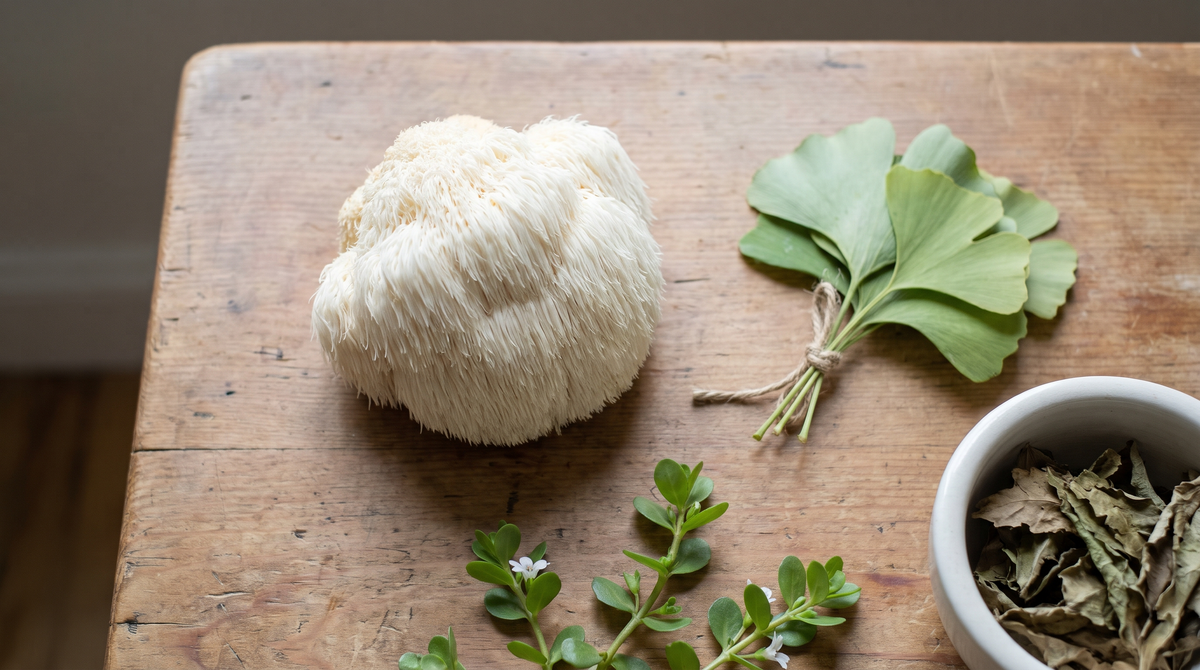
Lion's Mane (Hericium erinaceus) is an edible mushroom with a shaggy white fruiting body. It is the newest of the three to reach the focus aisle, and its human evidence is the thinnest.
The main trial enrolled 30 Japanese adults aged 50 to 80 with mild cognitive impairment. They took 3 g a day of Lion's Mane fruiting-body powder for 16 weeks, and their cognitive scores were higher than placebo by the end. Four weeks after they stopped, the benefit had faded (Mori et al., 2009).
It is one small trial, in people with a diagnosed memory problem rather than healthy students, and it used whole mushroom powder, not the concentrated extract found in most capsules. It is a promising signal, not a settled answer. More detail is in Lion's Mane mushroom: what the human research shows and how to use it.
Lion's Mane is generally well tolerated. Mild digestive upset is the most common side effect (under 10% of users), and allergic reactions have been reported, so stop and seek medical advice if you develop a rash, itching or swelling. Avoid it if you are allergic to mushrooms. Use it in courses of up to 16 weeks, the longest period tested in human trials, rather than indefinitely.
How do you choose between them, and can you combine them?
Pick the herb that matches your goal, run one bounded course, and keep a simple note of what you are tracking, such as how many tasks you finish before your attention drifts. Starting with one herb at a time means you know what is doing what.
Combining all three is a convenience choice, not an evidence-based one. No controlled trial has tested Lion's Mane, Ginkgo and Bacopa together, so any claim that the trio works better than its parts would be a guess. If you do combine them, the safety points above all still apply, and a pharmacist can check them against any medicine you already take.
Look for
The botanical name on the label (Bacopa monnieri for Brahmi, Ginkgo biloba, Hericium erinaceus for Lion's Mane), the amount per capsule, and the extract type. Ancient Nutra's Brahmi Capsule (Lunuvila) is Bacopa monnieri, and Ancient Nutra's Ginkgo Biloba Extract is a Ginkgo biloba extract.
Is Brahmi the same as Gotukola?
No. Brahmi usually means Bacopa monnieri (Lunuvila), while Gotukola is Centella asiatica. They are different plants, so research on one does not apply to the other.
Can I take Ginkgo with blood thinners?
Not without asking your doctor or pharmacist first. Ginkgo may raise bleeding risk with anticoagulants such as warfarin and before surgery.
How long should I take a focus herb?
In bounded courses. The Bacopa trials ran for 12 weeks and the Lion's Mane trial for 16 weeks, so pause and reassess at the end of a course instead of taking either one indefinitely.
The bottom line
Match the herb to the goal: Bacopa for steady attention and recall, Ginkgo only with modest expectations and a safety check, and Lion's Mane as an early, promising option. For people who want all three capsules in one box, Ancient Nutra's Focus & Cognition System bundles Lion's Mane, Brahmi and Ginkgo capsules.
The system also includes a week of Shield Shot, which contains turmeric. Treat the bundle as a bounded course of up to 12 weeks, and stop and speak to a doctor if you notice yellowing of the skin or eyes, dark urine, persistent nausea or unusual tiredness.

Focus & Cognition System
A daily brain-support bundle of Lion's Mane, Brahmi and Ginkgo Biloba capsules.
Shop Focus & Cognition SystemSources and further reading
- Calabrese C, et al. Effects of a standardized Bacopa monnieri extract on cognitive performance, anxiety, and depression in the elderly. J Altern Complement Med, 2008, PubMed.
- Peth-Nui T, et al. Effects of 12-week Bacopa monnieri consumption on attention, cognitive processing, working memory, and functions of both cholinergic and monoaminergic systems in healthy elderly volunteers. Evid Based Complement Alternat Med, 2012, PubMed Central.
- DeKosky ST, et al. Ginkgo biloba for prevention of dementia: a randomized controlled trial. JAMA, 2008, PubMed.
- Mori K, et al. Improving effects of the mushroom Yamabushitake (Hericium erinaceus) on mild cognitive impairment. Phytother Res, 2009, PubMed.
- Ginkgo, National Center for Complementary and Integrative Health.
- Bacopa, NIH LiverTox.
- Further reading: What focus herbs can honestly claim, and where the evidence stops.
Written by the Ancient Nutra Wellness Team. The team researches, sources, and tests every ingredient before it earns a place in an Ancient Nutra blend. Questions? Email info@ancientnutra.com or message Ancient Nutra on Instagram.
Medical disclaimer: This article is for educational purposes only and is not medical advice. Statements have not been evaluated by the FDA. Ancient Nutra products are not intended to diagnose, treat, cure, or prevent any disease. Speak with a qualified healthcare provider before starting any new supplement, especially if you take prescription medication or have a medical condition.