Ancient Nutra Wellness Team · 19 September 2026 · 6 min read
Why you feel sleepy after lunch: what the evidence shows
By the Ancient Nutra Editorial Team
- The after-lunch dip is real, but it is not universal. In a sleep-laboratory study of 15 healthy adults, only 5 fell asleep faster after a meal than they did without one.
- The popular carbohydrate-crash explanation does not survive testing. When researchers compared high-fat, high-carbohydrate and mixed meals under polysomnography, the constituents made no measurable difference. What did matter was whether the meal was solid or liquid.
- Genuine low blood sugar is uncommon in people who do not have diabetes, so for most people the afternoon slump needs a different explanation than a sugar crash.
Almost everyone has a story about the hour after lunch. The screen stops making sense, the second cup of tea arrives earlier than planned, and somewhere in the retelling a familiar phrase appears: a sugar crash. It is such a tidy explanation that it rarely gets questioned. The trouble is that researchers have been putting people in sleep laboratories and measuring exactly this since the early 1980s, and the results do not line up with the story most of us tell. What follows is what those measurements found, including the parts that are inconvenient for anyone selling a solution.
Start with what the sleep laboratory measured
The cleanest way to test drowsiness is not to ask people how tired they feel. It is to send them for a nap and measure how long they take to fall asleep, wired up for polysomnography. Shorter sleep onset latency means genuinely sleepier.
One of the earliest studies to do this fed 15 healthy volunteers on one of two successive days and compared their nap latency with a no-meal day. The finding was not the one folklore predicts. Across the group, sleep onset latency after the meal was not significantly different from the no-meal condition, and the volunteers' own subjective ratings did not shift either. Only 5 of the 15 fell asleep faster after eating, by between 1 and 11 minutes. The authors concluded that postprandial sleepiness is not an invariable consequence of eating, and that it depends on variables including hunger, the volume of the meal and what was in it (Stahl, Orr and Bollinger, 1983).
Roughly a third of a small healthy sample showed the effect at all. If you genuinely flatten after lunch you are not imagining it, but this is an individual difference rather than a universal law of digestion, and that distinction changes what is worth doing about it.
The carbohydrate crash story does not survive testing
If the sugar-crash account were right, a high-carbohydrate meal should reliably make people sleepier than a high-fat one. That specific comparison has been run.
In a pair of experiments, researchers gave 10 healthy men either a solid meal, a liquid meal or an equal volume of water, and separately compared high-fat, high-carbohydrate and mixed meals, taking objective sleep latencies at four points afterwards. The solid meal did produce a significant drop in sleep onset latency against an equivalent volume of water. Between the food constituents there was no significant difference at all. The authors stated it plainly: meal constituents have no effect on postprandial sleepiness (Orr et al., 1997).
A separate study pushed in the opposite direction from the folk account. Eighteen healthy volunteers ate either a high-fat, low-carbohydrate breakfast or a low-fat, high-carbohydrate one. Ratings of fatigue three hours later were significantly greater after the high-fat meal, not the high-carbohydrate one, and the pattern tracked cholecystokinin, a hormone released in response to fat in the gut, rather than glucose (Wells et al., 1997).
So the rice is a weaker suspect than its reputation suggests, and the curry it came with may be the more interesting one. Neither finding tells you to eat differently tomorrow. They mean the mechanism most people recite with confidence is not the one that has been measured.
Low blood sugar is not what is happening to most people
There is a further problem with the crash story, and it is a straightforward clinical one. Hypoglycaemia has a definition. NIH's Endotext reference describes symptomatic hypoglycaemia as diagnosed using Whipple's triad: symptoms of hypoglycaemia, a plasma glucose concentration below 55 mg/dL, and resolution of those symptoms once glucose is raised. The same chapter notes that hypoglycaemia "is frequently seen in patients treated for diabetes but is uncommon in people who do not have diabetes" (Endotext, NIH).
When people with post-meal symptoms are actually measured, the glucose is frequently not low. The sensation is genuine; the label attached to it usually is not. That matters commercially as much as clinically, because a great deal of supplement marketing rests on an unmeasured crash the buyer has been encouraged to assume is happening inside them.
What the evidence does point to
Strip out the mechanism that failed and a smaller, better supported picture remains.
- Meal size and solidity. Volume was named as a relevant variable in the 1983 study, and the solid-versus-liquid contrast was the one effect that reached significance in 1997. A large, heavy midday plate is a more plausible culprit than the specific macronutrient on it.
- Individual variation. Only a minority of healthy volunteers showed the effect, so your own pattern is better evidence about you than any general rule.
- Time of day. The early-afternoon dip in alertness is a feature of human circadian rhythm and turns up whether or not lunch happened. Some of what gets blamed on the meal is simply the hour.
- Sleep the night before. The least fashionable answer on this list and often the operative one. A meal did not cause a deficit that was already there at breakfast.
Build a lunch you can work after
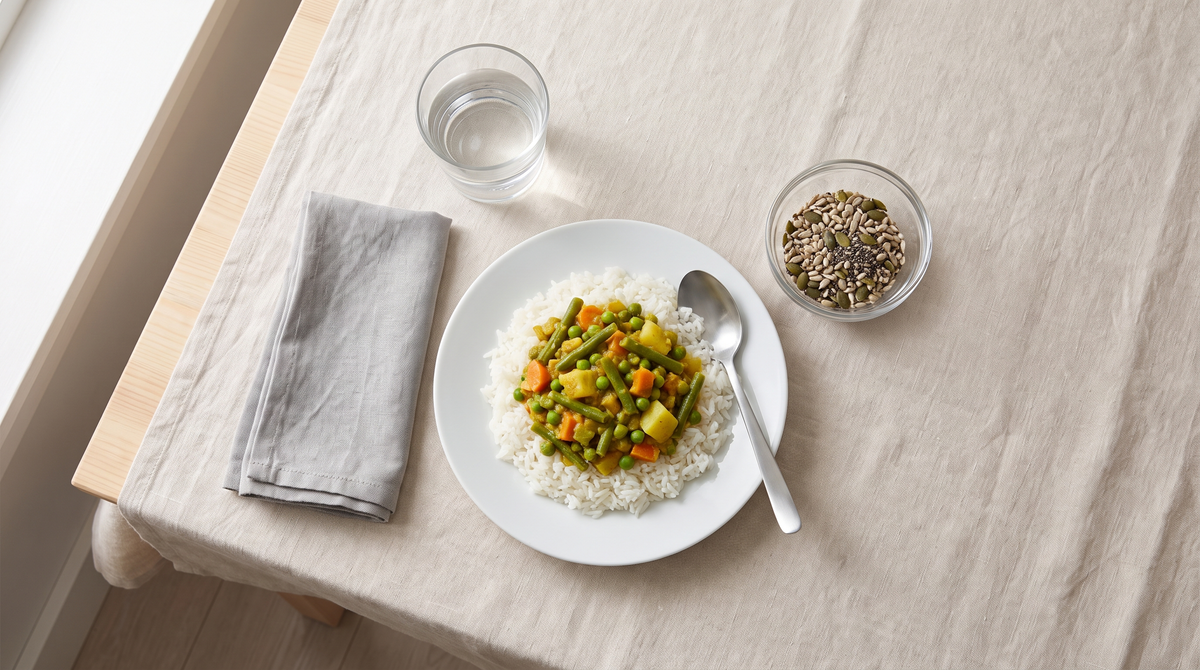
None of the above supports a supplement that fixes the afternoon. It does support a few unglamorous adjustments. Eat a smaller midday portion and judge the result over a week rather than a day. Notice whether the heaviest lunches and the flattest afternoons are the same days. Treat the 3pm dip as partly scheduled by the clock, and put the work that needs least concentration there if the day allows it.
Food quality still matters, for ordinary nutritional reasons rather than as a cure for drowsiness. Fibre and protein are the two things a hurried refined-carbohydrate lunch is usually shortest on, and seeds are a reasonable way to raise both. Ancient Nutra's 4-in-1 Super Seeds Mix is chia, sunflower, pumpkin and flaxseed with nothing else added. It is a food, and to be clear, nothing on this page shows that seeds prevent the after-lunch slump. They make an ordinary lunch more nutritious, which is a smaller and more honest claim.
Two cautions belong with those seeds. Chia should be soaked or stirred into liquid before eating rather than swallowed dry, because dry seeds absorb many times their weight in water and a published case report describes a dry tablespoon causing an oesophageal obstruction that needed an emergency endoscopy. The overnight chia soak covers the timing. NIH's National Center for Complementary and Integrative Health also advises against eating raw or unripe flaxseed, which may contain potentially toxic compounds. The flaxseed here is fully matured and dried, the standard form in raw seed blends, and is meant for the tablespoon-or-two daily serving rather than large amounts. If you are pregnant, breastfeeding or managing a health condition, speak with your doctor first.
Look for
A seed blend that lists its full composition on the pack with no fillers, bulking agents or added sugar, and that says plainly whether the seeds are raw. Ancient Nutra's 4-in-1 Super Seeds Mix names all four seeds and carries the raw flaxseed note on the product page rather than leaving you to find it elsewhere.
Know when afternoon tiredness deserves a doctor
An ordinary dip after a large lunch is an ordinary dip. Persistent, heavy daytime sleepiness is a different matter and deserves a medical appointment rather than a dietary experiment, particularly alongside strong thirst, unexplained weight change or frequent urination, or if you have a diabetes diagnosis or take medication that lowers blood glucose. Genuine hypoglycaemia is diagnosed by measurement, not by how the afternoon feels.
The bottom line
The after-lunch slump is real for some people and absent in others, and the mechanism most often quoted for it is the one the sleep laboratory did not find. Meal size and solidity have better support than the macronutrient breakdown, the early-afternoon dip partly belongs to the clock rather than the plate, and low blood sugar is uncommon in people without diabetes. That leaves a shorter, duller list of useful moves than the internet usually offers: a lighter midday plate, attention to your own pattern, and a proper night's sleep. For the routine version, a simple afternoon ritual sets it out step by step, and the blood sugar claims we will not make explains where the line sits for this brand.

4-in-1 Super Seeds Mix
Chia, sunflower, pumpkin and flaxseed, nothing else added. Soak the chia before eating, and read the raw flaxseed note on the product page.
Shop 4-in-1 Super Seeds MixSources and further reading
- Stahl ML, Orr WC, Bollinger C. "Postprandial sleepiness: objective documentation via polysomnography," Sleep, 1983.
- Orr WC, Shadid G, Harnish MJ, Elsenbruch S. "Meal composition and its effect on postprandial sleepiness," Physiology & Behavior, 1997.
- Wells AS, Read NW, Uvnas-Moberg K, Alster P. "Influences of fat and carbohydrate on postprandial sleepiness, mood, and hormones," Physiology & Behavior, 1997.
- Hypoglycemia, Endotext, National Institutes of Health.
- Flaxseed and flaxseed oil, National Center for Complementary and Integrative Health.
Written by the Ancient Nutra Wellness Team. The team researches, sources, and tests every ingredient before it earns a place in an Ancient Nutra blend. Questions? Email info@ancientnutra.com or message Ancient Nutra on Instagram.
Medical disclaimer: This article is for educational purposes only and is not medical advice. Statements have not been evaluated by the FDA. Ancient Nutra products are not intended to diagnose, treat, cure, or prevent any disease. Speak with a qualified healthcare provider before starting any new supplement, especially if you take prescription medication or have a medical condition.