
Ancient Nutra Wellness Team · 31 October 2026 · 6 min read
Triphala, the three-fruit blend: what the human research shows and what it does not
- Triphala is three dried fruits, amla, haritaki and bibhitaki, used together in Ayurveda for generations, classically in equal parts.
- The longest verified careful human study ran 4 weeks at 2,500 mg a day in 20 healthy volunteers, and it was a safety study, not a test of benefit.
- Reviews describe mild laxative action and gut-friendly polyphenols, but they also call for better trials, so think of Triphala as a traditional daily-routine herb, not a proven fix.
Open a Sri Lankan spice cupboard and you may find three dried fruits that look plain: a golden, wrinkled amla, a ridged brown haritaki and a round, dusty bibhitaki. Ground together they become Triphala, the most widely used polyherbal blend in Ayurveda. Its name simply means "three fruits." Here is what each fruit brings, what human research really exists, and how to fit Triphala into a daily routine without expecting more than the evidence allows.
Meet the three fruits
Each fruit comes from a different tree, and each plays a traditional role. Knowing the botany also helps you read a label with confidence.
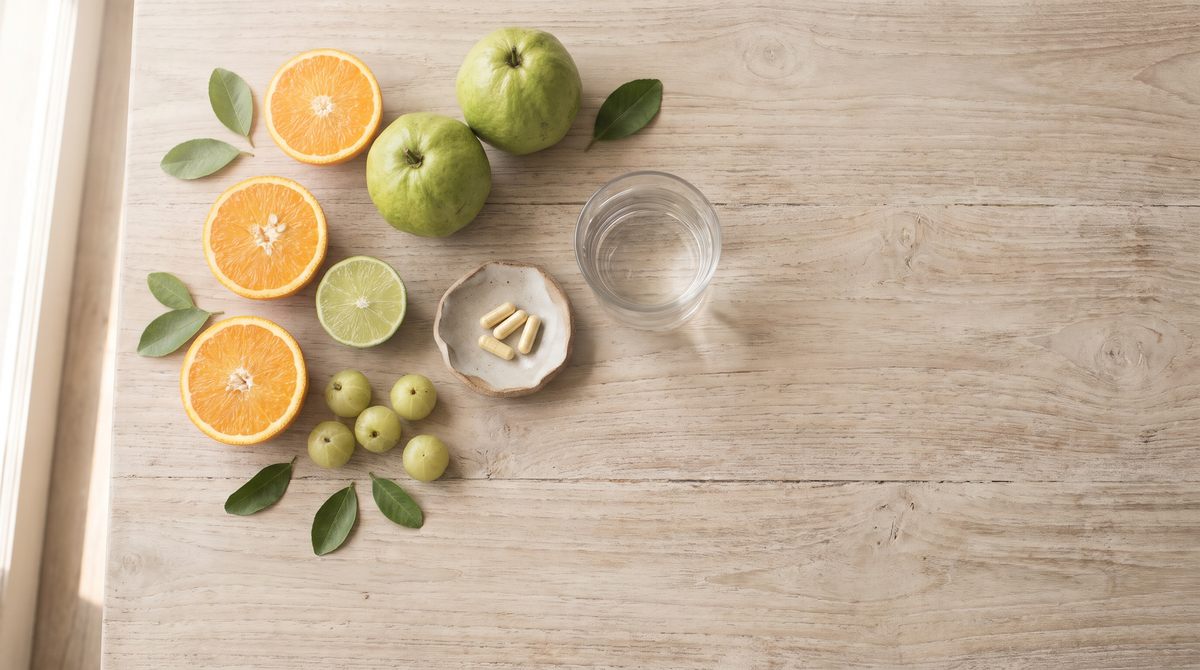
- Amla (Phyllanthus emblica, also written Emblica officinalis) is the vitamin C and polyphenol rich fruit, with a sharp, sour taste.
- Haritaki (Terminalia chebula) is the fruit most associated with gentle bowel movement in traditional texts.
- Bibhitaki (Terminalia bellirica) is the astringent, tannin-rich fruit, valued for balancing the other two.
Classically the three are combined in a 1:1:1 ratio. The idea behind the blend is that the fruits are meant to work as a set rather than as three separate herbs, which is one reason modern research on single fruits cannot be read as proof for the whole formula.
What the human research actually shows
Triphala is often oversold here, so precision matters. A 2017 review in the Journal of Alternative and Complementary Medicine gathered the literature on Triphala and described its traditional place in Ayurvedic digestive care. The same review reported laboratory findings that Triphala polyphenols influence the gut microbiome, while also making clear that much of the evidence is early. You can read it at PubMed (Peterson et al., 2017).
A 2018 review in Chinese Medicine focused on functional gut disorders. Its authors concluded that Triphala holds potential for lower digestive symptoms, and described its mild laxative action, but they framed it as an addition to standard care rather than a replacement. See the Tarasiuk et al. review.
The longest careful human study was short
The cleanest verified human data point is a Thai Phase I trial. Twenty healthy volunteers, ten men and ten women, took 2,500 mg of Triphala aqueous extract a day for 4 weeks, and the researchers monitored safety. They reported no serious adverse effects. It was open-label and single-arm, with no placebo group, and it was designed to test safety rather than benefit. The details are in the Phetkate et al. paper.
The plain reading is this: Triphala looks well tolerated over a month in healthy adults. Whether it improves a particular symptom has not been settled by strong placebo-controlled trials, so anyone promising a specific result is going further than the research does.
Fit Triphala into a steady routine
Because the evidence base is short, the sensible approach is a bounded, observed course rather than an open-ended habit. The longest verified human exposure is 4 weeks, so planning a course of four to six weeks, then pausing to review how you feel, stays within what has actually been studied.
- Pick one consistent time. Traditional use is in the evening, with warm water, though some people prefer the morning. Consistency matters more than the clock.
- Start low. Triphala has mild laxative action, so begin with the smaller end of the label dose and see how your body responds.
- Keep the rest of the day steady. Water, fibre-rich meals and regular sleep do more for digestion than any single herb. Triphala is a supporting habit, not the foundation.
- Change one thing at a time. If you add Triphala and a new probiotic the same week, you will not know which one did what.
If you want to see how the three fruits differ one by one, this guide to what each of the three fruits does goes through them in more detail, and a morning Triphala ritual shows one way to build the habit. For a different angle on digestion, this 5-minute morning ritual built around Beli pairs well with a calm evening routine.
Know who should be careful
Triphala's mild laxative action means loose stools are the most likely side effect, and if that happens, stop and reduce the amount or pause. Check with a qualified healthcare provider first if you are pregnant or breastfeeding, have a diagnosed digestive condition, take prescription medication, or are preparing for surgery. Persistent digestive symptoms deserve a proper medical assessment rather than a herbal workaround.
Look for
A label that names all three fruits with their botanical names, states the amount per serving, and lists nothing else you did not expect. Ancient Nutra's Triphala capsules keep the traditional three-fruit idea in a simple daily format, and the Beli range is a separate traditional fruit worth knowing if gentle digestion is your focus.
The bottom line
Triphala is a well-loved traditional blend with a reassuring short-term safety record in healthy adults and a research base that is still growing. Use it as a bounded, observed part of a steady routine, keep your expectations honest, and let the basics of food, water and sleep carry the real weight.

Triphala, 60 capsules
The classic amla, haritaki and bibhitaki blend, made for a simple evening routine.
Shop TriphalaSources and further reading
- Peterson CT, Denniston K, Chopra D. Therapeutic uses of Triphala in Ayurvedic medicine. J Altern Complement Med, 2017, PubMed.
- Tarasiuk A, Mosinska P, Fichna J. Triphala: current applications and new perspectives on the treatment of functional gastrointestinal disorders. Chin Med, 2018, PubMed.
- Phetkate P, et al. Study of the safety of oral Triphala aqueous extract on healthy volunteers. J Integr Med, 2020, PubMed.
Written by the Ancient Nutra Wellness Team. Questions? Email info@ancientnutra.com or message Ancient Nutra on Instagram.
Medical disclaimer: This article is for educational purposes only and is not medical advice. Statements have not been evaluated by the FDA. Ancient Nutra products are not intended to diagnose, treat, cure, or prevent any disease. Speak with a qualified healthcare provider before starting any new supplement, especially if you take prescription medication or have a medical condition.