Ancient Nutra Wellness Team · 2 October 2026 · 8 min read
Fenugreek and blood sugar after meals: what the research says
By the Ancient Nutra Editorial Team
- In a 2025 review of 26 trials, fenugreek seed lowered 2-hour post-meal glucose by about 22 mg/dL on average. The trials varied a lot, and the reviewers called for better studies.
- The small meal trials are the closest match to the idea: seed eaten with starchy food lowered the glucose rise in healthy and overweight adults. They were short and tiny.
- Fenugreek is not for everyone. Large doses can push blood sugar too low, and above food amounts it is not considered safe in pregnancy.
Most people who feel flat after lunch are not short of a supplement. They are riding a glucose spike that arrives with a big plate of rice and then drops away. Sleep, a walk after the meal and what is on the plate all matter too.
Still, fenugreek keeps coming up, and it is one of the few herbs with a real stack of human trials behind it. This guide covers what the seed does with food, what the research supports and where it runs out, who should leave it alone, and how to use it sensibly if it suits you.
Where fenugreek comes from, and how it is used
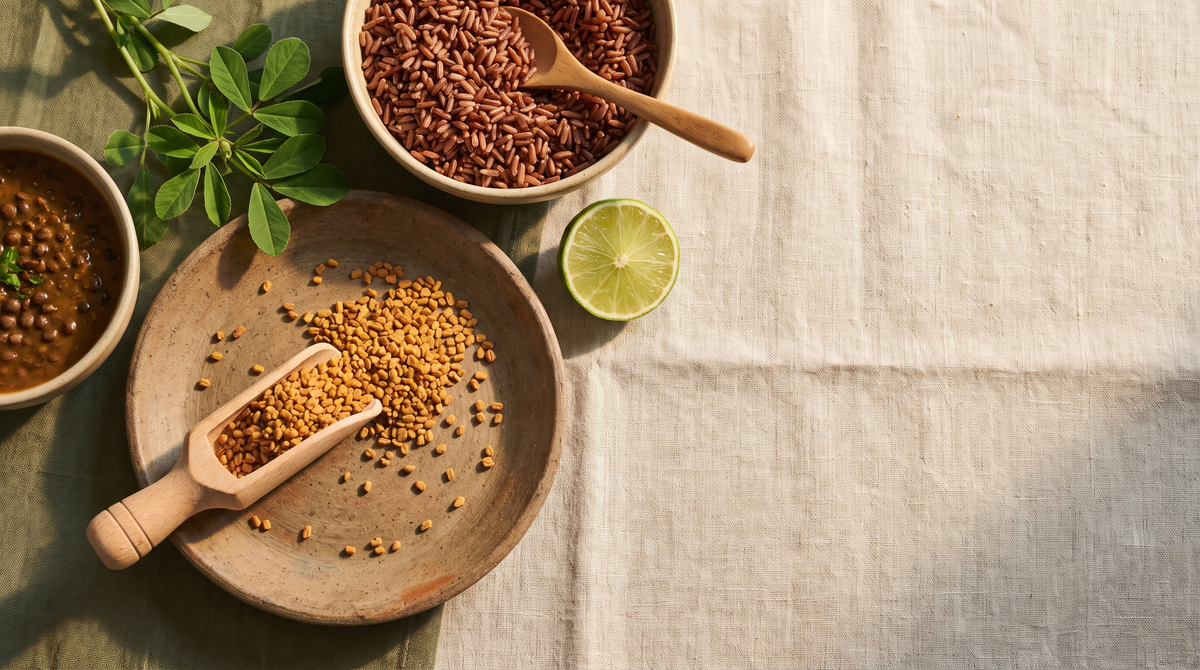
Fenugreek (Trigonella foenum-graecum) is a small annual plant grown for its seeds, which are golden-brown, hard and slightly bitter. Sinhala speakers call it uluhal, and in much of South Asia it is methi. The plant is native to the Mediterranean and western Asia, and India leads commercial production, so it is not a Sri Lankan crop even though it is a familiar one in Sri Lankan kitchens.
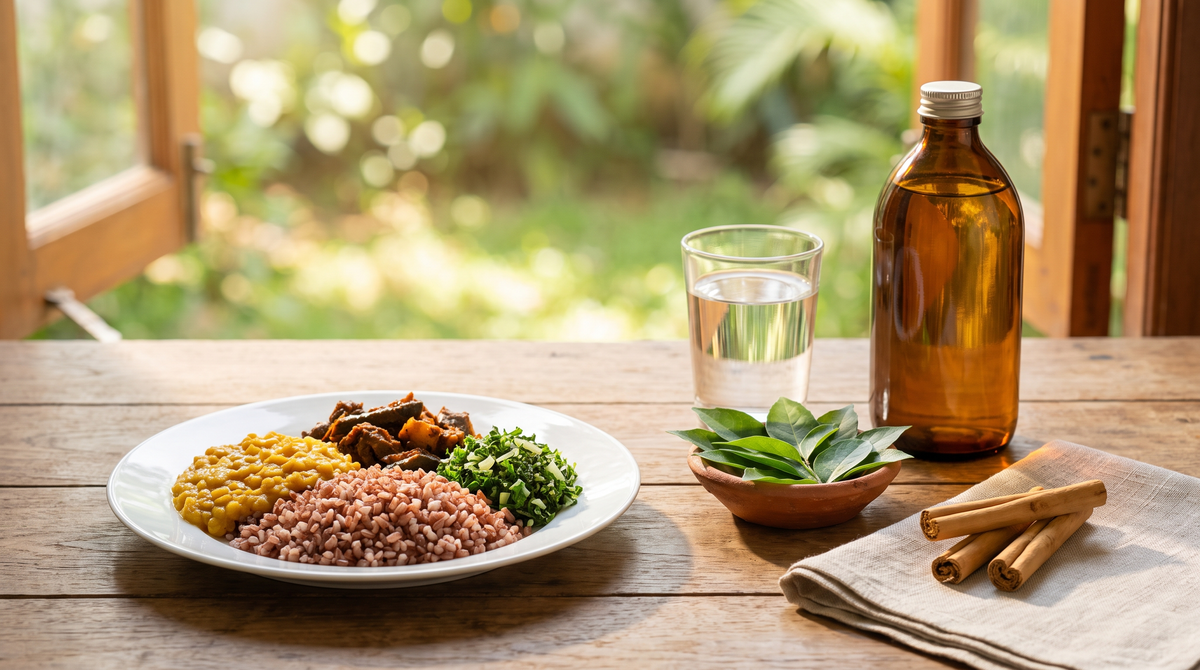
In cooking, the seed is tossed into hot oil at the start of a curry or dhal, or soaked and ground. That kitchen habit is where the interest in post-meal blood sugar began: the seed was already sitting on the plate next to the rice.
What does fenugreek do to blood sugar after a meal?
The best-supported idea is simple. Fenugreek seed is rich in soluble fibre, and fibre of this kind is thought to slow how quickly carbohydrate is digested and absorbed. A slower arrival means a smaller peak. That is a proposed mechanism, not a settled one, but it fits what the meal trials measured.
In a 2016 crossover trial in 10 healthy adults, replacing 10 percent of the wheat flour in buns and flatbreads with fenugreek seed powder cut the glucose response sharply, and the glycaemic index of the flatbread fell from 63 to 43 (Eur J Nutr 2016). A 2014 trial in 14 overweight and obese adults found that 5.5 g of fenugreek added to white bread with jam, or to fried rice, lowered the glucose curve over two hours by roughly a third (J Nutr Metab 2014).
Those are encouraging numbers, and they are also very small studies in a lab setting with a single meal. They tell you the effect is plausible. They do not tell you what a capsule does in a normal week.
How strong is the evidence?
Stronger than for most herbs, and weaker than the headlines suggest. Two meta-analyses are worth knowing.
A 2023 review pooled 10 randomised trials in 706 people with type 2 diabetes or prediabetes. Fenugreek lowered fasting glucose, 2-hour glucose and HbA1c, with no signs of liver or kidney harm and only mild digestive side effects in some trials (Int J Mol Sci 2023). A larger 2025 review of 26 trials found a drop in 2-hour glucose of about 22 mg/dL, fasting glucose of about 17 mg/dL and HbA1c of about 0.6 points, while stressing that higher quality studies are needed (Avicenna J Phytomed 2025).
Here is the counterweight. The 2-hour result in that 2025 review came with very high variation between trials, and the US National Center for Complementary and Integrative Health says many of the studies were not of high quality (NCCIH). Doses ranged from 500 mg to 10 g a day, and forms ranged from whole seed to extract. The trials in the 2023 review ran 8 to 16 weeks. The honest summary: a real signal, an uneven evidence base, and no proof that it replaces anything your doctor has prescribed.
If you want the wider picture, 4 blood sugar herbs, ranked by how strong the evidence is puts fenugreek next to the others, and why you feel sleepy after lunch covers the habits that matter more.
Who should skip fenugreek, or talk to a doctor first?
This part matters more than the benefits, so read it before you buy anything.
- Anyone on metformin, insulin or other glucose-lowering medicine. Large doses of fenugreek may cause a harmful drop in blood sugar (NCCIH). Stacking it on top of medicine is a conversation for your doctor, not a guess.
- Anyone pregnant or trying to conceive. Above food amounts, fenugreek is not considered safe in pregnancy, and its use has been linked to an increased risk of birth defects (NCCIH).
- Anyone breastfeeding. Fenugreek is traditionally used to support milk supply, but check with your doctor before starting any supplement while nursing.
- Anyone with a sensitive stomach. Diarrhoea, nausea and other digestive symptoms are the most common side effects.
On the liver, there is some reassurance: the US National Institutes of Health's LiverTox database states that fenugreek has not been implicated in causing liver injury (LiverTox).
How should you take fenugreek, and for how long?
Start with food. A spoon of seed tempered into dhal, or a pinch of ground methi in a curry, is the version most of the research is built on, and the cautions above apply at much higher amounts than a cook uses.
If you prefer a capsule, take it with a meal, the way the meal trials above gave it. Ancient Nutra's Fenugreek Capsules are directed at 1 to 2 capsules a day. Check the milligrams per capsule on the pack and compare it with the trial range of 500 mg to 10 g a day, because a low-dose capsule is not the same intervention as 5.5 g of seed in a meal.
Bound the experiment. The trials in the 2023 review ran 8 to 16 weeks, so treat 12 weeks as a sensible ceiling, then stop and reassess rather than continuing by default. If you have a glucose meter or a recent HbA1c from your doctor, compare before and after. If you do not, a clear plan with an end date is still better than an open-ended habit.
Look for
A clear milligram amount per serving, the plant part stated as seed, and no proprietary blend hiding the dose. 5 things to check on a fenugreek label walks through the full checklist.
Does fenugreek lower blood sugar?
In trials it lowered fasting and post-meal glucose on average, but the studies varied in quality and dose, so it is a possible aid and not a replacement for medical care.
Is fenugreek safe in pregnancy?
Not above food amounts. The NCCIH says its use in pregnancy has been linked to an increased risk of birth defects.
Can I take fenugreek with metformin?
Speak to your doctor first. Large doses may cause a harmful drop in blood sugar, and medicine and herbs can interact.
How long should I take fenugreek?
The trials ran 8 to 16 weeks. Treat 12 weeks as a ceiling, then stop and reassess.
The bottom line
Fenugreek is a kitchen seed with a genuine, uneven body of evidence for gentler glucose rises after meals. It works best as a small, bounded experiment alongside the basics, and it needs real caution around medication and pregnancy. If you want to try the capsule form, Ancient Nutra's Fenugreek Capsules are below.

Fenugreek Capsules, 60 capsules
Fenugreek seed in vegetarian capsules, taken with a meal.
Shop Fenugreek CapsulesSources and further reading
- Kim J, Noh W, Kim A, Choi Y, Kim YS. The Effect of Fenugreek in Type 2 Diabetes and Prediabetes: A Systematic Review and Meta-Analysis of Randomized Controlled Trials, International Journal of Molecular Sciences, 2023, PubMed.
- The effects of fenugreek (Trigonella foenum-graecum) seed on glycemic parameters: an updated systematic review and meta-analysis of randomized controlled trials, Avicenna Journal of Phytomedicine, 2025, PubMed.
- Reduction of postprandial blood glucose in healthy subjects by buns and flatbreads incorporated with fenugreek seed powder, European Journal of Nutrition, 2016, PubMed.
- Trigonella foenum-graecum seeds lowers postprandial blood glucose in overweight and obese individuals, Journal of Nutrition and Metabolism, 2014, PubMed.
- Fenugreek, NCCIH, US National Institutes of Health.
- Fenugreek, LiverTox, US National Library of Medicine.
Written by the Ancient Nutra Wellness Team. The team researches, sources, and tests every ingredient before it earns a place in an Ancient Nutra blend. Questions? Email info@ancientnutra.com or message Ancient Nutra on Instagram.
Medical disclaimer: This article is for educational purposes only and is not medical advice. Statements have not been evaluated by the FDA. Ancient Nutra products are not intended to diagnose, treat, cure, or prevent any disease. Speak with a qualified healthcare provider before starting any new supplement, especially if you take prescription medication or have a medical condition.