Ancient Nutra Wellness Team · 29 July 2026 · 6 min read
Ashwagandha powder vs capsules: when a spoon beats a pill
- Traditional Ayurvedic use of ashwagandha sits at roughly 2 to 6 grams of dried root per day, an amount measured in spoons, not milligrams. Health Canada's monograph still lists that range.
- Loose powder gives you a bigger, adjustable dose and a way to build it into food or a warm drink. Capsules give you a fixed dose, no taste, and no measuring.
- Pick powder if you want the traditional gram-scale amount and enjoy the ritual. Pick capsules if you travel, dislike the bitterness, or know you will skip anything that needs a spoon.
NIH LiverTox rates ashwagandha (Withania somnifera) likelihood score B, a likely cause of clinically apparent liver injury. Onset is typically 2 to 12 weeks after starting, with a cholestatic or mixed pattern, often with jaundice and itching. About 23 documented cases have been reported since 2017. Most were self-limited, but rare fatal cases, emergency transplant, and 3 deaths from acute-on-chronic liver failure have been reported in an Indian case series. Serious outcomes are uncommon relative to how widely ashwagandha is used, but they are real, so take the herb in a bounded course, not indefinitely.
Stop and seek medical help if you notice yellowing of the eyes or skin, itching, dark urine, persistent nausea, or unusual tiredness.
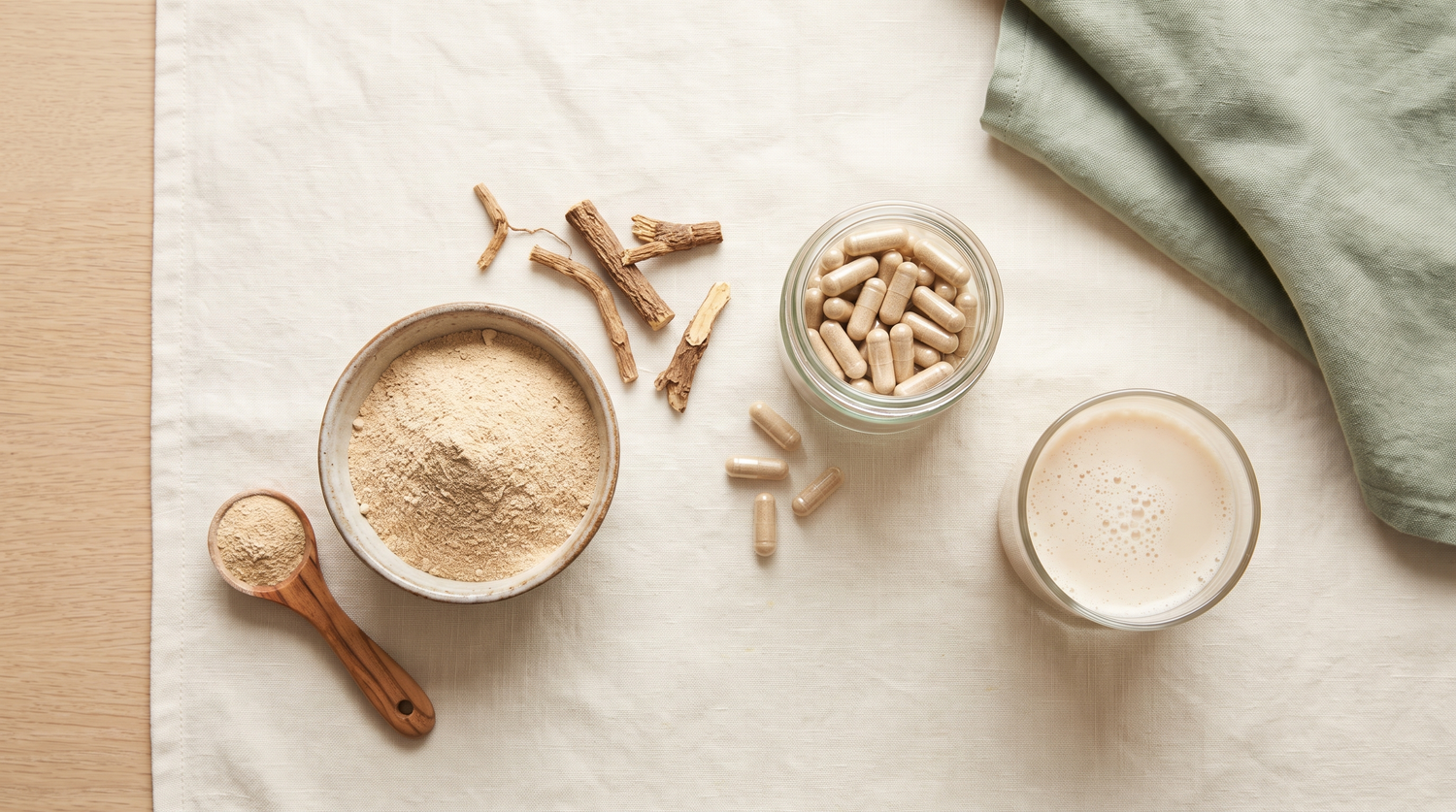
Ashwagandha turns up in two shapes on the same shelf. One is a bag of pale tan powder that you measure with a spoon. The other is a bottle of capsules you swallow without thinking. People usually assume the capsule is the modern, better version and the powder is the old-fashioned one. That is not quite what is going on. The two formats carry very different amounts of root, and they suit very different habits. Choosing well is less about which is stronger and more about which one you will still be taking in eight weeks.
Start with what loose powder actually is
Ashwagandha powder is the dried root of Withania somnifera, cleaned and ground down to a fine flour. Nothing is concentrated out of it and nothing is added to it. What you scoop is the root itself, which is exactly the form the herb has been taken in for most of its history, usually stirred into warm milk or honey rather than swallowed dry.
That matters for the numbers on the pack. Because plain powder is not concentrated, a useful daily amount is measured in grams. A standardised extract compresses the same active compounds into a few hundred milligrams. Neither one is diluted or inflated. They are simply two different scales, and comparing a gram of powder to a gram of extract is the mistake most people make first.
Understand why the traditional dose was measured in spoons
Health Canada's natural health product monograph for ashwagandha lists a traditional adult dose of roughly 2 to 6 grams of dried root per day, drawing on the Ayurvedic Pharmacopoeia of India and the standard materia medica references (Health Canada NHP Monograph, 2025). In practice that is somewhere between a level half teaspoon and a heaped teaspoon, taken once or twice a day.
Gram-scale powder is not just a historical footnote either. One controlled study gave 5 grams of ashwagandha root powder a day, stirred into a cup of skimmed milk, for three months, and tracked measurable changes in the participants (Mahdi et al., Evidence-Based Complementary and Alternative Medicine, 2011). That is the format and the vehicle the tradition describes, tested at the amount the tradition uses.
Compare the two formats honestly
The cleanest way to see the gap is through the quality standards. The United States Pharmacopeia specifies that ashwagandha root powder must contain at least 0.3 percent withanolides, while ashwagandha root dry extract must contain at least 2.5 percent. Those are minimum floors rather than typical readings, and real material often tests higher, but the ratio tells the story: extract is concentrated by roughly an order of magnitude, which is why its dose drops from grams to milligrams.
Capsules sit in between, and it depends entirely on what is inside them. A whole-root capsule holds the same ground powder, just pre-measured into 500mg or so per capsule, which is why a daily capsule dose usually lands lower than a traditional spoonful. An extract capsule holds the concentrated version. If you want the longer version of that particular comparison, the team covered it in whole root versus extract capsules.
Where loose powder wins
- Dose you can actually reach. Getting to a traditional 3 to 5 gram amount takes one spoon of powder, or six to ten whole-root capsules. The spoon is simply the practical route.
- Dose you can adjust. Start at a quarter teaspoon, sit there for a week, then move up. That fine control is impossible once the dose is sealed in a shell.
- Cost per serving. Powder is almost always the cheapest way to buy the same root, because you are not paying for encapsulation.
- It becomes a ritual. Stirred into warm milk at night, it turns into something you look forward to rather than one more thing to swallow.
Where capsules win
- Taste. Ashwagandha is genuinely bitter, with a horsey, earthy edge. Plenty of people never make peace with it, and a capsule bypasses the problem entirely.
- Travel and work. A bottle goes in a bag. A bag of powder, a spoon, and a mug of warm milk does not.
- Consistency. Every capsule is the same. No eyeballing, no heaped-versus-level guesswork.
- Follow-through. The best format is the one you take daily for three months. If a spoon means you will quit in week two, capsules are the better herb.
Take the powder without hating the taste
Warm liquid and a little fat do most of the work. The classic approach is a half teaspoon stirred into warm milk with a pinch of cinnamon and a little honey, taken in the evening. It also disappears well into a morning smoothie, into oats, or into a cocoa drink, where the bitterness reads as depth rather than a problem. A pre-blended option like Ancient Nutra's Moon Milk Powder does the same job with the flavour already balanced.
One honest caveat, because it gets repeated as fact online: the milk-and-ghee pairing is a genuine traditional practice and it was the vehicle used in the study above, but there is no published human head-to-head showing that milk or ghee increases withanolide absorption compared to a dry capsule. Take it with warm milk because it tastes better and it builds a habit, not because a study proved it works harder.
Look for
Pure ground root with nothing else in the bag, no leaf, no fillers, no added flavouring, and a fine even grind that dissolves instead of clumping. Ancient Nutra's Ashwagandha powder is single-ingredient ground root, so the spoon is the only variable you are managing.
Know the limits before you start
The safety picture is short and worth reading properly. The US National Center for Complementary and Integrative Health notes that ashwagandha may be safe taken in the short term, up to about three months, and that there is not enough information to draw conclusions about long-term safety. It also flags that although it is rare, a number of cases have linked liver injury to ashwagandha supplements, and it states plainly that ashwagandha should be avoided during pregnancy and should not be used while breastfeeding (NCCIH, 2023).
None of that is a reason to avoid the herb. It is a reason to treat a gram-scale daily dose as a real decision: start low, keep it to a bounded eight to twelve week course, take a break rather than running it indefinitely, and check with a doctor first if you take thyroid, sedative, immunosuppressant, blood pressure, or blood sugar medication, or manage a thyroid or autoimmune condition.
The bottom line
Powder is not the primitive version of the capsule, and the capsule is not an upgrade on the powder. Powder gives you the traditional gram-scale dose, full control over the amount, the lowest cost per serving, and an evening ritual worth keeping. Capsules give you a fixed dose, no bitterness, and something that survives a week of travel. Choose the one your actual routine will tolerate, then give it a consistent eight to twelve weeks before you judge it. For anyone who wants a concentrated dose in the smallest possible form instead, Ancient Nutra's Ashwagandha Extract is the third road.

Ashwagandha powder
Pure ground ashwagandha root, one ingredient, so you set the spoon and the ritual.
Shop Ashwagandha powderSources: NIH LiverTox, Ashwagandha (NBK548536).
This article is for general information and is not medical advice. Speak with a doctor before starting ashwagandha, especially if pregnant, on thyroid medication, sedatives, or immunosuppressants, or if managing a thyroid or autoimmune condition. Last reviewed 6 August 2026.
Sources and further reading
- Ashwagandha, Withania somnifera, natural health product monograph, Health Canada, 2025.
- Mahdi AA, Shukla KK, Ahmad MK, et al. Withania somnifera improves semen quality in stress-related male fertility, Evidence-Based Complementary and Alternative Medicine, 2011.
- Ashwagandha root powder and ashwagandha root dry extract monographs, United States Pharmacopeia, USP-NF.
- Ashwagandha, what the science says and safety, National Center for Complementary and Integrative Health (NIH), 2023.
Written by the Ancient Nutra Wellness Team. The team researches, sources, and tests every ingredient before it earns a place in an Ancient Nutra blend. Questions? Email info@ancientnutra.com or message Ancient Nutra on Instagram.
Medical disclaimer: This article is for educational purposes only and is not medical advice. Statements have not been evaluated by the FDA. Ancient Nutra products are not intended to diagnose, treat, cure, or prevent any disease. Speak with a qualified healthcare provider before starting any new supplement, especially if you take prescription medication or have a medical condition.