Ancient Nutra Wellness Team · 10 November 2026 · 6 min read
5 desk-drawer snacks for rainy weeks, and what to check on each label
Key takeaways
- A good desk-drawer snack is one you can read the label of in under a minute and still be happy with.
- Ancient Nutra's Granola Bar 40g shows 27.4 g sugar, 0.3 g salt and 24.5 g fat per 100 g on the pack, roughly 11 g of sugar and 10 g of fat per bar, so treat it as an energy snack, not a grazing food.
- Check serving size, sugar, salt and the allergen line on every pack, and keep crackers and breadsticks in an airtight tin during the wet season.
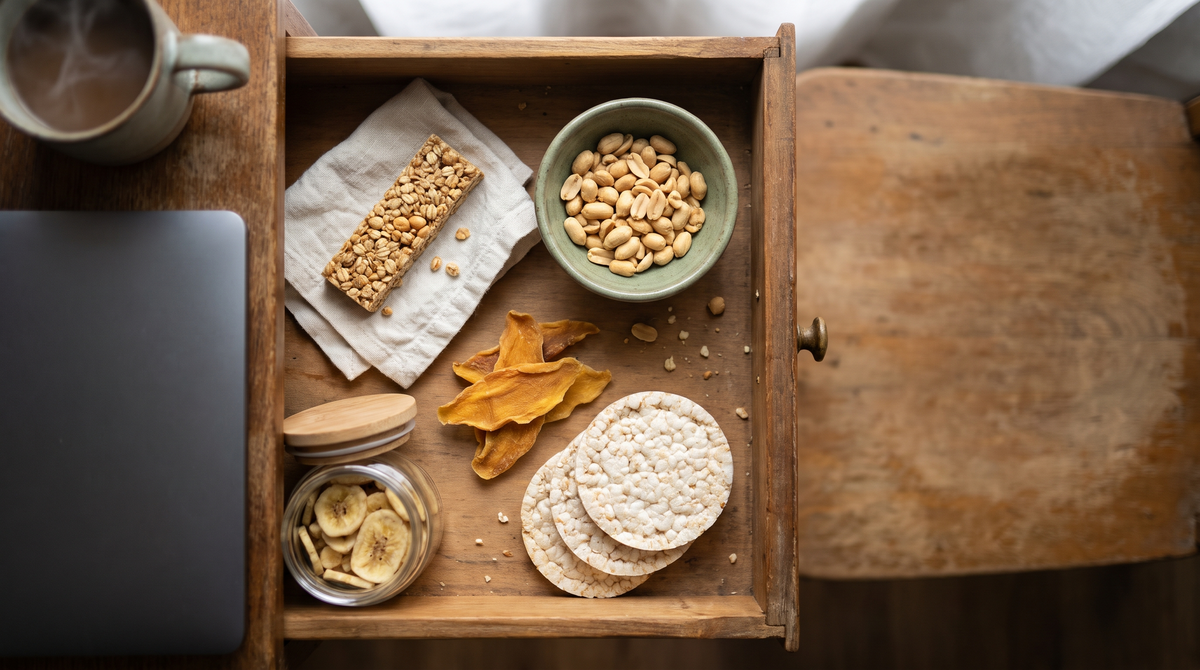
Long rainy weeks do odd things to a desk drawer. The afternoon dip arrives earlier, the walk to the canteen feels longer and wetter, and whatever is within reach quietly becomes lunch. A drawer stocked on purpose beats a drawer stocked by accident.
This list has one rule for inclusion: you can read the label in under a minute and still like what you find. Five snacks, one thing to check on each, and a short routine at the end that works on any pack you pick up.
1. Granola bar: read the sugar line before the oats
The ingredient list on Ancient Nutra's Granola Bar 40g reads chocolate chips, oats, peanuts, coconut treacle, peanut butter, salt and vanilla essence. The pack's traffic-light panel shows sugar at 27.4 g, salt at 0.3 g and fat at 24.5 g per 100 g.
On a 40 g bar that works out to roughly 11 g of sugar and 10 g of fat, with very little salt. That makes it an energy snack closer to a treat than to a light bite. It works for the afternoon you skipped lunch, and less well if you nibble at it all day. Peanuts appear twice in the list, so it is not for anyone with a peanut allergy.
2. Dip and breadsticks: check the serving size, not the front of the pack
Individually portioned packs settle the portion question before you open them. Ancient Nutra's Tropical Dip and Breadstick pack comes as five individual servings of breadsticks with a tropical dip, which suits a drawer well: one pack, one sitting.
On any dip pack, check whether the nutrition panel is per serving or per 100 g. The two numbers can look very different, and the front of the pack rarely tells you which one you are reading. The longer version of this idea is in a grown-up pantry snack: dip, breadsticks, and portion control.
3. Dry-roasted peanuts: the ingredient list should be one or two words
Plain peanuts have the shortest label in the drawer. The ideal list says "peanuts" or "peanuts, salt". Once a pack adds coatings, flavourings or glazes, the sugar and starch tend to arrive with them.
Compare salt per 100 g between two packs and pick the lower one. Keep the portion to a small handful, because nuts are energy-dense by nature. Check the workplace too: some offices and shared spaces ask for nut-free desks.
4. Dried fruit: the fruit should come first, and sugar should not appear twice
Dried mango, pineapple or banana chips are concentrated, so a few pieces go a long way. The ingredient list should name the fruit first. If sugar, syrup or glucose follows it, the pack is sweetened on top of the fruit's own sugars.
Two more checks. Banana chips are often fried, so read the fat line. And preservatives such as sulphur dioxide should be declared on the pack, which matters if you are sensitive to sulphites.
5. Plain crackers or rice cakes: salt per 100 g, then fibre
Crackers are a base, not a full snack. Salt varies widely from one brand to the next, so compare the per 100 g figure rather than trusting the flavour name. If a pack claims whole grain, the first ingredient should say whole grain, and the fibre line should back it up.
Pair them with a few peanuts and you have a proper snack instead of a gamble.
Look for: the one-minute label check
- Ingredients: short, with the real food named first.
- Sugar: per serving, not only per 100 g.
- Salt: per 100 g, so two packs can be compared fairly.
- Serving size: is the panel for one piece, one pack or 100 g?
- Allergens: peanuts, tree nuts, milk, sulphites, gluten.
For context, the World Health Organization advises keeping free sugars below 10% of total energy intake and salt below 5 g a day, roughly a teaspoon. A snack that uses up a big share of either in one sitting is worth a second look. The same habit works on supplement labels too, as what a supplement label has to tell you, and what it does not have to explains.
How to actually use this list
Do not stock all five at once. This is a buffet, not a shopping list. Pick two: one snack with some substance, such as the granola bar or peanuts, and one lighter base, such as crackers or fruit.
Then deal with the weather. Humidity softens crackers and breadsticks within days once a pack is open, so move them to an airtight tin. Keep portions small and visible, and refresh the drawer once a week so nothing sits there for a month.
The bottom line
The best desk-drawer snack is the one whose label you have actually read. Start with the sugar and serving-size lines, keep portions small, and be honest about which items are everyday snacks and which are treats. If an energy snack with oats and peanuts suits your afternoons, Ancient Nutra's Granola Bar 40g is the one on this list that fits.

Granola Bar 40g
An oat, peanut and chocolate chip bar for on-the-go afternoons. Contains peanuts.
Shop Granola Bar 40gSources and further reading
- Healthy diet fact sheet, World Health Organization.
- Product label details from the live Ancient Nutra Granola Bar 40g pack and product page.
- A grown-up pantry snack: dip, breadsticks, and portion control, Ancient Nutra.
Written by the Ancient Nutra Wellness Team. The team researches, sources, and tests every ingredient before it earns a place in an Ancient Nutra blend. Questions? Email info@ancientnutra.com or message Ancient Nutra on Instagram.
Medical disclaimer: This article is for educational purposes only and is not medical advice. Statements have not been evaluated by the FDA. Ancient Nutra products are not intended to diagnose, treat, cure, or prevent any disease. Speak with a qualified healthcare provider before starting any new supplement, especially if you take prescription medication or have a medical condition. If you have a food allergy, always read the full ingredient and allergen statement on the pack.