Ancient Nutra Wellness Team · 5 August 2026 · 5 min read
The 3 pm energy dip: what to do instead of another coffee
- The mid-afternoon drop in alertness is built into the body clock. It shows up in controlled studies even when people eat no lunch at all.
- Daylight and ten minutes of movement shift the dip faster than a fourth coffee, which mostly borrows energy from tonight's sleep.
- Maca is a caffeine-free root from the Peruvian Andes. In a 12-week placebo-controlled trial of 175 adults, 3 g a day of red or black maca extract improved self-reported energy and mood.
- Timing beats dose. Maca belongs with breakfast or lunch, not at 3 pm as a rescue shot.
The 3 pm feeling arrives on schedule. Focus goes soft, the screen gets heavier, and the walk to the kettle starts to look like a plan. Most people answer it with a third or fourth coffee, then wonder why bedtime keeps drifting later and why the next afternoon feels worse. The dip is real and well documented, but it is mostly a clock problem rather than a fuel problem. That distinction matters, because the fix looks completely different once you know what you are fixing. Here is the practical version: what the dip actually is, what moves it, and where a non-stimulant root like maca fits into a normal working day.
Understand what the 3 pm drop actually is
Sleep researchers call it the post-lunch dip, and the name is slightly misleading. In controlled studies the dip still appears when people eat nothing at all, and when they have no way of knowing what time it is (Monk, Clinics in Sports Medicine, 2005). It tracks a twelve-hour rhythm inside the body clock, not the size of the rice and curry at noon. Lunch can deepen the dip, especially a heavy one, but lunch did not create it.
That reframing is the whole article, really. If the dip were a fuel shortage, more fuel would fix it. Because it is a timing signal, the things that work are the things the clock listens to: light, movement, temperature, and consistent sleep. Caffeine does not talk to the clock. It blocks the adenosine signal that reports how long you have been awake, which is why a 4 pm coffee can still be measurably in your system at 10 pm, quietly setting up the same dip for tomorrow.
Move toward daylight before reaching for caffeine
The first move costs nothing. Ten minutes outside, on your feet, does more for afternoon alertness than the drink does, and it does it without a bill arriving at bedtime. Indoor office lighting is a small fraction of the light available outdoors, even under a grey Colombo sky before the rain. Standing up, walking, and getting real light on your face are three separate signals, and the afternoon dip responds to all of them.
Make it a rule rather than a decision. When the dip lands, walk first, drink a full glass of water, then reassess. Plenty of people find the craving has passed by the time they sit back down. If it has not, have the coffee, but treat it as the last one of the day and work toward finishing caffeine roughly eight hours before you intend to sleep.
Fix the lunch that sets up the crash
Lunch is not the cause, but it is the dial you can turn. A large, fast-digesting, mostly refined-carbohydrate lunch reliably deepens the slump. Two changes do most of the work: add protein, and add fibre, so the meal releases more slowly and the portion size drops on its own.
This does not require a new diet. A spoon of Ancient Nutra's 4-in-1 Super Seeds Mix over the rice, into a salad, or stirred through curd adds both in about five seconds. Ancient Nutra's Chia Seeds do the same job in a drink you can soak in the morning and finish at your desk. Keep the noon portion moderate, and save the heavier plate for a day when the afternoon is not going to ask much of you.
Give a non-stimulant adaptogen the right slot
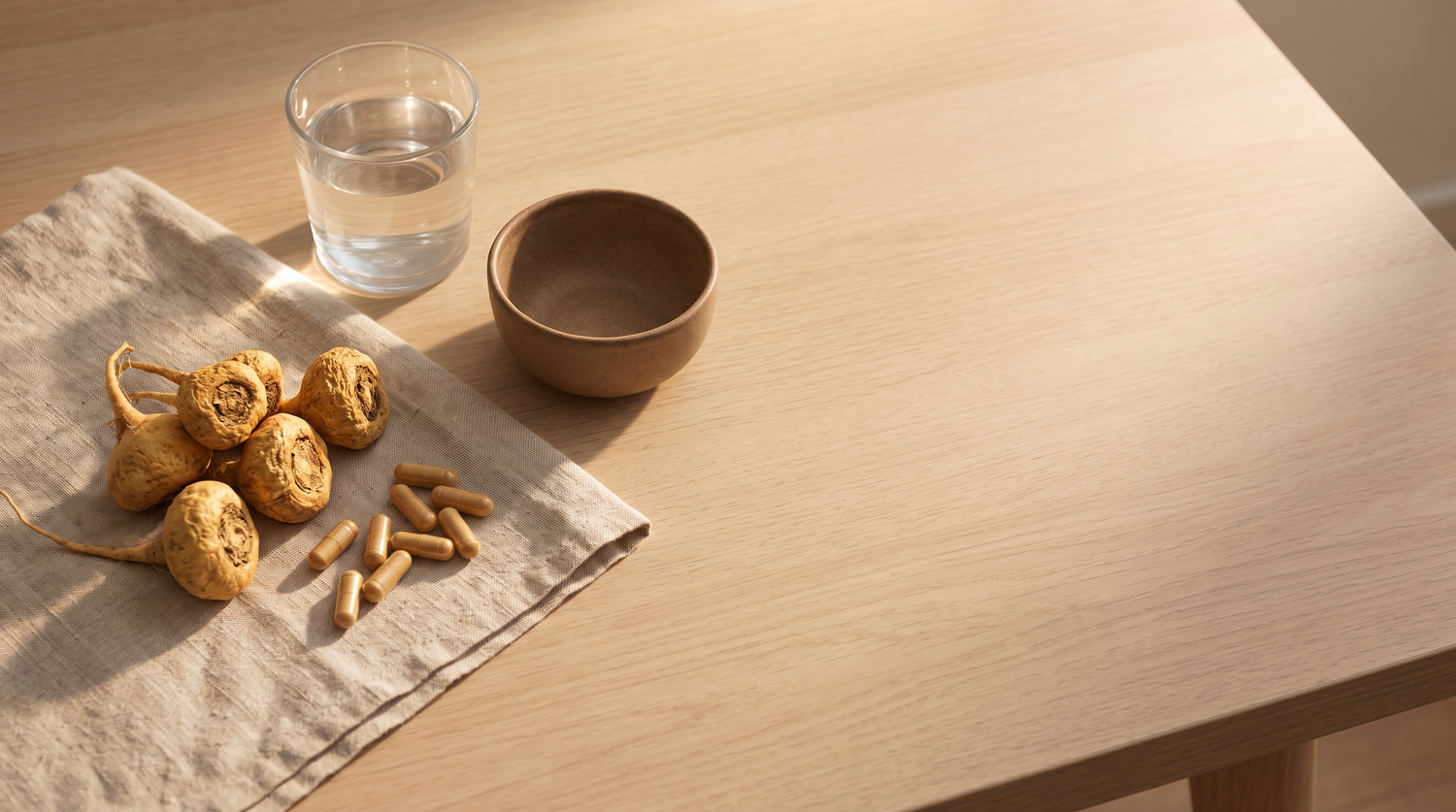
Maca is the root of Lepidium meyenii, a member of the cabbage family cultivated between roughly 4,000 and 4,500 metres in the central Peruvian Andes, on the Junin plateau, where it has been grown and eaten as an ordinary food for centuries (Gonzales, Evidence-Based Complementary and Alternative Medicine, 2012). It is not a Sri Lankan herb, and it carries no caffeine, which is exactly why it belongs in this conversation.
The most useful human evidence comes from a randomised, double-blind, placebo-controlled trial in which 175 adults took 3 g a day of a red or black maca extract, or a matching placebo, for 12 weeks. The maca groups reported better energy and mood than the placebo group, with red maca doing best on those two measures (Gonzales-Arimborgo et al., Pharmaceuticals, 2016). Hold on to the twelve weeks. That is the timescale this category actually works on.
The mistake worth naming
People take an adaptogen at 3 pm, expect it to behave like an espresso, feel nothing in twenty minutes, and conclude it does nothing at all. Ancient Nutra's Maca Root Extract is built for one capsule with breakfast, with some people adding a second at lunch. Taken late in the day it is more likely to interfere with sleep than to rescue the afternoon, and a poor night guarantees a deeper dip tomorrow. Put it early, keep it boring, and judge it at week twelve.
One caution before starting: maca contains goitrogens, so anyone taking thyroid medication should speak with their doctor first.
Look for
A maca product that names the species, Lepidium meyenii, states the daily dose on the label instead of hiding it inside a proprietary blend, and tells you where the root was grown. Ancient Nutra's Maca Root Extract is a standardised Peruvian maca extract in a vegetarian capsule, made in Sri Lanka under BRCGS, GMP, HACCP, FSSC 22000, and ISO 22000.
The bottom line
The afternoon dip is a clock event, not a fuel shortage, so treat it like one. Get light and movement into the 3 pm slot, keep lunch moderate and add protein and fibre, and protect tonight's sleep by finishing caffeine early. If a daily non-stimulant support makes sense for you, put it at breakfast and judge it at twelve weeks rather than twelve minutes. For the mechanism behind this category, Ancient Nutra's guide to how adaptogens work without acting like stimulants is the place to start, and the maca root extract deep-dive covers the root itself in more detail.

Maca Root Extract
A standardised, caffeine-free Peruvian maca extract for daily energy and mood support, taken with breakfast.
Shop Maca Root ExtractSources and further reading
- Monk TH. The post-lunch dip in performance. Clinics in Sports Medicine, 2005 (PubMed).
- Gonzales-Arimborgo C, et al. Acceptability, safety, and efficacy of oral administration of extracts of black or red maca in adult human subjects: a randomized, double-blind, placebo-controlled study. Pharmaceuticals, 2016 (PMC).
- Gonzales GF. Ethnobiology and ethnopharmacology of Lepidium meyenii (maca), a plant from the Peruvian highlands. Evidence-Based Complementary and Alternative Medicine, 2012 (PMC).
Written by the Ancient Nutra Wellness Team. The team researches, sources, and tests every ingredient before it earns a place in an Ancient Nutra blend. Questions? Email info@ancientnutra.com or message Ancient Nutra on Instagram.
Medical disclaimer: This article is for educational purposes only and is not medical advice. Statements have not been evaluated by the FDA. Ancient Nutra products are not intended to diagnose, treat, cure, or prevent any disease. Speak with a qualified healthcare provider before starting any new supplement, especially if you take prescription medication or have a medical condition.