Ancient Nutra Wellness Team · 5 November 2026 · 8 min read
Vitamin C capsules in the rainy season: how much you need, and when food is enough
- Many healthy adults can reach the recommended 75 to 90 mg a day from fruit and vegetables alone, and the authors of a hospital-based study suggested about 200 mg a day from produce as a sensible target.
- A Cochrane review of 29 trial comparisons found regular vitamin C did not lower the chance of catching a cold in the general public, though colds were a little shorter (8% in adults, 14% in children).
- A capsule is a gap-filler, not a shield. Stay at the label serving, and see a doctor first if you have had kidney stones.
When the Maha rains settle in, the cough and sniffle season arrives with them, and so does a rush of advice about vitamin C. Some of it is useful, and a lot of it is just loud. Here is how much vitamin C an adult actually needs, which everyday Sri Lankan foods cover it, what the best trials say about colds, and where a capsule such as Ancient Nutra's Vitamin C can sensibly fit. No supplement can promise to stop you getting ill, and the research does not say otherwise.
How much vitamin C do you actually need?
The current US recommended intake is 75 mg a day for adult women and 90 mg for adult men, set out in the NIH Office of Dietary Supplements fact sheet. That is a small amount. A careful hospital study in seven healthy volunteers measured blood and white-cell levels at daily doses from 30 mg up to 2,500 mg. Immune cells such as neutrophils, monocytes and lymphocytes were already saturated at 100 mg a day, and the authors concluded that about 200 mg a day, which fruit and vegetables can supply, was a sensible target. You can read the details in Levine et al., 1996.
The same study found that more is not better. At single doses of 500 mg and above, the body absorbed less, and the extra was passed out in urine. Urinary oxalate and urate also rose at 1,000 mg a day. In plain terms, the body has a ceiling, and a huge capsule does not raise it.
Start with the fruit already on your table
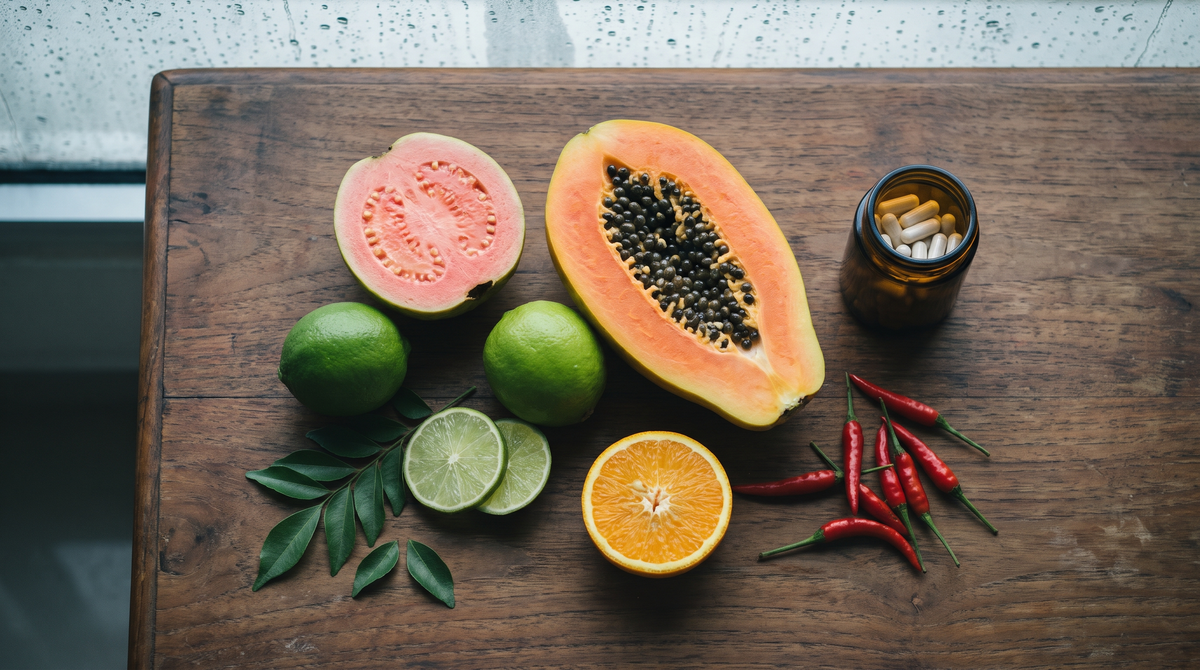
Sri Lankan kitchens are well placed here. Vitamin C is found in a wide range of fresh produce, and many of the best sources are ordinary market items: guava, papaya, limes and oranges, red and green chillies, and leafy greens. A glass of fresh lime water, a papaya at breakfast and a guava in the afternoon cover most of an adult's daily need before any capsule enters the picture.
- Eat it fresh. Vitamin C breaks down with heat and long storage, so raw fruit and quickly cooked vegetables keep more of it than a pot that simmers all afternoon.
- Spread it across the day. The body does not store vitamin C in large amounts, so a little at each meal works better than one big hit.
- Count what you already eat. If you eat two or three portions of fruit and a couple of vegetable portions most days, you are probably well covered.
Does vitamin C help with colds?
This is the question behind most vitamin C purchases, so the answer should be exact. The best summary is a Cochrane review by Hemila and Chalker, which pooled 29 trial comparisons with 11,306 participants. In the general community, regular vitamin C did not reduce the risk of developing a cold (pooled risk ratio 0.97, 95% confidence interval 0.94 to 1.00). The review did find that regular supplementation shortened colds slightly: by 8% in adults and 14% in children. In the few trials where vitamin C was started only after symptoms appeared, no consistent benefit was seen. The full abstract is on PubMed (Hemila and Chalker, 2013).
There was one group that did see a clear difference: 598 marathon runners, skiers and soldiers on subarctic exercises, who had a much lower risk of colds. That is a very specific population under heavy physical stress, so it does not describe a typical office worker in Colombo.
A separate review of vitamin C and the immune system explains why the nutrient matters at all. It supports the skin barrier and the function of immune cells, and low vitamin C leaves people more open to infection. The authors note that adequate intake, around 100 to 200 mg a day, is what keeps tissue levels healthy. See Carr and Maggini, 2017. Being low is worth fixing. Topping up beyond that has not been shown to stop colds.
Use a capsule to fill gaps, not to chase results
A capsule makes sense for a clear reason, not for a rainy-day panic. These are the situations where it can be a sensible, practical top-up.
- Your fruit and vegetable intake is patchy. Busy weeks and travel often push fresh produce off the plate.
- You want a simple daily habit. One capsule with a meal is easier to keep up than remembering to buy guavas.
- Your day has more physical or environmental load. Heavy training is the one setting where trials saw a clear signal, and food still comes first even then.
Ancient Nutra's Vitamin C 60 Capsules are made for this role: a vegetarian capsule, taken with a meal. Check the label for the amount per capsule and stay at the serving it states. If you want to compare approaches to rainy-season immunity more broadly, this guide to what the evidence supports for immunity supplements and this piece on steady support versus panic dosing are worth a read.
Know who should be careful with vitamin C capsules
For most healthy adults at the label serving, vitamin C is gentle. High doses are where the questions start, and kidney stones are the clearest one. A study of 156,735 women and 40,536 men followed for around 11 years found that supplemental vitamin C of 1,000 mg a day or more was linked to a higher risk of kidney stones in men (hazard ratio 1.19), while the link was not significant in women, and vitamin C from food was not associated with stones. The paper is Ferraro et al., 2016, and an earlier Swedish study in men pointed the same way (Thomas et al., 2013).
So the practical rules are short. Do not go above the serving on the label. Speak with a doctor before taking vitamin C capsules if you have ever had a kidney stone, have kidney disease, are pregnant or breastfeeding, take prescription medicines, or are due for surgery. Loose stools or stomach upset after a larger dose is a sign to cut back.
Look for
A label that states the vitamin C amount per capsule clearly, a short ingredient list, and a serving you can match to your meals. Ancient Nutra's Vitamin C 60 Capsules are a vegetarian capsule made in Sri Lanka under BRCGS, GMP, HACCP, FSSC 22000 and ISO 22000 certification.
The bottom line
Food first, capsule second, and no miracle claims. Most adults reach the recommended intake with fruit and vegetables. A capsule is a fair, low-fuss way to cover gaps, and the research gives it a modest but real role in keeping vitamin C levels adequate, while showing it will not guarantee you skip a cold. Keep to the label serving, mind the kidney-stone caution, and let sleep, water and warm meals carry the rest of the rainy season.
Does vitamin C lower your chance of catching a cold?
In the general population, regular vitamin C did not lower the risk of catching a cold in a large Cochrane review. It shortened colds slightly, by 8% in adults and 14% in children.
How much vitamin C should an adult take?
The US recommended intake is 75 mg a day for women and 90 mg for men, which fruit and vegetables can cover. If you use a capsule, follow the serving on the label.
Is it better to get vitamin C from food or capsules?
Food is the first choice, as it brings fibre and other nutrients. A capsule is a practical top-up when fresh produce is thin on the plate.
Who should check with a doctor first?
Anyone who has had kidney stones, has kidney disease, is pregnant or breastfeeding, takes prescription medicines or faces surgery.

Vitamin C, 60 capsules
A simple daily vegetarian capsule to fill the gaps when fresh fruit runs short.
Shop Vitamin CSources and further reading
- Hemila H, Chalker E. Vitamin C for preventing and treating the common cold. Cochrane Database Syst Rev, 2013, PubMed.
- Levine M, et al. Vitamin C pharmacokinetics in healthy volunteers: evidence for a recommended dietary allowance. Proc Natl Acad Sci USA, 1996, PubMed.
- Carr AC, Maggini S. Vitamin C and immune function. Nutrients, 2017, PubMed.
- Ferraro PM, et al. Total, dietary, and supplemental vitamin C intake and risk of incident kidney stones. Am J Kidney Dis, 2016, PubMed.
- Thomas LD, et al. Ascorbic acid supplements and kidney stone incidence among men. JAMA Intern Med, 2013, PubMed.
- NIH Office of Dietary Supplements. Vitamin C fact sheet for health professionals, ods.od.nih.gov.
Written by the Ancient Nutra Wellness Team. Questions? Email info@ancientnutra.com or message Ancient Nutra on Instagram.
Medical disclaimer: This article is for educational purposes only and is not medical advice. Statements have not been evaluated by the FDA. Ancient Nutra products are not intended to diagnose, treat, cure, or prevent any disease. Speak with a qualified healthcare provider before starting any new supplement, especially if you take prescription medication or have a medical condition.