By the Ancient Nutra Editorial Team
- Curry leaf powder scorches in hot oil within seconds, so it goes in last, off the heat, never at the start the way fresh leaves do.
- The aroma lives in a small amount of volatile oil, under 1% of the dried leaf in one large study, which is why timing and storage matter more than quantity.
- The whole tempering takes about five minutes: mustard seeds, onion and chilli first, then the pan comes off the flame and the powder blooms in the leftover heat for about ten seconds.
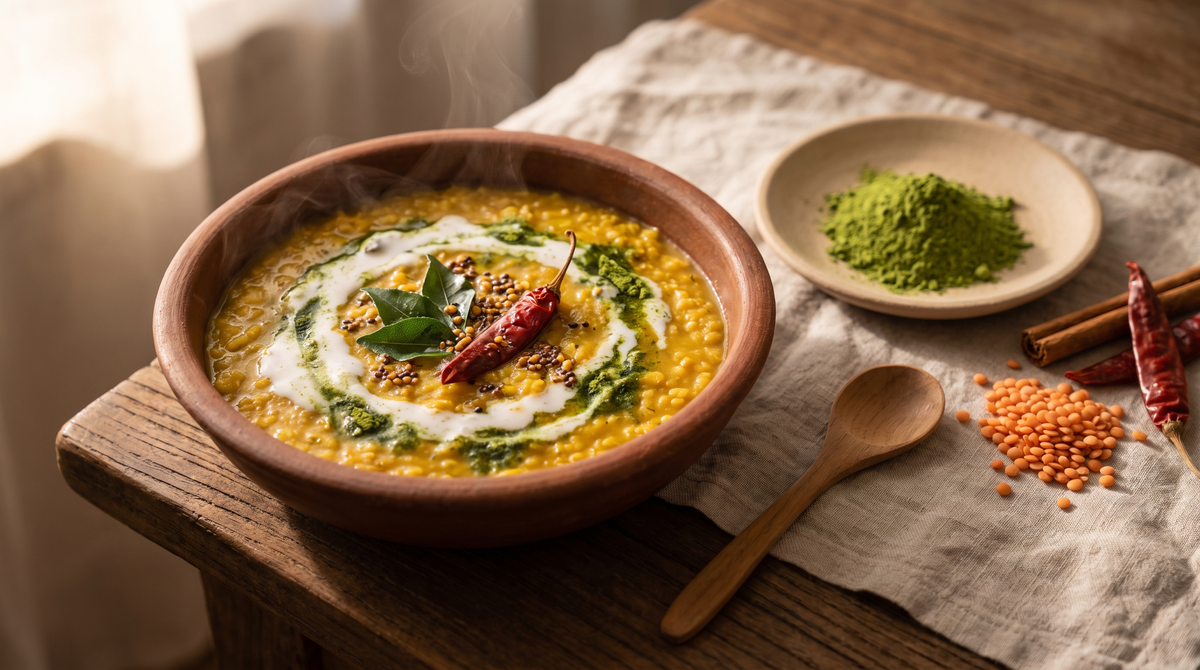
Most Sri Lankan cooks know the sound of a good tempering before they smell it: mustard seeds crackling, then the loud spit of fresh curry leaves hitting hot oil. Curry leaf powder does not make that sound, and that is exactly why it gets burnt. People treat it like the fresh leaf, drop it into smoking oil, and end up with a bitter, dusty pan. The powder needs a different order of steps, not a different amount. This guide walks through a five-minute tempering built around Ancient Nutra's Curry Leaves Powder, so the aroma ends up in the dhal instead of the air.
Gather everything before the pan heats
Tempering moves fast, so measure first. This amount finishes a pot of dhal or a vegetable curry for three to four people.
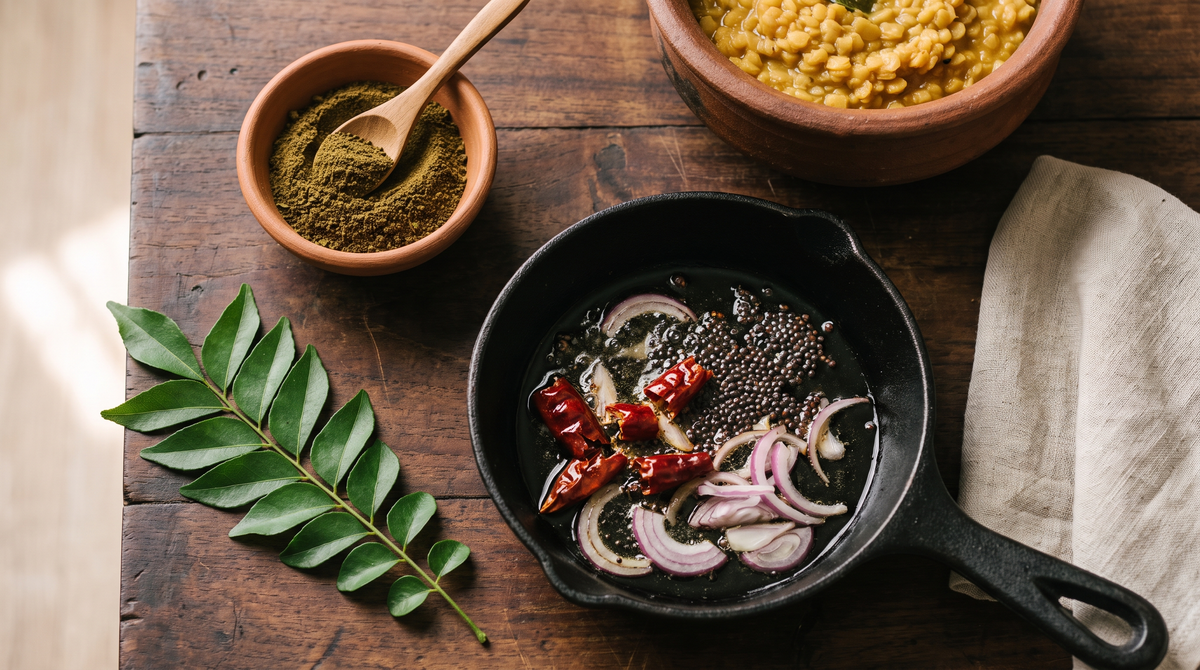
You will need
- 1 tablespoon coconut oil
- 1/2 teaspoon black mustard seeds
- 1 small red onion, thinly sliced
- 2 dried red chillies, broken in half
- 1 clove garlic, sliced, or a small pinch of Ancient Nutra's Garlic Powder
- 1/2 to 1 teaspoon Ancient Nutra's Curry Leaves Powder
- A cooked pot of dhal or curry, kept warm, ready to receive the tempering
Start with half a teaspoon of powder. You can always stir a little more into the finished pot, but you cannot take bitterness back out.
Temper it, step by step
- Heat the oil on medium, not high. Give it about a minute in a small pan. Drop in one mustard seed as a test; when it sizzles straight away, the oil is ready.
- Add the mustard seeds and wait for the pop. This takes 20 to 30 seconds. Keep a lid nearby, because the seeds jump.
- Add the onion and chillies. Stir for two to three minutes, until the onion edges turn golden and soft. Add fresh garlic for the last 30 seconds so it does not brown too far.
- Take the pan off the flame. This is the step that makes the difference. Let the sizzle drop for about ten seconds.
- Sprinkle in the curry leaf powder and stir for about ten seconds. The leftover heat is enough to wake the aroma. If you are using garlic powder, add it now as well. The powder should darken very slightly and smell green and toasty. If it turns black or smells sharp, the oil was too hot; start again rather than rescue it.
- Pour the whole tempering over the dhal at once. Stir it through, cover the pot and let it sit for two minutes so the oil carries the aroma into the dish.
The hands-on time is around five minutes, and only ten seconds of it involve the powder.
Why the powder goes in last
Curry leaf gets its smell from essential oil, and there is not much of it. A 2013 study in Chemistry & Biodiversity compared 58 wild populations of the curry leaf tree (Murraya koenigii) and found essential-oil yields of just 0.14 to 0.80% in shade-dried leaves. The main aroma compounds, such as alpha-pinene, sabinene and caryophyllene, are terpenes, the same light, volatile family that gives citrus peel and black pepper their smell. The mix also varied a lot from one population to the next, which is why two batches of curry leaf never smell quite the same.
Volatile compounds are the first thing heat drives off. A whole fresh leaf holds its oil in tiny glands inside the leaf, so it can survive a minute in hot oil and even needs that time to crisp. A powder has no such protection. Every particle is exposed at once, and the fine leaf matter itself scorches quickly, which is where the bitter, burnt note comes from. Taking the pan off the flame keeps the oil hot enough to pull the aroma out, but not hot enough to burn what carries it.
Fat matters too. Many aroma compounds dissolve far better in oil than in water, which is why tempering works at all: the oil collects the flavour in the pan, then spreads it through the whole pot when it is poured in.
Know when to use powder and when to use fresh leaves
Fresh curry leaves and curry leaf powder are not rivals; they do different jobs. Fresh leaves give texture and that bright, crackling hit on top of a dish. Powder spreads evenly, keeps for months in the cupboard, and is easier to measure when you want the same flavour every time.
If you have a sprig of fresh leaves, use them in step 3 with the onion, where they need a full minute to crisp, then skip step 5. If you have both, use fresh leaves in the pan and a small pinch of powder stirred into the pot at the end for depth. Powder also works well outside a tempering: stirred into rice with a little ghee, mixed into a coconut sambol, or folded into an omelette batter before it hits the pan.
For a full curry to use this on, the 25-minute weekend coconut milk curry is a good match, and karawila sambol makes a sharp side for a tempered dhal.
Look for
Good curry leaf powder is a clear olive to deep green, not grey or brown, and it should smell green and faintly citrusy the moment you open the pack. A dull colour and a flat, hay-like smell usually mean age, light or heat. Ancient Nutra's Curry Leaves Powder is dried, milled curry leaf, ready to measure straight from the pack.
Keep the aroma in the jar
Because the flavour is volatile, storage does as much work as technique. Keep the powder in an airtight container, away from the stove, direct sunlight and steam. Close it straight after use, and measure it with a dry spoon, since moisture makes it clump and go stale faster. Buy a quantity you will finish within a few months rather than a large bag that sits open. A quick sniff before cooking tells you most of what you need: if the smell is faint, use a little more, and if it has gone, replace it.
Curry leaf is a kitchen ingredient here, used in cooking amounts. This guide is about flavour, not a supplement routine, and it makes no health claims for the leaf.
The bottom line
Curry leaf powder burns because people cook it like a fresh leaf. Temper the seeds, onion and chilli as usual, take the pan off the heat, give the powder ten seconds in the warm oil, then pour it straight over the pot. Five minutes, one small pan, and a dhal that smells the way it should. Try it the next time a pot of dhal is on the stove and see how much less powder you need once none of it is burnt.

Curry Leaves Powder 40g
Dried, milled curry leaf for tempering, curries, rice and sambols, ready whenever fresh leaves are not.
Shop Curry Leaves PowderSources and further reading
- Verma RS, Chauhan A, Padalia RC, Jat SK, Thul S, Sundaresan V. Phytochemical diversity of Murraya koenigii (L.) Spreng. from Western Himalaya. Chemistry & Biodiversity, 2013.
Written by the Ancient Nutra Editorial Team. Published 17 September 2026.
Medical disclaimer: This article is for educational purposes only and is not medical advice. Statements have not been evaluated by the FDA. Ancient Nutra products are not intended to diagnose, treat, cure, or prevent any disease. Speak with a qualified healthcare provider before starting any new supplement, especially if you are pregnant or breastfeeding, take prescription medication, or have a medical condition.