Ancient Nutra Wellness Team · 1 August 2026 · 6 min read
Weekend coconut milk curry: the 25-minute Sri Lankan shortcut
- One pot, six pantry ingredients, 25 minutes from cold stove to the table.
- The shortcut is powdered spice instead of a wet grind: turmeric, curry leaf, and cinnamon go in dry, so nothing needs soaking, roasting, or blending.
- Coconut milk goes in last and stays under a simmer, which is the single step that keeps the gravy from splitting.
Saturday lunch in a Sri Lankan house usually starts with someone scraping a coconut. That step is lovely and it is also the reason most people give up on a weeknight curry. The version below skips the scraping and the wet spice grind entirely, and it still tastes like a proper kitchen curry rather than a jar of yellow sauce. It uses one pot, six things, and one tempering at the end. If the vegetables are already cut, it is on the table in 25 minutes, which is exactly the amount of effort a weekend deserves.
Gather six things
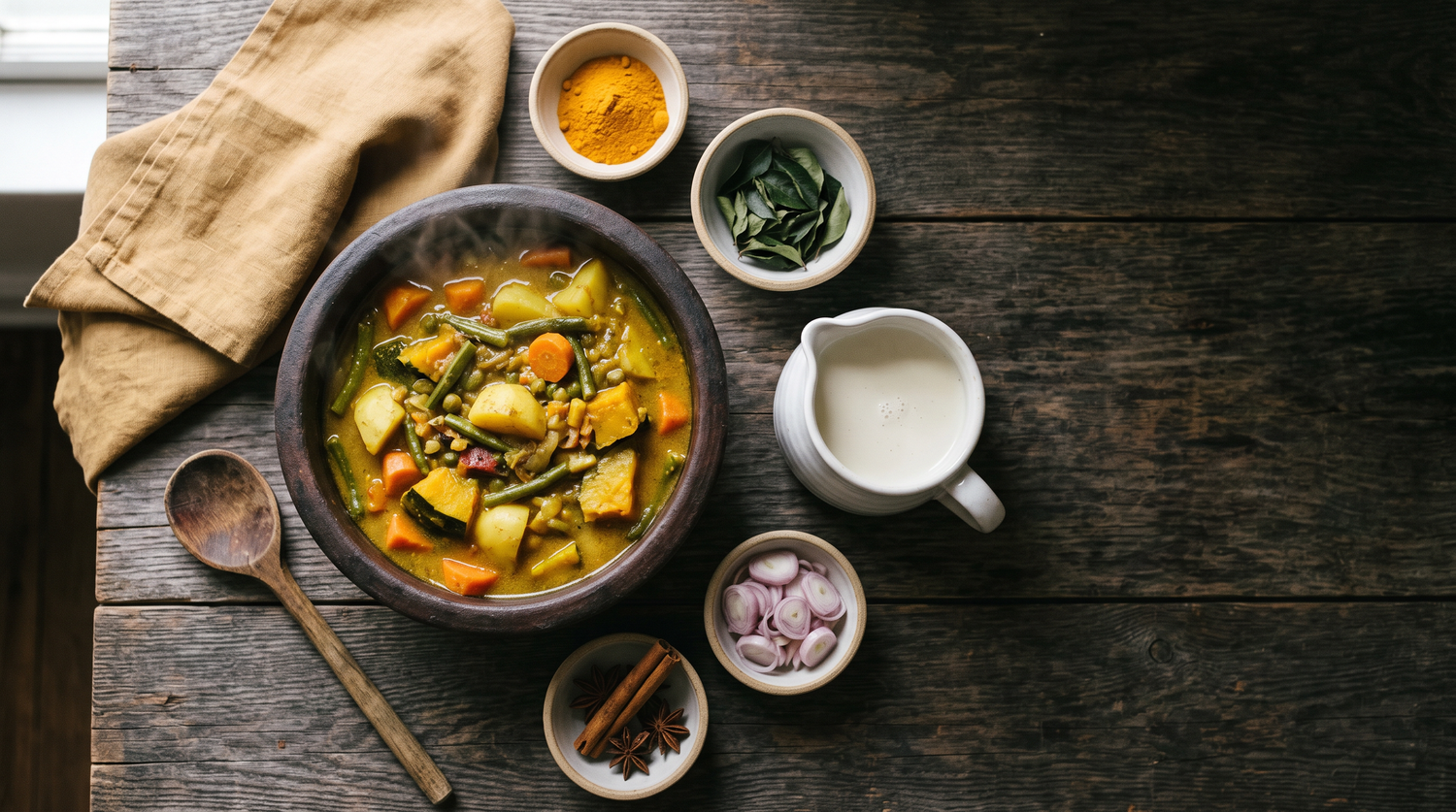
- 400 ml coconut milk (one standard can, or 4 heaped tablespoons of coconut milk powder whisked into 400 ml warm water)
- 600 g mixed vegetables cut into 3 cm pieces: potato, carrot, pumpkin, green beans
- 1 large red onion or 6 shallots, sliced thin
- 2 teaspoons Ancient Nutra's Curry Leaves powder 40g (or 2 fresh sprigs)
- 1 teaspoon Ancient Nutra's Organic Turmeric Powder 50g and half a teaspoon of Ancient Nutra's Cinnamon Powder 45g
- 2 tablespoons coconut oil, 1 teaspoon salt, quarter teaspoon black pepper, 1 green chilli split lengthways (optional)
Nothing on that list needs a trip to a specialist grocer, and nothing needs to be prepared the night before. Ground turmeric, curry leaf, and cinnamon carry the whole flavour base here, which is the entire point of the shortcut.
Cook it in six steps
- Heat the coconut oil in a wide pot over medium heat. Add the sliced onion and the green chilli, and cook for 3 minutes until the onion turns soft and translucent rather than brown.
- Add the curry leaf powder, turmeric, cinnamon, salt, and pepper. Stir for 30 seconds. The spices should smell warm and toasted, not sharp. This is the step that replaces a wet ground paste, so do not rush it.
- Tip in the hardest vegetables first, potato and carrot, and stir to coat every piece in the spice and oil. Add 150 ml of water, cover, and simmer for 8 minutes.
- Add the pumpkin and green beans, cover again, and cook for 5 more minutes. A knife should slide into the potato with slight resistance. The vegetables finish cooking in the coconut milk, so stop early rather than late.
- Pour in the coconut milk. Drop the heat to low. Let the curry come to a bare shiver, never a rolling boil, for 4 to 5 minutes. Boiling is what splits coconut milk into oil and grain, and once it splits it does not come back.
- Taste, correct the salt, and take the pot off the heat. Let it sit for 5 minutes before serving so the gravy thickens as it cools slightly.
Yields four generous portions with rice. Best eaten the same day, though the flavour deepens overnight if the pot goes into the fridge and gets reheated gently.
Understand why the shortcut works
A traditional Sri Lankan curry builds flavour with roasted whole spices ground wet, plus first and second extractions of freshly scraped coconut. Both steps exist to solve problems that powdered spice already solves. Ground turmeric, cinnamon, and curry leaf are surface area in a jar: they hydrate and release flavour in seconds once they hit hot oil, which is why 30 seconds of blooming in step 2 does the work of a 20-minute grind.
The turmeric is doing something besides colour. Curcumin, the active compound in turmeric, is famously poorly absorbed on its own, and a small human study published in Planta Medica found that piperine from black pepper raised curcumin bioavailability by around 2,000 percent. That is why the quarter teaspoon of black pepper is in the ingredient list rather than left to the table, and why fat matters too: the coconut milk and coconut oil give the curcumin something to dissolve into.
Curry leaf is the ingredient people underestimate. In a Sri Lankan kitchen it is not a garnish, it is a base note, closer to what a bay leaf does in a European stock. Powdered curry leaf distributes that base note through the whole pot instead of concentrating it in the few leaves someone pushes to the side of the plate.
Change it three ways
Swap the vegetables for 400 g of raw prawns or diced chicken, added in step 4 instead of the pumpkin, and cut the simmer in step 5 to 3 minutes so the protein stays tender. For a lighter weekday version, use 200 ml of coconut milk topped up with 200 ml of water and finish with a squeeze of lime. To batch it, cook through step 4 only, cool, and refrigerate for up to three days: the coconut milk goes in fresh on the day you eat it, which keeps the gravy smooth.
Curry leaf powder should be deep green and smell like the fresh leaf the moment the jar opens. Brown, dusty, or faintly hay-like powder has been over-dried or sitting too long, and it will taste flat no matter how much goes in. Ancient Nutra's Curry Leaves powder 40g is dried at low temperature and milled in small batches for that reason. Store it away from the stove: heat and steam are what kill a spice jar, not time.
Serve it at the right moment
This is a lunch curry. It is filling, it is warm, and it pairs with plain red rice, string hoppers, or good bread for the gravy. It does not need a second curry beside it, though a simple sambol cuts the richness nicely. Coconut milk is rich, so a large bowl in the evening sits heavier than most people expect. Keep it to the middle of the day when the plan is a slow afternoon, and treat it as what it is: a good, honest meal, not a health intervention. If the format question is the one holding you back, powder against can, the team already worked through it in coconut milk powder against the can.
The bottom line
A proper coconut milk curry does not need a scraped coconut or a ground paste, it needs good powdered spice, hot oil, and a cook who knows not to boil the milk. The minimum viable version is onion, turmeric, curry leaf powder, salt, whatever vegetables are in the fridge, and coconut milk added off the boil. Everything else on the list is an improvement, not a requirement. For an evening version of the same flavour in a cup rather than a bowl, the coconut milk dahl-spice latte uses the same spice logic.

Curry Leaves powder 40g
Low-temperature dried Sri Lankan curry leaf, milled fine so the base note reaches every spoonful.
Shop Curry Leaves powderSources and further reading
- Shoba G. et al., "Influence of piperine on the pharmacokinetics of curcumin in animals and human volunteers", Planta Medica, 1998 (PubMed).
- Codex Alimentarius Standard for Aqueous Coconut Products CXS 240-2003, FAO and WHO.
Written by the Ancient Nutra Wellness Team. The team researches, sources, and tests every ingredient before it earns a place in an Ancient Nutra blend. Questions? Email info@ancientnutra.com or message Ancient Nutra on Instagram.
Medical disclaimer: This article is for educational purposes only and is not medical advice. Statements have not been evaluated by the FDA. Ancient Nutra products are not intended to diagnose, treat, cure, or prevent any disease. Speak with a qualified healthcare provider before starting any new supplement, especially if you take prescription medication or have a medical condition.