Ancient Nutra Wellness Team · 5 September 2026 · 5 min read
Karawila sambol: how Sri Lankan kitchens tame the bitter melon
By the Ancient Nutra Editorial Team
Key takeaways
- Karawila sambol works because of two steps most people rush: scooping the seeds out, and resting the salted rings before they hit the pan.
- Bitter melon is one of the most studied traditional plants for blood sugar, but human trial results conflict and the evidence is rated low quality. Efficacy is not established.
- Published drying research finds that lower air-drying temperatures retain more of the fruit's phenolic compounds than higher-temperature drying, so how karawila is dried matters as much as the vegetable itself.
Almost every Sri Lankan has a karawila story, and most of them start with a child refusing to eat it. Bitter melon is the one vegetable on the table that does not try to please anybody. The interesting part is that the traditional kitchen never fought the bitterness by removing it. It worked around the bitterness with technique: a knife, a handful of salt, and twenty minutes of doing nothing. What follows is the side dish that technique produces, plus an honest account of what the research does and does not show about the plant itself.
Start with the plant, not the pan
Karawila is Momordica charantia, a climbing vine grown across the tropics, with India, China and Southeast Asia accounting for most of the world's production. In Sri Lanka the Department of Agriculture lists it as a crop that can be grown up to above 1,200 m, sown in the Maha season around October to November and again in the Yala season around April to May, and cultivated year round in suitable areas. Released local varieties include MC 43, Thinneweli White and Mathale Green.
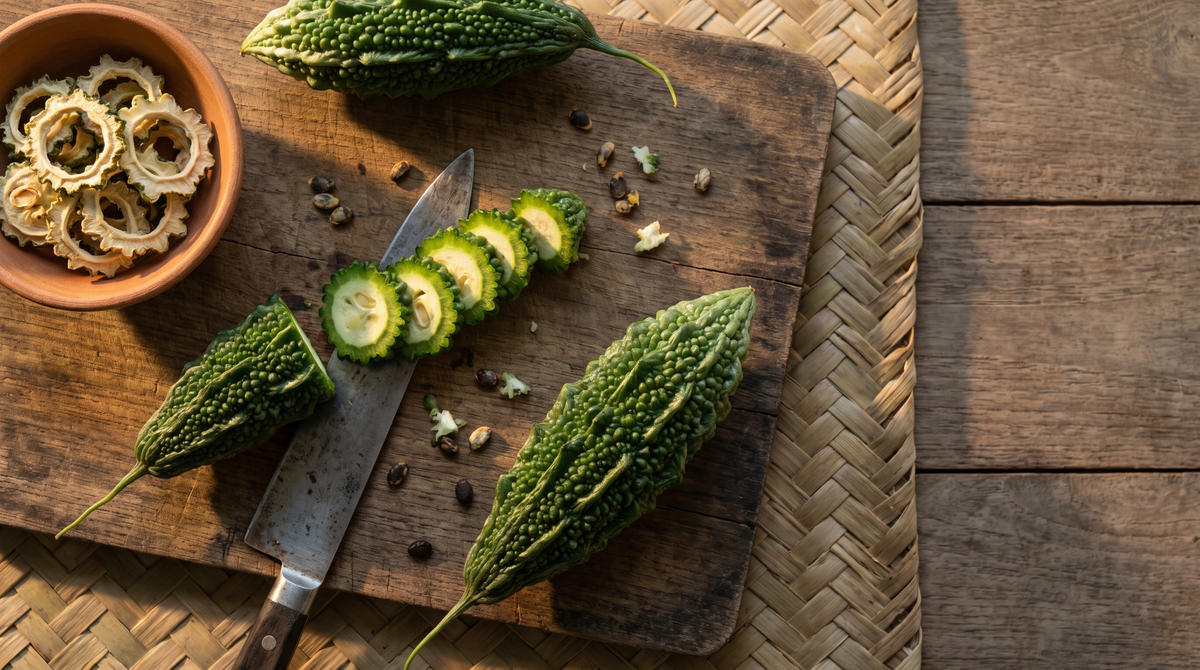
The one detail that changes how you cook it is the trellis. Karawila is trained onto mesh or stakes about three weeks after planting, which is why the fruit hangs straight and ridged instead of sprawling on the soil. A straight, firm, deep green gourd with tight ridges is a young one, and young ones are less aggressively bitter than the pale, yellowing fruit left on the vine too long.
Karawila sambol: what you need
- 3 medium karawila (bitter melon), firm and deep green
- 1.5 teaspoons salt, plus more to finish
- 0.5 teaspoon turmeric powder
- 1 large red onion, sliced very thin
- 1 medium tomato, deseeded and chopped
- 1 to 2 green chillies, sliced
- Juice of half a lime
- Coconut oil for frying
- A pinch of sugar (optional, to round the finish)
Make it in six steps
- Slice thin. Top and tail the gourds, then cut them into rings no thicker than 3 mm. Thin rings crisp; thick rings steam and stay soft.
- Scoop the seeds out. Push the seeds and the spongy white pith out of each ring with a thumb or the tip of a spoon. Do not skip this, and see the note below on why the tradition is worth keeping.
- Salt and rest. Toss the rings with the salt and turmeric and leave them in a bowl for 30 to 45 minutes. Water will pool at the bottom. That water is carrying the sharpest edge of the bitterness out with it.
- Squeeze and dry. Press the rings firmly between both palms, then spread them on a cloth and pat them properly dry. Wet rings will not crisp, they will spit.
- Fry until crisp. Deep fry in hot coconut oil in small batches until the rings are dark green at the edges and genuinely crunchy. Drain on paper.
- Toss at the last minute. Combine the fried rings with the onion, tomato, chilli, lime juice, a final pinch of salt and the optional sugar. Serve straight away, because the sambol softens as it sits.
It is a side dish, not a main. A small mound next to rice and curry is the whole idea.
Why the seed step earns its place
Scooping the seeds started as a texture and taste decision, but it lines up with something the laboratory work found much later. The seeds, rather than the flesh, carry a set of proteins called momorcharins, and in a 2019 zebrafish embryo screen the seed extract was the most toxic fraction of the plant. That is an animal study, not a human one, and it is not a reason for a healthy adult to fear a plate of sambol. It is a neat example of a kitchen habit that turned out to have a reason behind it.
Look for
If you want karawila without the taste or the frying, look for a capsule that names the plant part it uses and states a serving size on the label. Ancient Nutra's Karavila (Bitter Melon) capsules blend the fruit with karavila seed powder, at 2 capsules a day with a meal.
What the evidence actually says about blood sugar
Karawila has a reputation in Sri Lankan and Ayurvedic kitchens as the blood sugar vegetable, and it deserves a straight answer rather than a marketing one. Bitter melon is genuinely one of the most trialled traditional plants for glucose, and the results still do not agree. The only Cochrane review, published in 2012 and not updated since, pooled 4 randomised trials in 479 people and found no statistically significant difference in glycaemic control against placebo. A 2024 meta-analysis in Frontiers in Nutrition, restricted to placebo-controlled trials, pooled 9 trials in 414 patients over 4 to 16 weeks and concluded that the evidence does not support the practice.
Other pooled analyses do report reductions in fasting glucose and HbA1c, but each one rates its own underlying evidence as low or very low quality, with wide disagreement between the trials it contains. The honest summary is that efficacy is not established. Karawila is a good vegetable and a long tradition, and it is not a substitute for treatment. For the longer version of that argument, see Karavila and blood sugar, and for how it sits against the other local herbs, the blood sugar herb comparison.
Drying changes what survives
Fresh karawila is a vegetable. Dried karawila is an ingredient, and the drying step is not neutral. A 2020 study in Food Science and Nutrition compared drying conditions for bitter melon and found that lower air-drying temperatures retained more total phenolic content and more antioxidant activity than warmer drying, with the best antioxidant results at 25 degrees Celsius. Slow and cool is not nostalgia, it is simply what the measurements favour. That is a general finding about the fruit rather than a claim about any particular product, and it is the reason the drying method is worth asking about at all.
Who should leave it on the plate
Two groups should be careful with bitter melon in any concentrated form. Anyone taking medication that lowers blood sugar should speak with their doctor first, because a pharmacy review of the plant notes it may have additive effects alongside other glucose-lowering agents. And bitter melon is conventionally avoided during pregnancy: proteins isolated from the seeds were described in the literature as abortifacient as far back as 1987, and animal studies have reported developmental effects. Those are animal and laboratory findings rather than documented human cases, but avoiding it while pregnant is the settled convention and there is no good reason to test it.
On the liver, the record is reassuring. The NIH LiverTox database rates bitter melon likelihood score E, its cleanest category, and states that despite widespread use there have been no published reports of liver injury attributable to bitter melon extracts. Trials have also reported no significant change in liver enzymes. That is an absence of harm, not a benefit, so it is worth saying plainly: this is not a liver supplement.
The bottom line
Karawila sambol is a technique dressed up as a recipe. Slice thin, take the seeds out, salt the rings and let them sit, dry them properly, fry them hard. Do that and the bitterness becomes a flavour instead of a problem. As for what the plant does beyond the plate, the fair answer is that it has been studied a great deal and proven very little, which is a more useful thing to know than a promise would be. If the taste is the obstacle rather than the plant, the capsule is the practical route.

Karavila (Bitter Melon) - 60 capsules
The fruit blended with karavila seed powder, 2 capsules a day with a meal, without the bitterness.
Shop KaravilaSources and further reading
- Bitter Gourd crop guide, Department of Agriculture, Sri Lanka (HORDI).
- Laczkó-Zöld E et al., The metabolic effect of Momordica charantia cannot be determined based on the available clinical evidence, 2024, Frontiers in Nutrition.
- Ooi CP et al., Momordica charantia for type 2 diabetes mellitus, 2012, Cochrane Database of Systematic Reviews.
- Bitter Melon monograph, NIH LiverTox, NCBI Bookshelf.
- Nguyen TVL et al., Effects of drying conditions in low-temperature microwave-assisted drying on bioactive compounds of dehydrated bitter melon, 2020, Food Science and Nutrition.
Written by the Ancient Nutra Wellness Team. The team researches, sources, and tests every ingredient before it earns a place in an Ancient Nutra blend. Questions? Email info@ancientnutra.com or message Ancient Nutra on Instagram.
Medical disclaimer: This article is for educational purposes only and is not medical advice. Statements have not been evaluated by the FDA. Ancient Nutra products are not intended to diagnose, treat, cure, or prevent any disease. Speak with a qualified healthcare provider before starting any new supplement, especially if you take prescription medication or have a medical condition.