By the Ancient Nutra Wellness Team · 26 September 2026 · 7 min read
- Brahmi has the strongest human evidence of the popular focus herbs: a review of nine trials found better attention and processing speed after about 12 weeks.
- Ginkgo supports circulation, but a six-year trial of 3,069 older adults found it did not prevent dementia. Treat it as a supporting herb, not a shield.
- Lion's Mane and Gotukola are promising but thinly studied. Sleep, daylight, and protein still do more for focus than any capsule.
Almost every focus supplement makes the same three promises: sharper attention, better memory, and a brain that ages more slowly. The research behind those promises is not equal. For one herb it is solid. For another it is mixed, and for two it is still early.
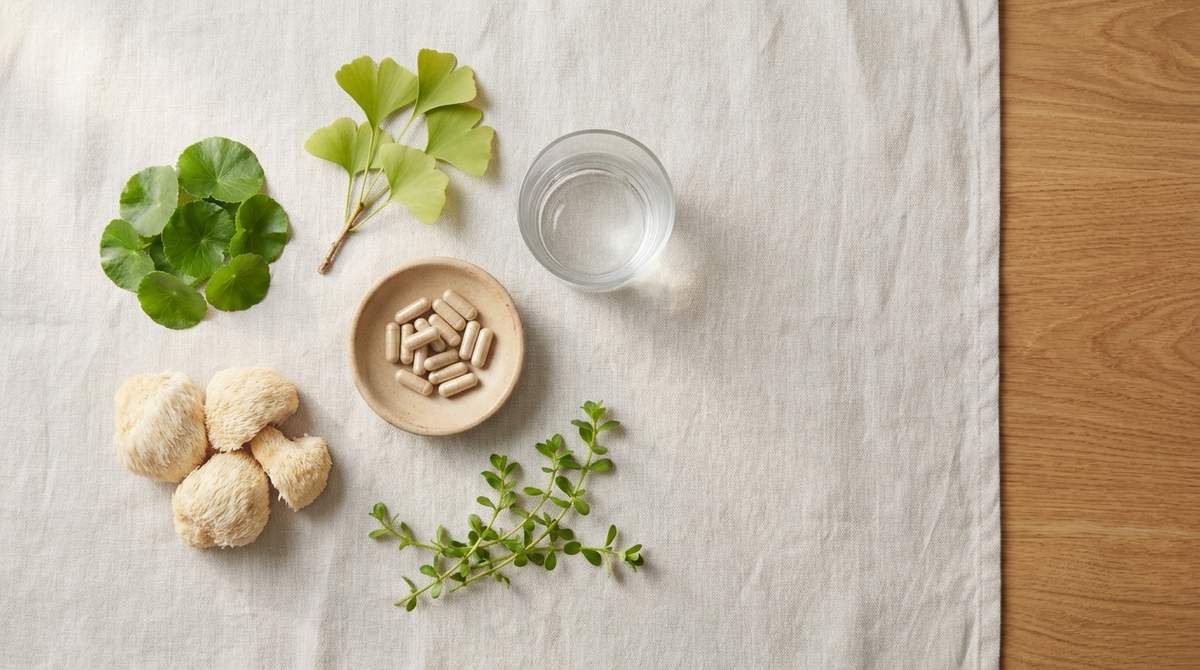
This is a plain-English grading of the four herbs people ask Ancient Nutra about most: Brahmi, Ginkgo, Lion's Mane, and Gotukola. Three of them sit inside Ancient Nutra's Focus & Cognition System. The fourth is sold separately, and it matters why.
Separate "supports focus" from "proven to sharpen"
"Supports focus" is a careful phrase. It means an herb has a plausible way of helping and some human data behind it. It does not mean every person will feel a difference, or that it works like caffeine.
A useful rule: the more a claim promises, the more evidence it needs. "Helps attention over 12 weeks" needs a few good trials. "Prevents memory loss" needs years of follow-up in thousands of people. Very few herbs clear that second bar, and honest labels do not pretend otherwise.
Grade each herb by the trials, not the label
Brahmi: the strongest case
Brahmi (Lunuvila in Sinhala, Bacopa monnieri on a label) is a small creeping herb of damp ground. A review pooling nine controlled trials found it improved attention and the speed of thinking through a task, with effects showing after about 12 weeks of daily use (Kongkeaw et al., 2014).
What it can honestly claim: steadier attention and quicker processing, built slowly. What it cannot claim: an instant lift before an exam. Grade: good evidence, slow build.
Ginkgo: real effects, oversold promise
Ginkgo is best understood as a circulation herb. It supports blood flow, including to the brain, and small studies suggest modest benefits for some people. The big test was the Ginkgo Evaluation of Memory study. It followed 3,069 adults aged 75 and over for roughly six years, and ginkgo did not lower the rate of dementia compared with placebo (DeKosky et al., 2008).
So the honest claim is smaller: a supporting herb for circulation and clarity, not a way to prevent memory disease. Grade: mixed evidence, modest role. For a closer look at where the Ginkgo data is strongest, read Ginkgo biloba and memory: where the evidence is strong.
Lion's Mane: promising, but small
Lion's Mane is a shaggy white mushroom studied for memory and long-term brain health. The best-known human trial was small: about 30 older adults in Japan with mild memory complaints. Their cognitive scores rose over 16 weeks on Lion's Mane, then slipped back once they stopped.
That is encouraging, and it is also one small study. The honest claim is "early human evidence for memory support, with consistency required." Grade: early evidence, worth a steady trial.
Gotukola: calm more than cognition
Gotukola is the round-leafed herb that grows in Sri Lankan home gardens and turns up in a lunchtime mallung. When researchers pooled its human trials, they found no clear improvement in overall thinking. They did see signs of better alertness and calmer mood (Puttarak et al., 2017).
That fits how it has always been used: a calm, clear-headed herb, not a memory drug. It is why Gotukola is not inside the Focus & Cognition System, and why it works best as a separate afternoon herb. Grade: limited evidence for cognition, reasonable for calm alertness.
Why the difference matters on a busy day
You feel this when you are tired, behind on work, and hoping a capsule will cover for four hours of sleep. It will not. None of these herbs is a stimulant, and none acts within the hour.
Knowing the grades protects your money and your patience. You give Brahmi 12 weeks instead of quitting at week two. You stop expecting Ginkgo to guard against something it was never shown to prevent. And you judge Lion's Mane and Gotukola on how you feel, not on a promise.
Fix the foundation first, then add herbs
- Sleep: seven hours or more is the biggest single lever for attention.
- Morning light: 5 to 10 minutes of daylight anchors your body clock.
- Protein at breakfast: eggs, dhal, or curd steady your mid-morning energy.
- One task before email: protect your first hour of real attention.
With those in place, start with the herb that has the best evidence. Brahmi at about 300 mg of extract a day, with food, is the standard trial dose. If you want the full morning routine in one place, the system adds Lion's Mane and Ginkgo on the same breakfast schedule. The ritual for that is here: a morning focus ritual that treats attention as an input.
Brahmi named as Bacopa monnieri, Ginkgo as a standardized leaf extract, and Lion's Mane as a fruiting-body extract. Plan on 8 to 12 weeks of daily use before you judge.
Ancient Nutra's Focus & Cognition System puts Lion's Mane, Brahmi, and Ginkgo (60 capsules each) into one breakfast routine. For the afternoon, Ancient Nutra's Gotukola capsules are sold separately.
Know when to stop self-managing
Everyday fog after a bad week is normal. Some changes are not. See a doctor if memory lapses are getting worse, if you get lost in familiar places, or if people close to you notice changes you do not. The same goes for sudden confusion, or fog that comes with low mood, weight change, or constant fatigue.
Ginkgo can thin the blood slightly. Check with your doctor before taking it if you use blood thinners or daily aspirin, or have surgery coming up. Anyone pregnant, breastfeeding, or on regular medication should ask first too.
Gotukola is an easy herb to underestimate because it is so ordinary. In many Sri Lankan homes it is simply lunch, shredded fine with coconut and lime. Tradition called it a food for a clear head long before anyone ran a trial, and the trials so far point to calm, not cleverness.
The bottom line
Focus herbs work slowly, on top of good sleep and food, and some have much better evidence than others.
- Brahmi: the best-supported choice for attention, over 12 weeks.
- Ginkgo: a modest circulation herb, not dementia protection.
- Lion's Mane and Gotukola: promising, early, and worth judging by how you feel.
For the three-herb morning routine in one box, that is what Ancient Nutra's Focus & Cognition System was built for. For how all five focus herbs compare side by side, see 5 herbs for focus and memory (without the jitters).
Which focus herb has the best evidence?
Brahmi (Bacopa monnieri). A review of nine controlled trials found improved attention and processing speed after about 12 weeks of daily use.
Does Ginkgo prevent memory loss?
Not according to the largest trial. Among 3,069 adults aged 75 and over followed for about six years, ginkgo did not lower dementia rates. It is better seen as a modest circulation herb.
Why is Gotukola not in the Focus & Cognition System?
Its evidence points more to calm alertness and mood than to memory, so it fits better as a separate afternoon herb alongside a morning routine.
How long should I take focus herbs before judging them?
Plan on 8 to 12 weeks of daily use. The trials that found benefits ran for 12 to 16 weeks.

Lion's Mane, Brahmi, and Ginkgo Biloba in one breakfast routine for steady, long-term focus support. Made in Sri Lanka.
Shop the Focus & Cognition SystemSources and further reading
- Kongkeaw C, et al. Meta-analysis of randomized controlled trials on cognitive effects of Bacopa monnieri extract. Journal of Ethnopharmacology, 2014.
- DeKosky ST, et al. Ginkgo biloba for prevention of dementia: a randomized controlled trial. JAMA, 2008.
- Puttarak P, et al. Effects of Centella asiatica (L.) Urb. on cognitive function and mood related outcomes: a systematic review and meta-analysis. Scientific Reports, 2017.
- Mori K, et al. Improving effects of the mushroom Yamabushitake (Hericium erinaceus) on mild cognitive impairment: a double-blind placebo-controlled clinical trial. Phytotherapy Research, 2009.
- Ginkgo: Usefulness and Safety. National Center for Complementary and Integrative Health (NIH). Sources retrieved 26 September 2026.
Written by the Ancient Nutra Wellness Team. The team researches, sources, and tests every ingredient before it earns a place in an Ancient Nutra blend. Questions? Email info@ancientnutra.com or message Ancient Nutra on Instagram.
Medical disclaimer: This article is for educational purposes only and is not medical advice. Statements have not been evaluated by the FDA. Ancient Nutra products are not intended to diagnose, treat, cure, or prevent any disease. Speak with a qualified healthcare provider before starting any new supplement, especially if you take prescription medication or have a medical condition.