By the Ancient Nutra Editorial Team
- Lion's Mane (Hericium erinaceus) is a shaggy white culinary mushroom. The nerve-growth findings you read about come mostly from cell and animal studies, not from people.
- Human trials exist but are small: one 16-week trial in 30 older adults with mild cognitive impairment, and one pilot in 41 healthy adults. Results were mixed, and the older-adult effect faded after the mushroom was stopped.
- If you try it, treat it as a defined test with a start and a review date, take it with a meal, and keep sleep, food and movement first.
Lion's Mane gets described as a "brain mushroom" so often that it is easy to assume the case is closed. It is not. There is real, interesting research, and there are also some very large claims standing on some very small studies.
This piece sets out what the mushroom is, what has actually been tested in people, and how to fit it into an ordinary working day without expecting more from it than the evidence supports.
Know what you are buying
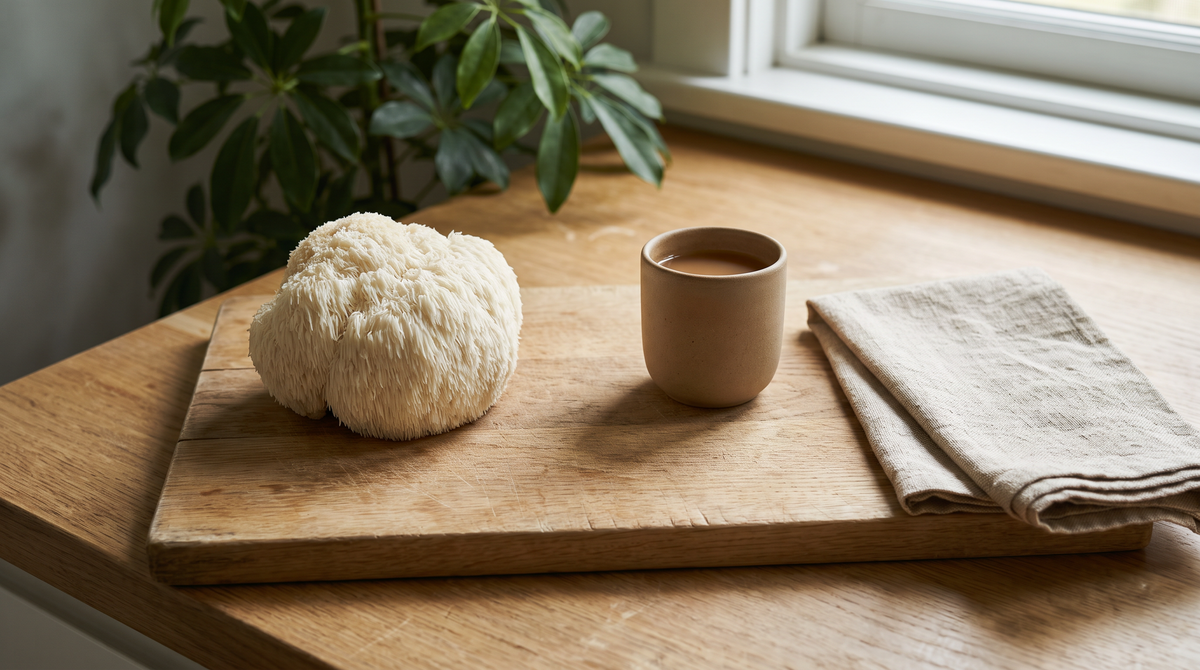
Lion's Mane (Hericium erinaceus) is a pale, shaggy mushroom that grows on hardwood trees across the temperate forests of the Northern Hemisphere. It has been eaten in East Asia for a long time and appears in traditional Chinese medicine as a tonic, according to the NIH LiverTox entry. In Japan it is called yamabushitake, a name often linked to the ruffled tassels worn by mountain ascetics.
It is not an Ayurvedic herb, and the Ancient Nutra team does not pretend otherwise. It sits on the shelf as an East Asian mushroom with a modern research story, and that story is worth reading carefully.
Two compound families get most of the attention: hericenones, found in the fruiting body, and erinacines, found in the mycelium. Both have shown the ability to prompt nerve growth factor activity in laboratory work. That finding comes from cells in a dish and animals, not from people. The 2025 systematic review in Frontiers in Nutrition notes that the human trials it covered did not show a rise in nerve growth factor in people.
Read the human research for what it is
Older adults with mild cognitive impairment
In a Japanese double-blind trial, 30 adults aged 50 to 80 with mild cognitive impairment took about 3 grams a day of Lion's Mane powder or a placebo. By weeks 8, 12 and 16 the mushroom group scored higher on a cognitive scale than the placebo group. Four weeks after they stopped, their scores had dropped back down (Mori et al., Phytotherapy Research).
That is encouraging, and it is also 15 people per group, run in part by people connected to a mushroom company. It has not been confirmed by a larger independent trial.
Healthy young adults
A UK pilot gave 41 healthy adults aged 18 to 45 either 1.8 grams of Lion's Mane or a placebo. An hour after a single dose, the mushroom group was faster on a Stroop attention task. After 28 days, a hint of lower perceived stress showed up, but it did not reach statistical significance (Docherty et al., Nutrients). The authors themselves say the findings are tentative and that some measures showed nothing.
The wider picture
The same systematic review found only a handful of randomised trials, in different groups, using different preparations and doses. Cognitive results were mixed, and one four-week study found no effect at all. The authors could not combine the data into a single analysis. A fair summary: promising, preliminary, and not yet proof of a benefit for everyday focus.
Build a working day around the basics
No capsule makes up for six hours of sleep, a skipped lunch or a day of back-to-back calls with no break. If your focus is poor, start there. Those are the levers with the strongest evidence behind them.
If you still want to try Lion's Mane, keep the plan plain.
- Take it with a meal. Breakfast or lunch works. Lion's Mane is not a stimulant, so it does not need to be timed like coffee, and taking it with food is easier on the stomach.
- Follow the label. The label on Ancient Nutra's Lion's Mane Capsule gives the directions, with 500 mg of extract per capsule. The trials above used gram-level amounts of powder, so the numbers are not directly comparable. Do not assume one capsule matches a trial dose.
- Set a window. In the older-adult trial, differences from placebo only appeared at week 8 and later. A few days tells you nothing, so if you try it, pick a window of about 8 to 12 weeks, note how your focus and mood feel, and then make a call. The longest placebo-controlled trial discussed here ran 16 weeks, and its effect faded after stopping.
- Change one thing at a time. If you start a new supplement, a new sleep schedule and a new workout plan in the same week, you will never know what helped.
For a gentler way into the mushroom family, the team's morning mushroom ritual sets out a short routine you can build on.
A label that tells you which part of the mushroom is used (fruiting body, mycelium or both), the amount per serving, and the form (powder or extract). Trials used different preparations, so a clear label matters more than a bold claim. Ancient Nutra's Lion's Mane Capsule is a full-spectrum extract from both the fruiting body and the mycelium, in a vegetarian capsule.
Know who should skip it or check first
NIH LiverTox rates Lion's Mane as an unlikely cause of liver injury (likelihood score E) and describes it as not linked to liver enzyme rises. That is a reassuring signal, but it is not the same as "safe for everyone".
Trials report mild stomach complaints such as discomfort, nausea or loose stools, usually in fewer than 1 in 10 people. Rare allergic reactions have been reported. Skip it, or speak to your healthcare professional first, if you are pregnant or nursing, have a mushroom allergy, are under 18, or take blood-thinning, immunosuppressant or psychiatric medication. Stop and seek advice if you develop a rash, itching, swelling or trouble breathing. Long-term and high-dose safety have not been well studied, which is one more reason to use a defined window rather than an open-ended habit.
The bottom line
Lion's Mane is an interesting mushroom with a thin but genuine research trail. It is worth trying only if you go in with modest expectations, a clear review date and the basics already in place. If it helps, good. If it does not, you will know within a few months and can move on without regret.

Lion's Mane Capsule
A full-spectrum Hericium erinaceus extract, 500 mg per capsule, 60 vegetarian capsules.
Shop Lion's Mane CapsuleSources and further reading
- Mori K, et al. Improving effects of the mushroom Yamabushitake (Hericium erinaceus) on mild cognitive impairment, Phytotherapy Research, 2009.
- Docherty S, et al. The acute and chronic effects of Lion's Mane mushroom supplementation on cognitive function, stress and mood in young adults, Nutrients, 2023.
- Benefits, side effects, and uses of Hericium erinaceus as a supplement: a systematic review, Frontiers in Nutrition, 2025.
- Lion's Mane, NIH LiverTox.
Written by the Ancient Nutra Wellness Team. The team researches, sources, and tests every ingredient before it earns a place in an Ancient Nutra blend. Questions? Email info@ancientnutra.com or message Ancient Nutra on Instagram.
Medical disclaimer: This article is for educational purposes only and is not medical advice. Statements have not been evaluated by the FDA. Ancient Nutra products are not intended to diagnose, treat, cure, or prevent any disease. Speak with a qualified healthcare provider before starting any new supplement, especially if you take prescription medication or have a medical condition.