By the Ancient Nutra Editorial Team
- In people without diabetes, blood glucose peaks roughly 50 minutes after a meal at about 140 mg/dL, then returns to pre-meal levels within two to three hours.
- Fenugreek has the strongest human evidence of the four herbs here: 10 randomised trials, 706 people, fasting glucose down 26.66 mg/dL and HbA1c down 0.54 percentage points.
- Ceylon cinnamon moved fasting glucose by 8.59 mg/dL in a 12 week Sri Lankan trial, but its effect on HbA1c was null.
- Karavila and gurmar both show a signal that reviewers rate as low certainty, so neither should be described as proven.
- Every trial below ran between 8 and 16 weeks. That is the honest ceiling for how long any of this has actually been tested.
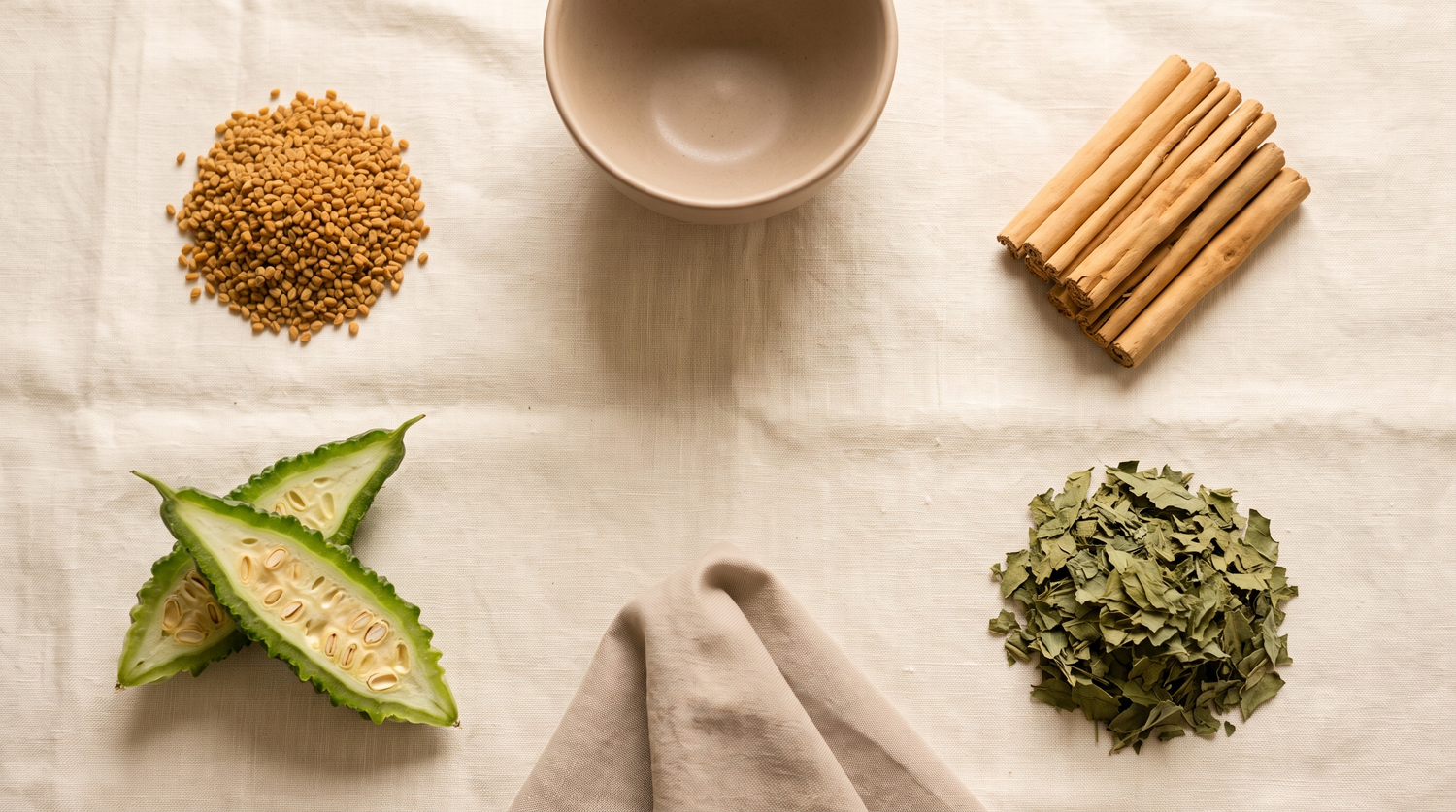
Sri Lankan kitchens have been reaching for bitter gourd, fenugreek and cinnamon bark for generations, and the internet now sells all three as blood sugar answers. The traditional use is real. The question worth asking is narrower and more useful: when researchers put these herbs in front of actual patients and measured what happened, which ones held up? Below, four herbs that grow in or move through Sri Lanka, ranked by the strength of the human evidence behind them rather than by how good the story sounds.
Start with the curve your body already runs
A meal is not supposed to leave blood sugar flat. In healthy adults wearing continuous monitors, glucose reaches its peak in under an hour, at a median of about 50 minutes, topping out around 143 mg/dL on average (Journal of Diabetes Science and Technology, 2022). The International Diabetes Federation puts the settling half of the curve just as plainly: in people with normal glucose tolerance, plasma glucose generally rises no higher than 140 mg/dL after meals and typically returns to pre-meal levels within two to three hours.
So the rise is normal. What matters is the shape: how high the peak goes, and how long the return takes. That is the window every herb below is being tested against, and it is why trial results are reported as fasting glucose, two hour glucose and HbA1c rather than as how a person felt.
1. Fenugreek carries the strongest evidence of the four
Fenugreek (Trigonella foenum-graecum) is a Mediterranean and West Asian legume, grown commercially at scale in India, and used as the dried seed. A 2023 systematic review and meta-analysis in the International Journal of Molecular Sciences pooled 10 randomised controlled trials covering 706 people with type 2 diabetes or prediabetes. Fasting blood glucose fell by 26.66 mg/dL, two hour plasma glucose by 30.29 mg/dL, and HbA1c by 0.54 percentage points, with low to moderate variation between studies. Doses ranged from 500 mg to 10 g daily, across trials lasting 8 to 16 weeks.
That is the most consistent dataset in this list, and it still comes with an official caution attached. The US National Center for Complementary and Integrative Health states that there is not enough high quality evidence to determine whether fenugreek is useful for diabetes, and that many of the underlying studies were not of high quality. Two safety points from the same source are not optional reading: large doses may cause a harmful drop in blood sugar, and fenugreek above food amounts is not considered safe in pregnancy, having been linked to increased risks of birth defects. Ancient Nutra's Fenugreek Capsules hold the seed in a 60 capsule bottle.
2. Ceylon cinnamon moves fasting glucose, not HbA1c
Most cinnamon research is run on cassia, which is a different species from the true cinnamon Sri Lanka is known for. A 2025 randomised, double blind, controlled trial published in PLOS One is the useful exception: it tested Cinnamomum verum specifically, 1,000 mg daily for 12 weeks, in 150 adults. Fasting blood sugar came down by 8.59 mg/dL against control, with a larger effect in the participants who already had type 2 diabetes. HbA1c did not move at all. That null result is part of the finding, not a footnote to it.
The species distinction also carries the safety difference. True cinnamon is the inner bark of Cinnamomum verum and is low in coumarin, while cassia is much higher in it. If you already read the cinnamon story here, the Ceylon cinnamon guide covers the bark itself in more depth; this piece is about where it sits against the other three. Ancient Nutra's Ceylon Cinnamon is the capsule form of that same bark.
3. Karavila shows a signal reviewers do not yet trust
Bitter melon (Momordica charantia), known locally as karavila, is a pan tropical vine grown across South and Southeast Asia rather than a Sri Lankan crop specifically, and the fruit is the part used. It is the herb where the honest answer is the least satisfying. A Cochrane review of four randomised trials in 479 people concluded there was insufficient evidence to support its use in type 2 diabetes, with three of the four trials showing no significant difference against placebo or standard medication.
A much larger 2025 pooling in Metabolism Open, covering 25 trials, did find reductions in fasting glucose and HbA1c. The problem is what the authors graded that evidence at: low certainty for fasting glucose, very low for HbA1c, with extreme variation between studies and detectable publication bias that shrank the HbA1c effect by roughly two thirds once adjusted for. Read together, karavila is a plausible candidate with a weak file, not a settled one. Ancient Nutra's Karavila capsules blend the fruit with seed powder.
4. Gurmar has the thinnest evidence base of the four
Gurmar (Gymnema sylvestre), masbedda in Sinhala, is the herb with the best origin story and the weakest paperwork. Chewing the leaf genuinely dulls the taste of sweetness, which is a real and reproducible effect on the tongue. The glucose evidence is a different matter. A 2021 review in Phytotherapy Research gathered 10 studies in 419 people, but 8 of those 10 were not randomised, and the pooled comparison was before versus after treatment rather than against a placebo group. Variation between studies reached 99 percent for HbA1c.
A 2023 review of six randomised trials reported a reduction in fasting blood sugar, while its own authors listed notable heterogeneity and low study quality as limitations and called for larger, longer, higher quality trials before the effect can be considered established. The cleanest randomised anchor available runs 600 mg daily for 12 weeks. Ancient Nutra's Gurmar is the single herb form.
Compare the four side by side
| Herb | Best human dataset | Trial length | Evidence strength |
|---|---|---|---|
| Fenugreek | 10 RCTs, 706 people | 8 to 16 weeks | Strongest here, still called insufficient by NIH |
| Ceylon cinnamon | 1 RCT, 150 people, species specific | 12 weeks | Fasting glucose only, HbA1c null |
| Karavila | 25 trials pooled, plus a Cochrane review | 4 weeks to 26 weeks | Low to very low certainty, publication bias |
| Gurmar | 10 studies, only 2 randomised | 12 weeks in the cleanest trial | Weakest, mostly non randomised |
On a cinnamon label, look for the species. Cinnamomum verum is true Ceylon cinnamon and is low in coumarin; Cinnamomum cassia is the common supermarket bark and is much higher in it. On a fenugreek label, look for the seed rather than a leaf or sprout preparation, since the seed is what the trials used. And look for a stated daily dose you can compare against a published trial, not a proprietary blend that hides the amount.
Worth noting how the shelf itself answers this question. Ancient Nutra's Sugar Balance System box is built from gurmar, Ceylon cinnamon and venivel, and its own product page answers the obvious follow up directly: asked whether the box contains bitter melon, the answer printed there is simply no, with a pointer to the separate karavila pack instead. Four herbs in one article does not mean four herbs in one box.
Use this list without overreaching it
Three practical boundaries follow from the evidence above. First, duration. Every trial cited here ran between 8 and 16 weeks, and nothing in this article supports open ended daily use beyond that window, because nobody has tested it. Treat 12 weeks as the working figure, and 16 weeks as the outer edge for fenugreek alone.
Second, medication. If you take metformin, insulin or any other blood sugar medicine, speak with your doctor before starting any of these. The concern is not that they will fail, it is that they may add to the effect of the drug you are already on. The same conversation applies before surgery, and fenugreek above food amounts is not considered safe in pregnancy.
Third, the liver. The NIH LiverTox database lists both cinnamon and gymnema at likelihood score D, meaning a possible rare cause of clinically apparent liver injury, with cases reported but attribution usually weak. Fenugreek and bitter melon both sit at score E, unlikely. Rare is not the same as never, so at concentrated capsule doses, stop and speak to a doctor if you notice yellowing of the skin or eyes, dark urine, persistent nausea or unusual tiredness. Culinary amounts of cinnamon in food are a different exposure from a supplement dose and should be read that way.
The bottom line
If you want the herb with the most human data behind it, that is fenugreek. If you want the one tested in the exact species Sri Lanka grows, that is Ceylon cinnamon, with the honest caveat that its win was on fasting glucose and not on HbA1c. Karavila and gurmar are both worth watching and neither is worth overselling. None of the four replaces medical care, and the entire evidence base here is measured in weeks, not years.
Which blood sugar herb has the strongest human evidence?
Fenugreek. A 2023 meta-analysis of 10 randomised trials in 706 people reported fasting glucose down 26.66 mg/dL and HbA1c down 0.54 percentage points, with low to moderate variation between studies.
Does Ceylon cinnamon lower HbA1c?
Not in the trial that tested the Ceylon species directly. A 2025 randomised controlled trial of 1,000 mg daily for 12 weeks in 150 adults found fasting blood sugar fell by 8.59 mg/dL, while the HbA1c difference was not significant.
Is bitter melon proven for type 2 diabetes?
No. A Cochrane review of four trials in 479 people found insufficient evidence, and a larger 2025 pooling that did find an effect graded its own certainty as low for fasting glucose and very low for HbA1c.
How long should someone take these herbs?
The published trials ran 8 to 16 weeks, so that is the tested range. Twelve weeks is the common figure across cinnamon, gurmar and bitter melon studies, and 16 weeks is the upper bound seen in fenugreek trials. Anyone on blood sugar medication should ask their doctor first.

One month of Ancient Nutra's blood sugar routine, built from gurmar, Ceylon cinnamon and venivel in three full size bottles.
Shop Sugar Balance SystemSources and further reading
- Fenugreek in type 2 diabetes and prediabetes, systematic review and meta-analysis, International Journal of Molecular Sciences, 2023.
- Fenugreek safety and evidence summary, NIH National Center for Complementary and Integrative Health.
- Cinnamomum zeylanicum extract on lipids and glucose, randomised controlled trial, PLOS One, 2025.
- Momordica charantia for type 2 diabetes mellitus, Cochrane Database of Systematic Reviews.
- Bitter melon and glycaemic control, meta-analysis with GRADE certainty ratings, Metabolism Open, 2025.
- Continuous glucose profiles in healthy people, Journal of Diabetes Science and Technology, 2022.
- Cinnamon and Gymnema liver injury likelihood scores, NIH LiverTox.
Written by the Ancient Nutra Editorial Team. The team researches, sources, and tests every ingredient before it earns a place in an Ancient Nutra blend. Questions? Email info@ancientnutra.com or message Ancient Nutra on Instagram.
Medical disclaimer: This article is for educational purposes only and is not medical advice. Statements have not been evaluated by the FDA. Ancient Nutra products are not intended to diagnose, treat, cure, or prevent any disease. Speak with a qualified healthcare provider before starting any new supplement, especially if you take prescription medication or have a medical condition.