Ancient Nutra Wellness Team · 17 October 2026 · 5 min read
Water, breakfast, then Katupila: a 5-minute morning routine
- Five steps, about five minutes: a glass of water, a minute of daylight, a real breakfast, one Katupila capsule with the meal, then the jar goes back beside the bowl.
- The order follows the label. Ancient Nutra's Katupila directions say 1 to 2 capsules a day with water, ideally with meals, so the capsule comes after the food.
- Katupila (Flueggea leucopyrus) has a long traditional record in Sri Lanka and some lab work, but no human trials. The routine stands on the water, light and breakfast. The capsule rides along.
Most people take a capsule the way they take a vitamin: dry, in a rush, somewhere between the alarm and the door. The label on Ancient Nutra's Katupila asks for something slightly different. One or two capsules a day, with water, ideally with a meal. Build a small routine around that one line and the capsule stops being a thing you forget. Here is the sequence, why the order matters, and what to do on the mornings when there is no Katupila in the house.
The routine, step by step
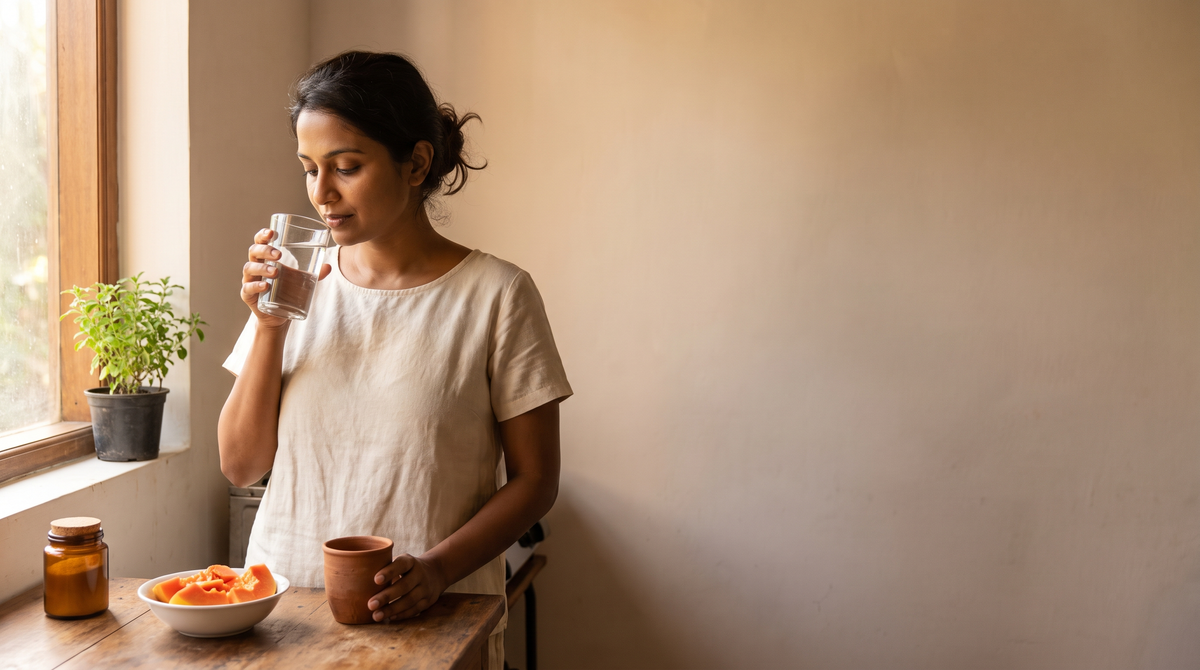
- Drink a full glass of water before anything else. Not coffee, not tea. A plain glass, around 250 ml, within a few minutes of getting up. You have gone all night without one.
- Open a curtain or step to a window for one minute. Morning daylight, even through glass on a grey day, is the signal your body clock reads first. Let the light in while you finish the water.
- Eat a real breakfast. Fruit and a slice of toast, a bowl of kola kenda, two string hoppers with sambol. Anything that counts as a meal, because the next step asks for one.
- Take one Katupila capsule with the meal, and another sip of water. One capsule a day is the lower end of the label; two is the upper end. Start at one. Swallow it mid-meal rather than on an empty stomach, which is what the directions on Ancient Nutra's Katupila say.
- Put the jar back next to the breakfast bowl. Not in a cupboard. Tomorrow you should see it when the bowl comes out. That is the whole retention trick, and it costs nothing.
The hands-on time, not counting the eating, is around five minutes. The breakfast you were going to have anyway.
Why the order matters
Each step is doing one plain job. The water comes first because it is the simplest thing the morning needs. The CDC's guidance on water is blunt: getting enough water every day is important for health, and one of its practical tips is to serve water with meals (CDC). A glass before breakfast and a glass with it covers both.
The light comes second because of timing. Your body runs on a roughly 24-hour cycle, and according to the National Institute of General Medical Sciences, light and dark have the biggest influence on that cycle (NIGMS). A minute at the window tells the clock the day has started. It is the cheapest step on the list and the one most people skip.
The capsule comes last because the label says with meals. That is the direction printed on the jar, and following it is the honest baseline for any herb. No human trial tells you Katupila works better at 7 am than at 7 pm. What exists is a traditional record and some lab work: a 2014 study at a Sri Lankan university tested a water extract of the leaves in test tubes and found antioxidant activity (BMC Complementary and Alternative Medicine, 2014). Test tubes are not people. So the morning slot is a habit choice, not a biology claim. Breakfast is simply the meal you are least likely to skip.
For the fuller picture of the plant, the team has written it up twice already: what Katupila actually is, and an earlier look at its traditional skin and liver uses. This article is only about the routine.
When to do it, and when to skip it
Run it within the first hour of waking, whatever time that is for you. If you work nights, your morning is whenever you get up, and the light step still applies, even if the light is a lamp. Do it daily if you are taking Katupila daily. The label allows one or two capsules a day, and one is a fine place to stay.
Skip the capsule, and keep the water and the light, on any morning you are fasting for a blood test, feeling unwell, or starting a new prescription until you have checked with your doctor. The routine does not depend on the capsule being there. That is deliberate.
Look for
A capsule that names the plant properly: Katupila is Flueggea leucopyrus (older books call it Securinega leucopyrus). Plain dried powder, a vegetarian capsule, and a label that gives a daily range rather than a promise. Ancient Nutra's Katupila comes as 60 capsules, 1 to 2 a day with meals.
If you do not have Katupila at home
Do the first three steps anyway. Water, light and breakfast are the routine. The capsule is the passenger. If you want a traditional Sri Lankan herb in the same breakfast slot while you wait for the jar, Ancient Nutra's Iramusu (Sarsaparilla) is another dry-country root with a long household record, also taken as a capsule with food. If you would rather drink the herb than swallow it, Ancient Nutra's Heenbovitiya Powder steeps into a plain hot cup that can stand in for the second glass of water. Neither is a substitute for Katupila in any clinical sense. They are different plants that happen to fit the same five minutes.
Safety
Katupila has no human trials, so there is no evidence-based course length. Treat it as a bounded habit: take the labelled 1 to 2 capsules a day for a set period, then review with a practitioner rather than continuing indefinitely. Stop and speak to a doctor if you notice unusual tiredness, nausea, loss of appetite, dark urine, pain on passing urine, or any yellowing of the skin or eyes. If you are pregnant or breastfeeding, have a kidney or liver condition, or take prescription medication, check with your doctor before starting.
The bottom line
The routine does one modest thing: it attaches a traditional herb to three habits that already have a case of their own, and it does so the way the label asks. Try the five steps for seven mornings. If the jar is still being opened on day eight, the routine worked, whatever else you decide about the herb inside it. Ancient Nutra's Katupila is made for exactly that kind of plain daily use.

Katupila - 60 capsules
Pure Katupila (Flueggea leucopyrus) powder in a vegetarian capsule. 1 to 2 a day with meals.
Shop KatupilaSources and further reading
- About Water and Healthier Drinks, Centers for Disease Control and Prevention.
- Circadian Rhythms fact sheet, National Institute of General Medical Sciences.
- Soysa P, De Silva IS, Wijayabandara J. Evaluation of antioxidant and antiproliferative activity of Flueggea leucopyrus Willd (katupila). BMC Complement Altern Med. 2014;14:274, Europe PMC. In vitro study only.
- Ancient Nutra, Katupila: What Sri Lanka's Dry-Zone Herb Actually Is.
Written by the Ancient Nutra Wellness Team. The team researches, sources, and tests every ingredient before it earns a place in an Ancient Nutra blend. Questions? Email info@ancientnutra.com or message Ancient Nutra on Instagram.
Medical disclaimer: This article is for educational purposes only and is not medical advice. Statements have not been evaluated by the FDA. Ancient Nutra products are not intended to diagnose, treat, cure, or prevent any disease. Speak with a qualified healthcare provider before starting any new supplement, especially if you take prescription medication or have a medical condition.