By the Ancient Nutra Editorial Team
- Tongkat Ali (Eurycoma longifolia) and Ashwagandha (Withania somnifera) are different plants from different traditions, and the research on each one asks a different question.
- Tongkat Ali trials have mostly measured testosterone, stress hormones and quality of life in men, using 100 to 400 mg daily over 4 to 12 weeks.
- Ashwagandha trials have mostly measured perceived stress and cortisol, commonly at 300 mg twice daily over 8 weeks.
- Neither herb is meant for open-ended daily use. Both belong in a bounded course, and both carry a documented liver-injury signal in the NIH LiverTox database that is worth knowing before you start.
- Taking both at once is the most common mistake, because it makes it impossible to tell which one did anything.
Two bottles sit next to each other on the same shelf, both labelled adaptogen, both promising energy. That word does a lot of work and explains very little. Tongkat Ali and Ashwagandha are not interchangeable, and the honest answer to "which one is better" is that they have been studied for different outcomes in different people. What follows is what the published trials measured for each herb, and where the evidence runs thin.
What does Tongkat Ali actually do in the body?
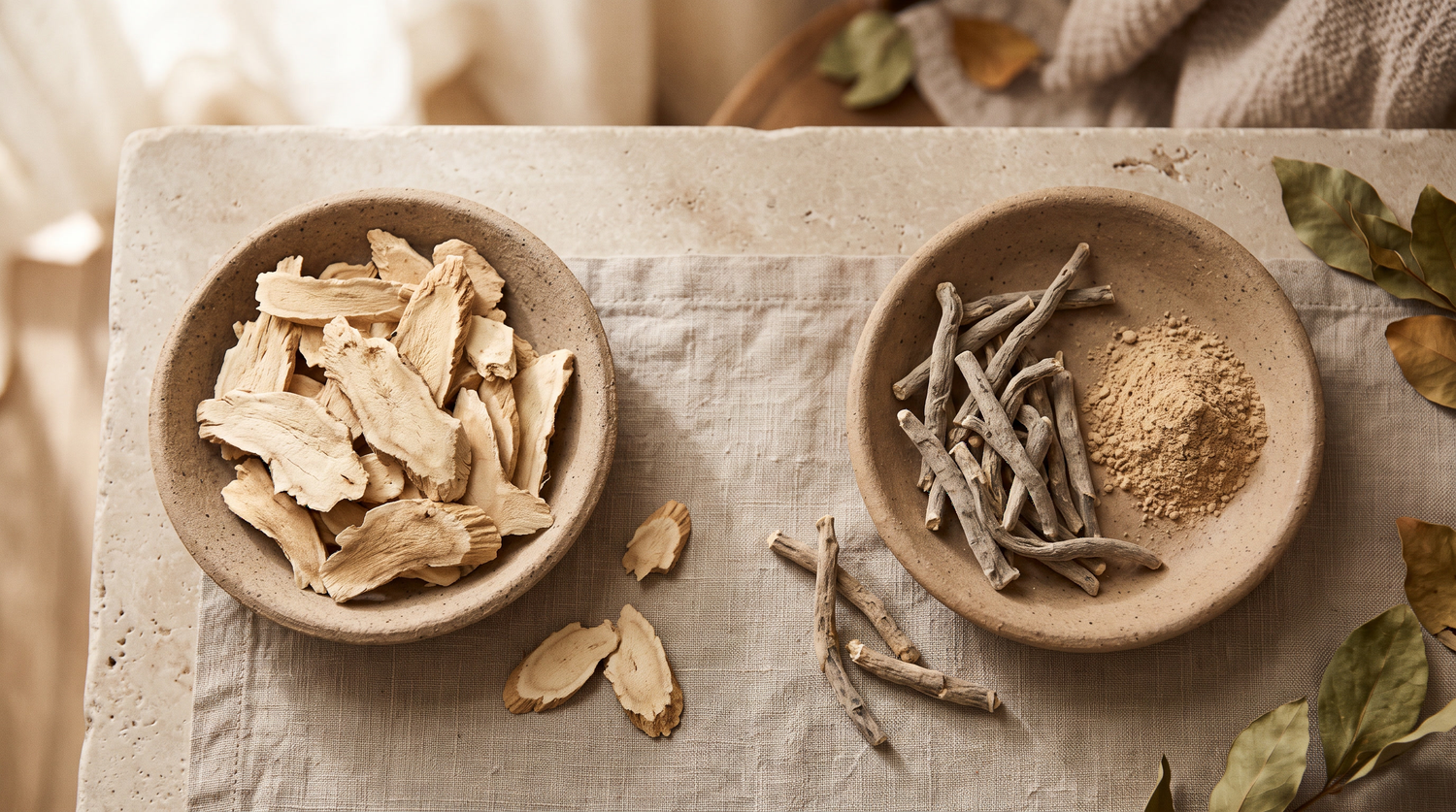
Tongkat Ali is the root of Eurycoma longifolia, a slow-growing shrub native to the rainforests of Southeast Asia, where it is known as Longjack and has a long history of use in Malaysia and Indonesia. The root is the part used, and it is bitter enough that traditional preparations were boiled rather than eaten.
The modern research on it clusters around one idea: hormonal balance under stress. In a randomised, double-blind, placebo-controlled study of 105 men aged 50 to 70, a standardised water extract at 200 mg daily produced a significant rise in total testosterone compared with placebo, first measurable at week 4 of a 12-week course. A separate placebo-controlled study in moderately stressed adults reported reductions in tension, anger and confusion alongside lower cortisol over a shorter course. The pattern across these trials is a shift in the cortisol-to-testosterone ratio rather than a dramatic hormonal jump.
Two honest limits belong here. Most of the good trials use one specific standardised aqueous root extract, so results do not automatically transfer to every Tongkat Ali product on a shelf. And a 2022 meta-analysis of testosterone outcomes reported very high statistical heterogeneity between studies, which is a technical way of saying the trials disagree with each other more than you would want before calling anything settled.
What does Ashwagandha actually do?
Ashwagandha is the root of Withania somnifera, grown commercially across India, and it has been part of Ayurvedic practice for centuries. Ceylon households know the pattern well: a root, warmed in milk, taken at night rather than in the morning.
Its clinical literature points somewhere different from Tongkat Ali's. The trials that get cited most measure perceived stress, sleep quality and serum cortisol, typically using a standardised root extract at 300 mg twice daily for 8 weeks, or 600 mg daily in a single dose. A 2025 multi-centre, randomised, double-blind, placebo-controlled study of adults with stress and anxiety used exactly that 600 mg per day for 8 weeks and reported it was well tolerated over that window, with no serious adverse events.
Notice what those trials are not: they are not testosterone trials in ageing men. Ashwagandha's evidence base is strongest for how stressed people say they feel, measured on validated scales, over roughly two months. A claim stretching much further than that is marketing, not data.
Which herb fits which goal?
Start with the outcome you want to notice, then work backwards to the herb whose trials measured it. Duller than picking the bolder label, and the only method that lets you judge whether anything worked.
If the goal is hormonal support and stamina in men over 40, the Tongkat Ali literature is the one that has asked that question directly, and Ancient Nutra's Longjack-Tongkat Extract is the standardised-extract format. If the goal is the feeling of being wound too tight, poor wind-down at night, or stress that has outstayed its cause, the Ashwagandha trials map onto that better, and Ancient Nutra's Ashwagandha Extract is the concentrated version of it. For readers deciding between the root powder and the capsule form of that second herb, our guide to when the whole root beats the extract covers that choice in detail.
What about both together? The Men's Vitality and Performance System does combine them, and combining is reasonable once you already know how each one behaves in your body. Starting with both at once is the part worth avoiding, because if week six feels better you will have no idea which bottle to credit, and no idea which to stop.
A standardised extract with the plant part named on the label, root for both herbs, not "whole plant" or an unspecified aerial mix. The trials described above were run on standardised root extracts, so a product that does not tell you what it standardises is not a product those results describe.
How long should you take either one?
Both herbs work best as a defined course with a start date and an end date, rather than an indefinite daily habit.
For Tongkat Ali, clinical trials have generally run 4 to 12 weeks at 100 to 400 mg daily. That is the window the useful data covers, and a sensible course sits inside it. Commercial products sold at 1,000 to 1,600 mg are well above the doses those trials used, which is worth checking on a label before assuming more is better.
For Ashwagandha, the trial window is tighter still: roughly 8 weeks at 300 mg twice daily is the most repeated protocol, and a bounded 8 to 12 week course is the outer edge of what published research actually supports. There is no trial evidence for taking it every day for a year, and the practical case for a break is stronger than the case against one.
What should you know about safety before starting?
This is the part most comparison articles skip, and it is the part that should change how you take both herbs. The NIH LiverTox database, the reference resource on drug and supplement liver injury, has an entry for each.
Ashwagandha carries a likelihood score of B, meaning a likely cause of clinically apparent liver injury, with roughly 23 published cases as of its December 2024 update. The reported cases typically appeared 2 to 12 weeks after starting, most often as a cholestatic or mixed pattern presenting with jaundice and itching, and most were mild to moderate and resolved within one to four months of stopping. Rare severe outcomes have been reported. That 2 to 12 week window is precisely why a bounded course, rather than an open-ended habit, is the sensible way to use it. Ashwagandha also warrants a conversation with your doctor first if you take thyroid medication, sedatives or immunosuppressants, or if you are pregnant or breastfeeding.
Tongkat Ali carries a likelihood score of D, a possible rare cause of clinically apparent liver injury, based on a single published case with an onset around one week and a self-limited recovery over one to two months. Short-term clinical studies reported no changes in liver enzymes or bilirubin. The signal is genuinely small, and it is not a reason for alarm, but it is a reason to know the symptoms.
For either herb, stop and speak to a qualified healthcare provider if you notice unexplained abdominal discomfort, persistent nausea, unusual fatigue, dark urine, itching or any yellowing of the skin or eyes. None of this is a diagnosis, and none of it replaces medical advice.
The bottom line
Tongkat Ali and Ashwagandha are not rivals for the same job. One has been studied mainly for hormonal balance and stamina in men, the other mainly for perceived stress and sleep, and each one's evidence is bounded by the length and design of the trials that produced it.
- Pick the herb whose trials measured the outcome you actually want to notice.
- Run one at a time, as a course with an end date, inside the windows the research used.
- Know the liver-injury symptoms for both, and stop and seek advice if any appear.
If the goal is hormonal support and stamina, the standardised Longjack root extract is the format the research describes.
Is Tongkat Ali or Ashwagandha better for energy?
Neither has been studied as a stimulant. Tongkat Ali trials measured testosterone and quality of life in men over 12 weeks; Ashwagandha trials measured perceived stress and cortisol over about 8 weeks. If low energy tracks with stress and poor sleep, the Ashwagandha literature is closer to that question. If it tracks with age-related hormonal change in men, the Tongkat Ali literature is.
Can you take Tongkat Ali and Ashwagandha together?
They are combined in some formulas, including Ancient Nutra's Men's Vitality and Performance System. The practical argument against starting both at once is that you cannot tell which one is responsible for any change you notice, or which to stop if something feels off.
How long does Tongkat Ali take to work?
In the randomised trial of men aged 50 to 70, the significant rise in total testosterone at 200 mg daily was first measured at week 4 of a 12-week course. Trials generally run 4 to 12 weeks at 100 to 400 mg daily.
Is it safe to take Ashwagandha every day, long term?
Published trials support roughly 8 weeks of daily use, and a bounded 8 to 12 week course is the outer edge of what the evidence covers. NIH LiverTox rates Ashwagandha a likely cause of clinically apparent liver injury, with reported cases appearing 2 to 12 weeks after starting, so open-ended daily use is not something the research supports.
Which is better for stress specifically?
Ashwagandha has the larger body of trials measuring perceived stress and cortisol directly. Tongkat Ali trials have also reported lower cortisol alongside mood improvements, but stress is the primary question in the Ashwagandha literature and a secondary one in most Tongkat Ali studies.

Longjack-Tongkat Extract
A standardised Eurycoma longifolia root extract, the format used in the published trials, for a bounded course of hormonal and stamina support.
Shop Longjack-Tongkat ExtractSources and further reading
- Tongkat Ali, LiverTox, National Institute of Diabetes and Digestive and Kidney Diseases. Retrieved 29 August 2026.
- Ashwagandha, LiverTox, National Institute of Diabetes and Digestive and Kidney Diseases. Retrieved 29 August 2026.
- Effect of Eurycoma longifolia standardised aqueous root extract on testosterone levels and quality of life in ageing male subjects, a randomised, double-blind, placebo-controlled multicentre study, Food and Nutrition Research, via PubMed Central. Retrieved 29 August 2026.
- Efficacy and safety of Eurycoma longifolia water extract plus multivitamins on quality of life, mood and stress, a randomised placebo-controlled parallel study, PubMed Central. Retrieved 29 August 2026.
- Safety of 8-week administration with Ashwagandha root extract in adults with stress and anxiety, a prospective, randomised, multi-centre, double-blinded, placebo-controlled study, PubMed Central. Retrieved 29 August 2026.
Written by the Ancient Nutra Wellness Team. The team researches, sources, and tests every ingredient before it earns a place in an Ancient Nutra blend. Questions? Email info@ancientnutra.com or message Ancient Nutra on Instagram.
Medical disclaimer: This article is for educational purposes only and is not medical advice. Statements have not been evaluated by the FDA. Ancient Nutra products are not intended to diagnose, treat, cure, or prevent any disease. Speak with a qualified healthcare provider before starting any new supplement, especially if you take prescription medication or have a medical condition.