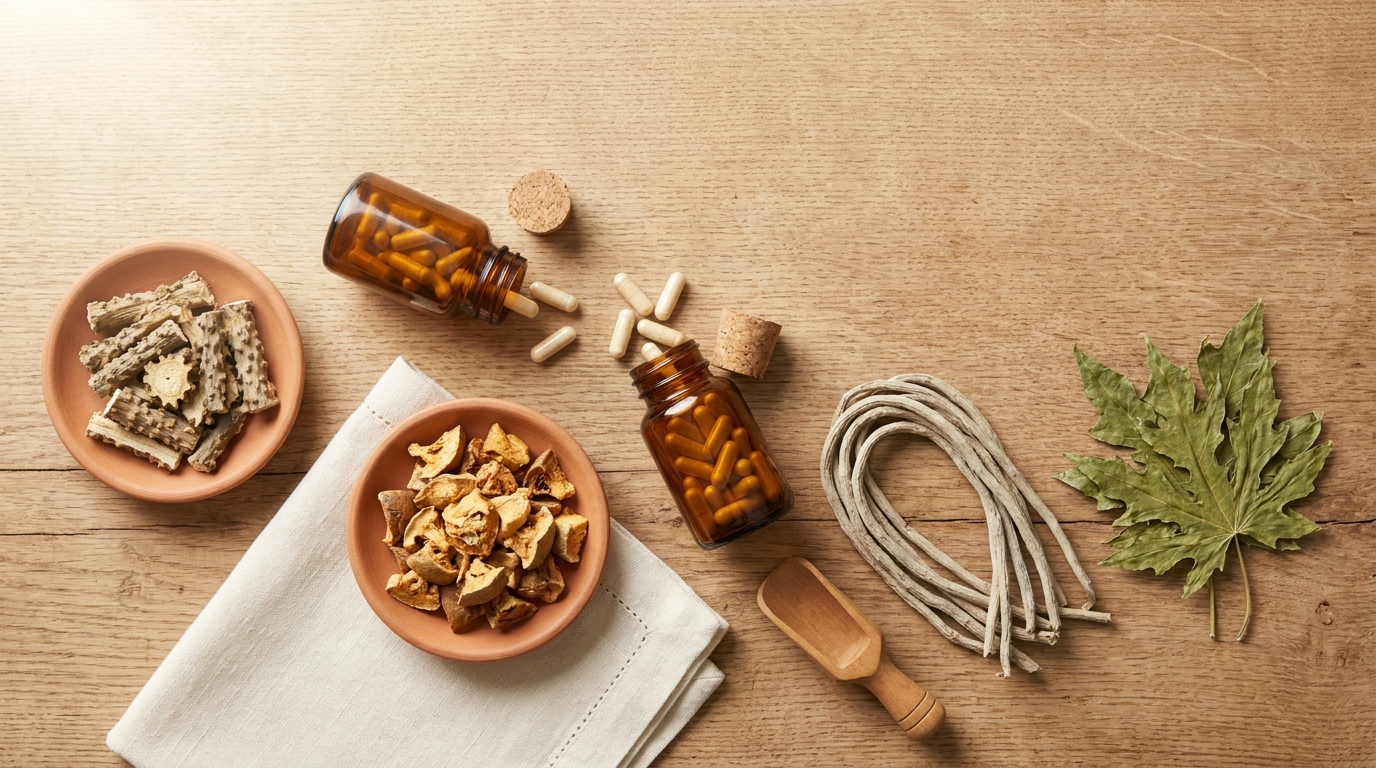
- Four heritage Sri Lankan herbs map to the four main monsoon pressures: Guduchi for general immune resilience, Beli for the monsoon stomach, Iramusu for humidity skin and urinary flares, and Papaya leaves on standby for the dengue weeks.
- Guduchi is the broadest starting point and is traditionally taken as a 500mg capsule once or twice daily across the 6 to 8 week monsoon window.
- Start in early May, run daily through August, and taper in September. Papaya leaf is reserved for a confirmed dengue case under medical supervision, not used as a preventive.
The Yala monsoon arrives in Sri Lanka in mid-May, and it brings two things at once. Relief from the heat. And a fresh wave of colds, gut bugs, and mosquito-borne illness. Health officials this week confirmed Sri Lanka has already logged 27,754 dengue cases and 14 deaths in the first four months of 2026, and warned that the rains will push transmission higher (National Dengue Control Unit, May 2026).
Sri Lankan grandmothers had a small set of herbs they reached for in May without asking why. Here is what they used, and why the modern science quietly backs the tradition.
The short version
- Guduchi, for general immune resilience and recurrent infections
- Beli, for the monsoon stomach (loose motions, bloating, traveler's gut)
- Iramusu, for the heat-and-humidity skin flare-up and the urinary side of things
- Papaya leaves, for the dengue-prone weeks when platelet counts matter
Why the Yala monsoon is different
Three things shift in mid-May, and the body feels all three. Standing water explodes mosquito breeding, so dengue, leptospirosis, and chikungunya start climbing. Humidity sits at 80 to 90 percent, which makes fungal skin issues and damp-house respiratory irritation worse. Food and water get easier to contaminate, and gut infections rise.
Sri Lanka has documented two annual dengue peaks for years, and both line up with the two monsoons. Yala (May to September) is the first. Maha (October to January) is the second. The herb stack that helps now is the same one that helps in October.
What helps during the monsoon
1. Guduchi, the general-immunity root
Guduchi (Tinospora cordifolia) is the herb Ayurveda calls amrita, the "nectar of immortality," and the one Sri Lankan households reach for when colds and fevers start cycling through the family.
In a randomised double-blind placebo-controlled trial of 75 patients with allergic rhinitis (the seasonal sneezing and nasal congestion that monsoon humidity often triggers), eight weeks of Guduchi extract relieved sneezing in 83 percent of patients, nasal discharge in 69 percent, and nasal obstruction in 61 percent. The placebo group barely moved (Badar et al., Journal of Ethnopharmacology, 2005). Mechanism reviews credit immune-active polysaccharides and alkaloids that nudge macrophage and natural killer cell activity.
Best for: people who pick up every cold going around the office, post-illness recovery, and the week when half the household is sneezing. Typical use: a 500mg capsule once or twice daily with meals, for 6 to 8 weeks across the monsoon window.
2. Beli, the monsoon stomach herb
Beli (also called bael, Aegle marmelos) is what Sri Lankan families brew when the kids come home with loose motions after a wet-weather school week. The unripe fruit is the active part, and it has a curious bidirectional reputation: it slows things down when the gut is racing, and gently eases things along when constipation hits.
Pharmacology work has shown the unripe-fruit decoction interferes with bacterial colonisation of the gut wall and dampens enterotoxin activity. Methanol extracts have shown in vitro activity against the usual monsoon offenders: Salmonella typhi, Escherichia coli, and Vibrio cholerae.
Best for: traveler's gut during the rains, monsoon bloating, and the household where someone always seems to be running to the bathroom in May. Typical use: a 500mg capsule twice daily, before meals, for 2 to 4 weeks during the wettest stretch.
3. Iramusu, the cooling and clearing herb
Iramusu (also called Indian Sarsaparilla, Hemidesmus indicus) is the herb Sri Lankan families reach for when the body feels overheated, the skin starts breaking out from humidity, or urination feels slow. Pharmacology reviews list anti-inflammatory, antimicrobial, and antioxidant activity as the headline properties.
What is interesting for the monsoon: lab work has shown the root extract disrupts biofilm formation by drug-resistant Staphylococcus aureus and Streptococcus pyogenes, the bacteria behind humid-weather skin and throat infections. Tradition got the use case right long before the petri dish caught up.
Best for: monsoon skin flares, urinary discomfort after long humid days, and people who feel internally hot even when the rain is cooling everything else down. Typical use: a 500mg capsule once or twice daily, on an empty stomach.
4. Papaya leaves, for the dengue-prone weeks
This one is specific. Papaya leaf (Carica papaya) is the herb Sri Lankan households associate with one thing: helping the platelet count recover during dengue fever. It is not a preventive. It is the herb that gets pulled out when the diagnosis comes back.
A 2019 systematic review and meta-analysis pooled clinical trial data and found papaya leaf extract was associated with a faster rise in platelet count during the acute dengue window (mean difference of roughly 20,000 platelets per microlitre across the trials), and a meaningful reduction in hospital stay (about 2 days). The authors flagged the evidence as low to moderate quality and called for larger trials. The signal is consistent enough that papaya leaf has become part of dengue supportive care in many Sri Lankan households.
Best for: a household keeping it in the cabinet through the monsoon, ready to use under medical supervision if a confirmed dengue case turns up. Typical use: as guided by the treating doctor, alongside hydration and standard CBC monitoring.
Look for
Standardised capsules with a single named species on the label (Tinospora cordifolia, Aegle marmelos, Hemidesmus indicus, Carica papaya) and an honest dose in milligrams per capsule. Avoid blends that hide the dose inside a "proprietary formula".
The four herbs above are available individually at clinical doses on the Ancient Nutra shelf: Ancient Nutra's Guduchi, Ancient Nutra's Beli, Ancient Nutra's Iramusu, and Ancient Nutra's Papaya Leaves. The Guduchi capsule is the one most households start with during Yala, and stocks tend to thin out by the second week of the rains.
A team observation
When the team at Ancient Nutra ran the first internal monsoon protocol in 2024 (Guduchi daily, Beli on the worst rain weeks, Iramusu on humid afternoons), the most common feedback was small but consistent: "fewer sick days off in May and June than last year." Not dramatic. Just the difference between catching every bug at the office and catching almost none.
When to start, when to stop
Start in the first week of May, around the time the inter-monsoonal showers begin to feel less like showers and more like a season. Run it daily through to the end of August. Taper off through September. These are seasonal tools, not year-round fixtures, and the body responds better to a defined window than to a permanent low-dose drip.
Hold off entirely on Papaya leaves until a confirmed dengue case shows up in the household, and use it then under medical supervision. The other three (Guduchi, Beli, Iramusu) are safe daily picks for healthy adults during the monsoon window.
The bottom line
Four herbs, one season. Guduchi for general resilience. Beli for the gut. Iramusu for the heat-and-humidity flare-up. Papaya leaves on standby for the dengue weeks. Start with one (Guduchi is the broadest), add the others as the specific need turns up, and taper off in September.
For the household that wants a single starting point this Yala, Ancient Nutra's Guduchi is the capsule the team reaches for first. The bitter root has earned its place on the Sri Lankan monsoon shelf for centuries. The modern data is finally catching up.

Guduchi - 60 capsules
Guduchi is traditionally used to support general immune resilience through the monsoon window.
Shop GuduchiSources
- National Dengue Control Unit, Sri Lanka, May 2026: 27,754 dengue cases and 14 deaths in the first four months of 2026, with rains expected to push transmission higher.
- Badar VA et al., Journal of Ethnopharmacology, 2005: Randomised double-blind placebo-controlled trial of Tinospora cordifolia (Guduchi) in allergic rhinitis, n=75, 8 weeks.
- Phytochemical and biological review of Aegle marmelos (Beli), PMC, 2023: Antidiarrhoeal, antibacterial, and gut-protective actions of the unripe fruit.
- Nandy S et al., Journal of Ethnopharmacology, 2012: Bioactive and therapeutic potential of Hemidesmus indicus (Iramusu, Indian Sarsaparilla) root, including antimicrobial and anti-inflammatory activity.
- Charan J et al., BMC Complementary Medicine and Therapies, 2019: Systematic review and meta-analysis of Carica papaya leaf extract in dengue: faster platelet recovery, reduced hospital stay, low to moderate quality evidence.
Medical disclaimer: This article is for educational purposes only and is not medical advice. Statements have not been evaluated by the FDA. Ancient Nutra products are not intended to diagnose, treat, cure, or prevent any disease. Dengue is a medical emergency: seek immediate care from a qualified clinician if you suspect a dengue infection. Speak with a qualified healthcare provider before starting any new supplement, especially if you take prescription medication, are pregnant or breastfeeding, or have a medical condition.