Ancient Nutra Wellness Team · 12 August 2026 · 7 min read
Ceylon Cinnamon: How It Is Grown, Peeled, and Graded
- Ceylon cinnamon is Cinnamomum verum, and the part used is the soft inner bark, not the woody stem or the rough outer skin.
- It is a low country wet zone crop grown in Galle, Matara, Ratnapura, Kalutara, and Hambantota, not a hill country crop. Sri Lanka's Department of Cinnamon Development puts the commercial ceiling at 700 metres above sea level.
- A new planting waits two to three years for its first harvest, and every quill is still rolled by hand with a brass rod and a small curved blade.
- Cassia cinnamon averages about 3,000 mg of coumarin per kilogram. A Cinnamomum verum sample from a Sri Lankan plantation measured below the limit of detection in the same peer reviewed survey.
A jar of cinnamon capsules gives away almost nothing about how long it took to fill. The label lists a weight, a species if the brand is careful, and a serving size. What it cannot show is the four year gap between someone pushing a cutting into red wet zone soil and the first bark worth peeling, or the fact that the rolling itself has resisted every attempt to mechanise it. Sri Lanka's spice and concentrate exports earned US$461.85 million in 2024, and a large share of that value is still produced sitting on a shed floor with a brass rod. Here is what actually happens in that gap.
Start with the plant, not the powder
Two different trees are sold as cinnamon. Ceylon cinnamon, the one Sri Lanka is known for, is Cinnamomum verum (also written Cinnamomum zeylanicum). The cheaper and far more common supermarket product is cassia, Cinnamomum cassia. They are related, they smell similar, and they behave very differently once you start taking them daily.
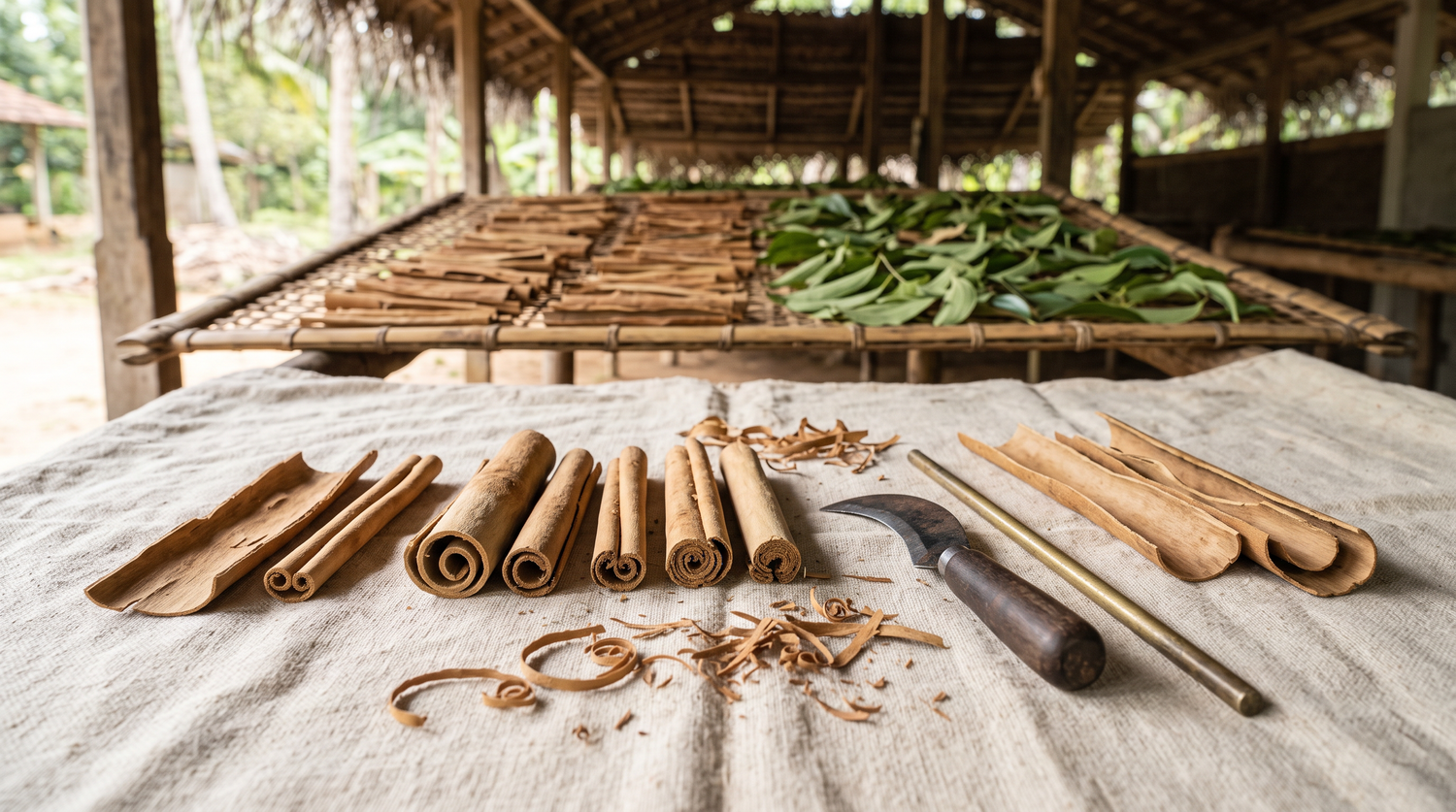
The part used is specific. The brown outer bark, called sumbula or kurutta, is scraped off the stem and discarded. What gets peeled, rolled, and dried is the soft, pale inner bark underneath. Everything that makes a quill worth buying comes from that thin layer.
You can see the difference without any equipment. Germany's Federal Institute for Risk Assessment describes a cassia stick as a single thick outer layer curled into a small roll, while the cross section of a Ceylon quill "resembles a cut cigar", several fine layers rolled inside one another. That structure is a direct fingerprint of how the two are made.
Where does Ceylon cinnamon actually grow?
Not in the hills. This is worth stating plainly, because cinnamon gets romanticised into Sri Lanka's tea country by people who have never seen a cinnamon garden. Tea belongs to the cool uplands around Nuwara Eliya and Kandy. Cinnamon belongs to the warm, wet, low lying south and west.
The Department of Cinnamon Development sets the commercial limit at 700 metres above mean sea level, and describes the wet zone with its red soil as the primary cultivation area, with sandy and sandy loam soils on the plains and along the coast also suitable. It wants 25 to 35 degrees Celsius and rainfed conditions with annual rainfall above 1,875 mm. Research published in the Colombo Economic Journal in 2024 places the crop across the Galle, Matara, Ratnapura, Kalutara, and Hambantota districts, covering roughly 32,985 hectares.
That geography is not decorative detail. Coastal wet zone heat and rainfall are what produce a thin, pliable inner bark. A grower cannot move the crop uphill and get the same product, which is a large part of why the origin claim on a cinnamon label is checkable rather than poetic.
How long before a new planting earns its first harvest?
Two to three years, according to the Department of Cinnamon Development, after which a well managed garden can be harvested two to three times a year. Field reporting from individual estates has put it closer to four years, so two to four is the honest public range for a first cut. Either way, nobody plants cinnamon for this season's revenue.
The yields explain why so much of the crop stays in smallholder hands. Average annual productivity of dry quills runs at about 500 kg per hectare against an assessed potential of 1,500 kg per hectare, and 92 per cent of cinnamon farmers produce under 1,000 kg per hectare. Around 250,000 cultivators and 400,000 peelers work in the sector, and it is the primary income for roughly 60,000 family units.
Watch what happens in the peeling shed
Harvesting is only the start. The stem is cut, the rough outer bark scraped away, then the stem is rubbed with a brass rod until, in the Department's own description, the juice oozes out and loosens the bark from the wood. The loosened sheets are lifted off with a small curved knife called a thalana kokeththa. The peeler then slides finer layers inside coarser ones so the quill dries as one piece rather than a stack of curls.
Drying takes 4 to 7 days on strings, racks, or nets, down to a moisture content of 14 per cent or less. Finished quills are cut to 105 cm (42 inches) and sorted into 13 grades, which split into two families: heen kurundu, the finer Alba and C groups, and gorosu kurundu, the coarser M and H groups. Grade is decided by the thickness and cleanliness of that inner bark, which traces straight back to how the tree was grown and how steady the peeler's hand was.
None of this has been automated, and that is the industry's live problem rather than a marketing story. Sri Lanka's Export Development Board reports a shortfall of more than 35,000 skilled workers for harvesting and processing, with the industry running at around 65 per cent of capacity as a result. A training academy was set up in the Galle district specifically to address it. One veteran peeler interviewed by Al Jazeera said he started at twelve and it still took him several years to strip the inner bark without damaging it.
Why does the coumarin difference matter?
Coumarin is a naturally occurring compound that cassia carries in quantity and Ceylon cinnamon largely does not. Germany's Federal Institute for Risk Assessment reports that cassia contains on average about 3,000 mg of coumarin per kilogram, with the highest measured samples reaching 10,000 mg per kilogram. A peer reviewed survey of 60 ground cinnamon samples in the Czech retail market, all of them cassia, found a mean of 3,856 mg per kilogram, while the Cinnamomum verum control sample taken from a Sri Lankan plantation measured below the limit of detection.
The tolerable daily intake for coumarin is 0.1 mg per kilogram of body weight per day, a figure the European Food Safety Authority arrived at independently. For a 60 kg adult that works out to roughly 2 grams of cassia cinnamon per day before the limit is reached, and about 0.5 grams for a 15 kg child. The same regulator notes that cinnamon based food supplements can carry high coumarin levels and that, depending on the dose recommended, cassia powder can push a consumer past the TDI.
That is the entire practical case for buying by species rather than by the word "cinnamon", and it is why the label matters more here than in almost any other spice.
Look for
The species stated as Cinnamomum verum or Cinnamomum zeylanicum on the label, not just the word "cinnamon" or a country name. Ancient Nutra's Ceylon Cinnamon states the species, and the capsules are ground true cinnamon bark rather than a cassia blend.
A note on daily use
Cinnamon is well tolerated by most people, but it is not inert. The US National Institutes of Health LiverTox database gives cinnamon a likelihood score of D, meaning a possible but rare cause of clinically apparent liver injury, based on a small number of published cases. Anyone taking it daily should stop and speak to a doctor if they notice yellowing of the skin or eyes, dark urine, persistent nausea, or pain in the upper right abdomen. Cinnamon can also amplify the effect of blood sugar medication, so anyone on metformin or insulin should clear it with their doctor first.
What can a brand honestly prove about its sourcing?
Provenance language has become cheap. Named valleys, single farms, and third generation growers appear on labels constantly, and very little of it is verifiable by the person reading it. A useful rule when reading any sourcing claim, including this one: separate what is publicly checkable from what is simply asserted.
Publicly checkable, for cinnamon, is quite a lot. The species is testable in a lab. The growing districts, the elevation ceiling, the harvest cycle, and the grading system are all published by the Sri Lankan government. Coumarin content is measurable. Ancient Nutra states region level sourcing, that its Ceylon cinnamon, turmeric, ashwagandha, gotukola, moringa, and ginger come from Sri Lankan growing regions and supply chains rather than generic global sourcing, and that many ingredients come from small scale growers. That is a claim about a region and a supply chain, and it is the level at which the company can stand behind it.
What is not published, here or by most brands, is a farm by farm register: the specific grower, the specific plot, the harvest date of the batch in a specific jar. Anyone who tells you otherwise on a supplement label is usually describing an aspiration rather than a record. The right question to ask a brand is not "which farm" but "what can you show me", and the answers worth having are a species confirmation, a certificate of analysis, and a manufacturing standard. For more on where that line sits, what a lab test proves about a herb, and what it cannot covers the same ground for testing claims.
The same logic applies across the shelf. Ancient Nutra's Moringa and Iramusu (Sarsaparilla) each have their own growing calendar and their own processing method, and each is worth judging by what can actually be demonstrated rather than by how evocative the origin story sounds.
The bottom line
Ceylon cinnamon is slow in a way that does not show up on a label: two to three years to a first harvest, a few days of drying per batch, and a peeling skill that takes years to acquire and is currently short of tens of thousands of hands. The species distinction is the part that changes what the product does in a daily routine, and it is checkable. Buy on species and on evidence, and treat the romance as a bonus rather than the reason.
Where does Ceylon cinnamon grow in Sri Lanka?
In the low country wet and intermediate zones, across the Galle, Matara, Ratnapura, Kalutara, and Hambantota districts. The Department of Cinnamon Development puts the commercial ceiling at 700 metres above sea level, so it is a lowland and coastal crop rather than a hill country one.
How long does Ceylon cinnamon take before the first harvest?
Two to three years from planting according to the Department of Cinnamon Development, with field reports from some estates closer to four. After that, a well managed garden can be harvested two to three times a year.
What is the difference between Ceylon cinnamon and cassia?
They are different species. Ceylon cinnamon is Cinnamomum verum and cassia is Cinnamomum cassia. Cassia averages about 3,000 mg of coumarin per kilogram, while a Cinnamomum verum sample from a Sri Lankan plantation measured below the limit of detection in a peer reviewed retail survey.
Is cinnamon safe to take daily?
It is widely described as well tolerated, but the NIH LiverTox database gives cinnamon a likelihood score of D, a possible but rare cause of clinically apparent liver injury. Stop and speak to a doctor if yellowing of the skin or eyes, dark urine, persistent nausea, or upper right abdominal pain appear. Anyone taking blood sugar medication should check with their doctor first.

Ceylon Cinnamon, 60 capsules
True Cinnamomum verum bark, the low coumarin species, in a stated dose.
Shop Ceylon CinnamonSources and further reading
- Post Harvest Technology and Environmental Factors, Department of Cinnamon Development, Sri Lanka.
- FAQ on coumarin in cinnamon and other foods, German Federal Institute for Risk Assessment (BfR).
- Cinnamon, likelihood score D, LiverTox, US National Institutes of Health.
- Assessment of Coumarin Levels in Ground Cinnamon Available in the Czech Retail Market, The Scientific World Journal, 2012.
- Technical Efficiency of Cinnamon Cultivation, Colombo Economic Journal, University of Colombo, 2024.
- Processing of Ceylon Cinnamon and export performance data, Sri Lanka Export Development Board.
Written by the Ancient Nutra Wellness Team. The team researches, sources, and tests every ingredient before it earns a place in an Ancient Nutra blend. Questions? Email info@ancientnutra.com or message Ancient Nutra on Instagram.
Medical disclaimer: This article is for educational purposes only and is not medical advice. Statements have not been evaluated by the FDA. Ancient Nutra products are not intended to diagnose, treat, cure, or prevent any disease. Speak with a qualified healthcare provider before starting any new supplement, especially if you take prescription medication or have a medical condition.