Ancient Nutra Wellness Team · 24 October 2026 · 6 min read
5 mistakes people make with Heenbovitiya, Sri Lanka's liver leaf
By the Ancient Nutra Editorial Team
- Heenbovitiya (Osbeckia octandra) was a kitchen herb before it was a capsule: young leaves cooked into porridge as a liver tonic, mature leaves dried for tea.
- The evidence is animal work in rats and mice. The one human trial, 30 adults over two months, tested a two-herb capsule, so it cannot say what Heenbovitiya does on its own.
- In Ancient Nutra's Liver & Detox System it is one of three herbs, taken with breakfast beside Yaki Narang and Triphala. It is not a cleanse and not a substitute for medical care.
Most people who buy Heenbovitiya get about half of what the leaf has to offer. Not because the plant is weak. Because they treat a village kitchen herb like a three-day detox kit, then judge it by the kit's promises. Heenbovitiya, in Sinhala heen bovitiya, is a small flowering shrub of the melastome family. It grows wild in Sri Lanka and, by most botanical accounts, nowhere else. Households have cooked its leaves for generations. Here are the five mistakes that quietly waste it, and the one-step fix for each.
The short version
- Treating it like a cleanse.
- Expecting human-trial proof that does not exist yet.
- Skipping the cooking step the tradition never skipped.
- Running it forever, or instead of a doctor.
- Mistaking the leaf for the whole liver routine.
Mistake 1. Treating it like a cleanse
The most common mistake is buying Heenbovitiya for a hard reset: a week of capsules after a heavy month, then nothing.
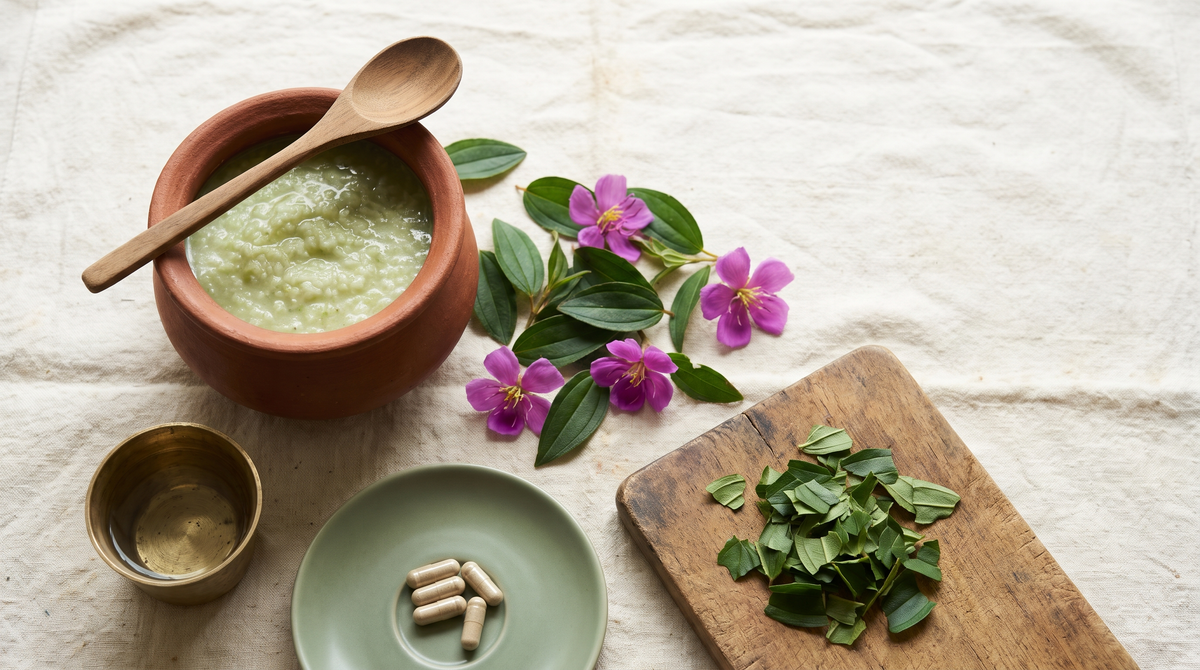
That is the opposite of how the leaf was used. In Sri Lankan ethnobotany, a porridge made from the young leaves is recorded as a liver tonic, and a tea from the dried mature leaves is taken for blood sugar. Both are small, repeated, with food. The Sri Lankan name for that style of eating is kola kenda, the green herbal porridge that starts the day in many homes. Nobody called it a cleanse. It was breakfast.
The fix: think of Heenbovitiya as a daily leaf, not an event. One capsule with a meal, or a cup of leaf tea, on ordinary days. The live post Heenbovitiya for the liver: the daily ritual, not the crash cleanse walks through that rhythm in detail.
Mistake 2. Expecting human-trial proof
People search for "Heenbovitiya clinical trial" and either find nothing, or find something that is not quite what it looks like.
Here is the honest shape of the evidence. The liver work on this plant is decades old and almost entirely in animals. A leaf extract protected mice against paracetamol liver injury, with plasma AST at roughly half the level of the untreated group (Thabrew et al., Xenobiotica, 1995). In rats with chemically induced cirrhosis, boiled and raw leaf extracts lowered the gene activity that drives scarring and inflammation (Bogahawaththa et al., Molecules, 2021). Promising. Still rats and mice.
The one human trial that exists tested a capsule combining Heenbovitiya with aloe vera in 30 adults with fatty liver over two months. Liver enzymes fell in the herb group and not in the placebo group (Kuruppu et al., J Ayurveda Integr Med, 2025). It was small, short, and funded by the product's maker, and because two herbs were mixed it cannot tell you what Heenbovitiya alone does.
The fix: hold the leaf as what it is. A traditional herb with real laboratory support and no single-herb human trial yet. Keep your doctor in the loop, and keep the plant. Both can be true at once.
Mistake 3. Skipping the cooking step
Fresh Heenbovitiya leaf is astringent, and some people chew a few raw leaves and decide that is the "pure" way.
The tradition cooked it. Porridge, tea, a simmered leaf mash. That is worth noticing, because in the cirrhosis rat work the researchers compared a raw leaf suspension with a boiled leaf extract, and the boiled extract came out the more effective treatment. One animal study is not a rule. It does line up with how grandmothers prepared the leaf, and that alignment is interesting.
The fix: cook it or use a prepared form. Ancient Nutra's Heenbovitiya Powder steeps into a plain leaf tea in about five minutes, and the post Heenbovitiya Powder: when a daily tea is the better delivery covers the brewing method. A capsule of leaf powder taken with a cooked meal is the no-fuss version.
Mistake 4. Running it forever, or instead of a doctor
Two mistakes share this heading because they share a root: trusting the leaf to do a job nobody has shown it can do.
No trial gives Heenbovitiya a long-term safety record in people. The animal studies ran about five weeks. The combination capsule trial ran two months. Beyond that, nobody has measured anything. Ancient Nutra's own label asks you to speak to your doctor before long-term use, and that line is doing real work. The second half is more serious. If a scan or a blood test has already found a liver problem, a leaf is not the plan. Your doctor's plan is the plan, and the leaf, at most, sits beside it.
The fix: run a defined course of no more than eight weeks, which is as far as any human data goes, then stop, notice how you feel, and talk to your doctor before you go again. Keep every appointment you already had.
Mistake 5. Mistaking the leaf for the whole system
A frequent question runs: "Is the Liver & Detox System just Heenbovitiya in a bigger box?" No, and the difference matters.
Ancient Nutra's Liver & Detox System is built around Heenbovitiya, but it is one of three herbs. The product page spells out the placement: one Heenbovitiya capsule with breakfast, one Yaki Narang capsule daily with food, and one Triphala capsule before bed. Heenbovitiya carries the Sri Lankan liver tradition. Yaki Narang is a second local leaf with its own tonic history. Triphala, the three-fruit blend, looks after digestion and regularity, which is the part of a "detox" the body actually runs every day.
A second mix-up hides inside this one. "Bovitiya" is a family name in Sinhala for several related shrubs. Heen means small, and the liver leaf is specifically Osbeckia octandra. A bag labelled only "bovitiya" is not a guarantee you have the right plant.
The fix: if you want the full routine, take the three herbs as placed, and read the three-herb liver routine that fits around rice and curry for the meal-by-meal timing. If you only want the leaf, buy the leaf, and check the botanical name.
Look for
The botanical name Osbeckia octandra on the label, leaf (not root or stem) as the plant part, and a stated amount per capsule. Ancient Nutra's Heenbovitiya capsules declare 450 mg of leaf powder each, and the Liver & Detox System uses that same capsule as its morning herb.
How to course-correct in a week
- Day 1. Check the label for Osbeckia octandra. If it is a powder, brew one cup of tea with breakfast. If it is a capsule, take one with the meal.
- Days 2 to 4. Same dose, same meal, no doubling up. Pay attention to digestion and appetite rather than hunting for a liver "feeling". There is none to find.
- Day 5. If you are on the three-herb system, confirm the placement: Heenbovitiya morning, Yaki Narang with food, Triphala at night.
- Day 7. Write down the end date of your course, eight weeks at most, and book or keep the doctor's appointment you would have had anyway.
Do not expect to feel different by day seven. What you will have is a repeatable habit, a cooked or steeped leaf with a meal, which is exactly what the tradition handed down.
Safety
Human safety evidence for Heenbovitiya (Osbeckia octandra) is very limited: there are no published human clinical trials, only traditional use and animal or laboratory studies. As a precaution, avoid during pregnancy or breastfeeding. Speak to your doctor before use if you take any medication or have liver or kidney disease, and before long-term use.
The bottom line
The two mistakes that cost the most are treating a kitchen leaf like a cleanse and expecting a proof that nobody has run yet. Fix those two and the rest follow: cook or steep it, keep it to a defined course, keep your doctor, and know whether you bought the leaf or the routine. For the routine, Ancient Nutra's Liver & Detox System places Heenbovitiya, Yaki Narang and Triphala across the day for you. For the leaf alone, the powder or the capsule does the job. The tradition does not care which one you pick, as long as it goes in with a meal.

Liver & Detox System
Heenbovitiya, Yaki Narang and Triphala, placed across the day as a liver-support routine.
Shop Liver & Detox SystemSources and further reading
- Thabrew MI, et al. Protective effects of Osbeckia octandra against paracetamol-induced liver injury. Xenobiotica 1995;25(9):1009-1017. PubMed.
- Bogahawaththa S, et al. Anti-fibrotic and anti-angiogenic activities of Osbeckia octandra leaf extracts in thioacetamide-induced experimental liver cirrhosis. Molecules 2021;26(16):4836. PubMed.
- Kuruppu AI, et al. A randomised double blind placebo-controlled clinical trial to evaluate the effects of Liv-Pro, a food supplement for non-alcoholic fatty liver disease. J Ayurveda Integr Med 2025;16(6):101196. PubMed.
- Jayathilaka KA, et al. An evaluation of the potency of Osbeckia octandra and Melothria maderaspatana as antihepatotoxic agents. Planta Medica 1989;55(2):137-139. PubMed.
- Abeykoon AU, et al. In vitro antioxidant effects and in vivo hepatoprotective effects of Osbeckia octandra, Vernonia cinerea and Atalantia ceylanica in a high-fat-diet mouse model. BMC Complement Med Ther 2025;25:186. PubMed.
- Osbeckia octandra DC., traditional uses (porridge of young leaves as liver tonic; tea of dried leaves). Medicinal Plants of Asia database.
Written by the Ancient Nutra Wellness Team. The team researches, sources, and tests every ingredient before it earns a place in an Ancient Nutra blend. Questions? Email info@ancientnutra.com or message Ancient Nutra on Instagram.
Medical disclaimer: This article is for educational purposes only and is not medical advice. Statements have not been evaluated by the FDA. Ancient Nutra products are not intended to diagnose, treat, cure, or prevent any disease. Speak with a qualified healthcare provider before starting any new supplement, especially if you take prescription medication or have a medical condition.