
Ancient Nutra Wellness Team · 18 August 2026 · 7 min read
Gut Reset vs Gut Cleanse: The Honest Difference
- A gut reset is a slow maintenance habit measured in weeks. A gut cleanse is a short protocol that promises to flush something out, usually within a few days.
- A 2015 review in the Journal of Human Nutrition and Dietetics found no randomised controlled trials testing whether commercial detox diets remove toxins from the human body.
- Senna, the laxative herb inside many detox teas, carries an NIH LiverTox likelihood score of D, a possible rare cause of liver injury, mostly at excessive or prolonged doses.
- The best-documented human use of Triphala ran for four weeks, so treat four to six weeks as a review point rather than starting something open ended.
Every few weeks the same question lands in the Ancient Nutra inbox. Someone has eaten carefully, still feels heavy, and wants to know which cleanse will fix it. It is a fair question with an uncomfortable answer: the word cleanse is doing two completely different jobs on the same shelf. One of those jobs is slow, unglamorous, and mostly about consistency. The other is a marketing category that often has a laxative inside it. Telling them apart matters more than choosing between brands, because the first asks for six weeks of small habits and the second asks for three days and a bathroom.
What is the difference between a gut reset and a gut cleanse?
The difference is not the ingredient list. It is duration, mechanism, and what the product claims to be doing to you.
A reset is maintenance. It runs daily, alongside food, for weeks, and it does not promise a visible event. Nothing dramatic is meant to happen on day two. The point is that the same small thing happens ninety times in a row: a herb taken with dinner, a heavier meal moved earlier, water that actually gets drunk. Progress is measured by how an ordinary Tuesday feels compared with an ordinary Tuesday six weeks ago.
A cleanse is an event. It runs for three days or seven, it usually restricts food or accelerates bowel movements, and it promises removal. The language is the giveaway: flush, purge, eliminate, reset your system in 72 hours. Something is being taken out of you, quickly, and you are expected to feel the difference immediately. You often do feel a difference, though not for the reason the label suggests.
Do detox products actually remove toxins from the body?
This is the part worth being precise about, because it is the entire premise of the category.
In 2015, researchers at the University of New South Wales published a critical review of detox diets in the Journal of Human Nutrition and Dietetics. Their conclusion was blunt: there is very little clinical evidence supporting these diets, and no randomised controlled trials have been conducted to assess whether commercial detox diets actually eliminate toxins in humans. Not weak trials. No trials.
Meanwhile the organ the marketing borrows its credibility from is already doing the work. The liver, as the United States National Library of Medicine puts it, helps the body digest food, store energy, and remove poisons. It does that continuously, without a purchase, and it does not wait for a seven day window in August.
So when a product says detox, the honest reading is not that it removes toxins. It is that it may support digestion, or move the bowels, or replace a week of poor eating with a week of better eating. Those are real things. They are just not the thing on the label.
Is a detox tea or a colon cleanse safe?
Most detox teas work through senna, an anthraquinone laxative. NIH LiverTox gives senna a likelihood score of D, meaning a possible rare cause of clinically apparent liver injury, with most reported cases following excessive or prolonged doses rather than occasional use. The injury pattern described is direct rather than idiosyncratic, and it is generally self limiting once the product is stopped.
That is a manageable risk profile for occasional short use, and a poor one for the way detox teas are often actually used, which is daily and indefinitely. Anyone taking a senna based product who develops unusual fatigue, nausea, loss of appetite, dark urine, or yellowing of the skin or eyes should stop and speak to a doctor rather than push through.
Colon cleansing sits further along the same line. A review in the American Journal of Gastroenterology catalogued electrolyte imbalance, septicemia, colitis, rectal perforation, and death among reported adverse events, including one amebiasis outbreak traced to colonic irrigation in which 36 patients were infected, 10 required colectomy, and 6 died. A separate 2011 review in the Journal of Family Practice reported cramping, bloating, nausea, vomiting, electrolyte imbalance, and renal failure. The gastroenterology position is not cautious enthusiasm. It is that the practice cannot be recommended.
Ancient Nutra is not innocent of the vocabulary here, and it is worth saying so plainly. There is a product on the site called Slim Detox Tea, and the word detox is on the label. Its own product page answers the obvious question directly: it is not a laxative tea. It is a daily steep meant to sit alongside balanced eating, which is the maintenance category, not the flush category. The name is inherited from how the shelf talks. The formulation is not.
Build the maintenance version instead
If the cleanse is off the table, what replaces it is less exciting and considerably more useful.
Start with the three habits that cost nothing: the largest meal earlier in the day, water before coffee rather than after it, and a fixed gap between the last meal and sleep. Most people who describe a heavy gut are describing a timing problem before they are describing a herb problem. That ground is covered in more detail in the five mistakes that keep digestion stuck in crisis mode, which is worth reading before adding anything to the shelf.
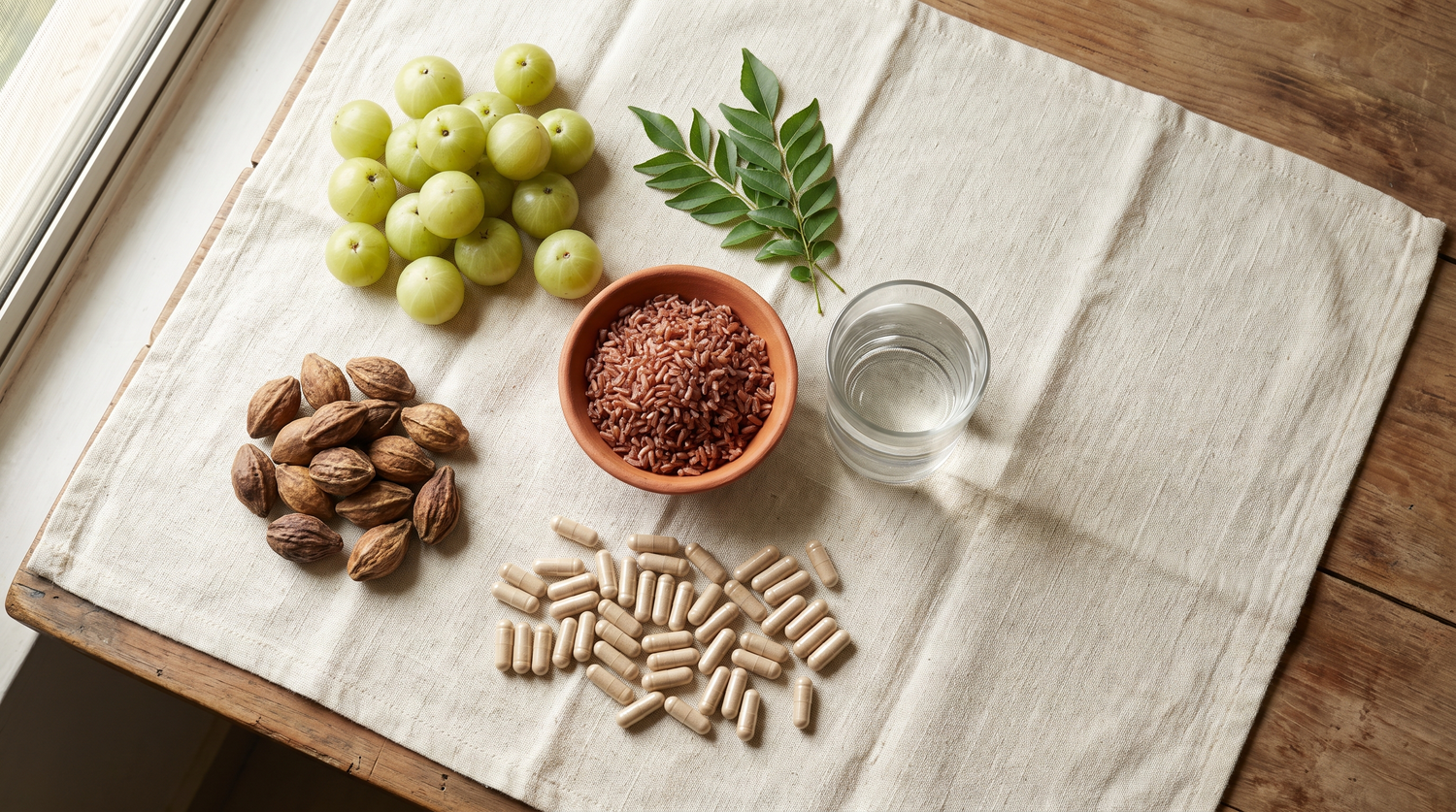
Then, if a herb is going to be part of it, pick one and give it a fixed window. Ancient Nutra's Triphala is the usual starting point: a traditional blend of three fruits, Terminalia chebula, Terminalia bellirica, and Phyllanthus emblica, taken in the evening. The best documented human use is modest and worth quoting accurately: an open label study of 20 healthy volunteers taking 2,500 mg daily for four consecutive weeks, published in the Journal of Integrative Medicine in 2020, reported no serious adverse events. Four weeks is what has been observed. That makes four to six weeks a sensible review point, after which the honest question is whether anything changed, not whether to keep going by default.
For a broader routine, the Liver & Detox System groups Triphala with two Sri Lankan plants that grow within a few hours of the Ancient Nutra kitchen: Heenbovitiya (Osbeckia octandra), a wet zone shrub used traditionally as a liver tonic, and Yaki Narang (Atalantia ceylanica), a spiny wild citrus from the island's intermediate forest. Both are traditional and preclinical rather than clinically proven. There are no human trials behind either of them, and any article that tells you otherwise is importing another plant's research.
Which is the actual difference between the two categories, once the packaging is stripped away. A cleanse asks you to believe something is being removed. A maintenance routine asks you to keep doing an unremarkable thing long enough to notice.
Look for
Read the directions before the claims. If a product tells you to take it for three to seven days, it is a cleanse regardless of what the front of the pack says. If it tells you to take it daily with food and gives you a point to stop and reassess, it is maintenance. The Liver & Detox System is the second kind: one capsule of each with food, reviewed at the end of a set window rather than run open ended. Also check the ingredient list for senna, cascara, or any anthraquinone laxative, and treat those as short term tools rather than daily habits.
How long before a daily gut routine shows anything?
Longer than a cleanse promises, and sooner than most people expect from something this quiet. Digestion and timing changes tend to register within one to two weeks. A herb taken consistently is better judged at the four to six week mark, in line with the trial length above rather than an arbitrary house number.
The trap is judging a maintenance herb at crisis speed, which is exactly what a cleanse trains people to do. If a herb has not produced a visible event by Thursday, it gets abandoned on Friday, and the next cleanse goes in the basket. For a comparison of which Sri Lankan herbs suit which situation, including the genuinely fast acting ones for an acute bad evening, the ranked guide to five Sri Lankan gut herbs separates the rescue options from the maintenance ones.
The bottom line
A cleanse sells removal and delivers a short, sometimes uncomfortable event with no trial evidence behind the toxin claim. A reset sells nothing dramatic and asks for six weeks. Ancient Nutra builds the second kind: daily capsules taken with food, with a point at which you stop and ask whether it worked. That is a harder thing to put on a label, and it is the only version worth buying twice.
What is the difference between a gut reset and a gut cleanse?
A gut reset is a daily maintenance habit taken with food over several weeks, with no promise of an immediate visible effect. A gut cleanse is a short protocol, usually three to seven days, that promises to flush or remove something and typically works by restricting food or accelerating bowel movements.
Do detox and cleanse products remove toxins?
A 2015 critical review in the Journal of Human Nutrition and Dietetics found very little clinical evidence for detox diets and no randomised controlled trials assessing whether commercial detox diets eliminate toxins in humans. The liver and kidneys carry out this work continuously as normal physiology.
Are detox teas safe to drink every day?
Most rely on senna, which NIH LiverTox rates a likelihood score of D, a possible rare cause of clinically apparent liver injury, with most cases following excessive or prolonged use. Daily indefinite use is not the pattern the safety data supports. Stop and speak to a doctor if unusual fatigue, nausea, loss of appetite, dark urine, or yellowing of the skin or eyes appears.
How long should a daily gut routine run before judging it?
Timing and diet changes usually register within one to two weeks. For Triphala, the best documented human use is a four week open label study in 20 healthy volunteers, which makes four to six weeks a reasonable point to stop and reassess rather than continuing open ended.

Liver & Detox System
Triphala, Heenbovitiya, and Yaki Narang as a daily routine taken with food, not a three day flush.
Shop Liver & Detox SystemSources and further reading
- Klein AV, Kiat H. Detox diets for toxin elimination and weight management: a critical review of the evidence. Journal of Human Nutrition and Dietetics, 2015;28(6):675-686. PubMed.
- Senna. LiverTox: Clinical and Research Information on Drug-Induced Liver Injury, National Institute of Diabetes and Digestive and Kidney Diseases. NCBI Bookshelf.
- Acosta RD, Cash BD. Clinical effects of colonic cleansing for general health promotion: a systematic review. American Journal of Gastroenterology, 2009;104(11):2830-2836. Summary, American Family Physician.
- Mishori R, Otubu A, Alleyne Jones A. The dangers of colon cleansing. Journal of Family Practice, 2011;60(8):454-457. PubMed.
- Phetkate P, Rattanaphan S, Sirikulkajorn A, et al. Study of the safety of oral Triphala aqueous extract on healthy volunteers. Journal of Integrative Medicine, 2020;18(1):35-40. PubMed.
- Liver Diseases. MedlinePlus, United States National Library of Medicine. MedlinePlus.
Written by the Ancient Nutra Wellness Team. The team researches, sources, and tests every ingredient before it earns a place in an Ancient Nutra blend. Questions? Email info@ancientnutra.com or message Ancient Nutra on Instagram.
Medical disclaimer: This article is for educational purposes only and is not medical advice. Statements have not been evaluated by the FDA. Ancient Nutra products are not intended to diagnose, treat, cure, or prevent any disease. Speak with a qualified healthcare provider before starting any new supplement, especially if you take prescription medication or have a medical condition.