Ancient Nutra Wellness Team · 3 July 2026 · 6 min read
5 myths about coconut sugar (and why we still use it)
Key takeaways
- Coconut sugar is still sugar. It is roughly 70 to 80% sucrose with about the same calories as table sugar, so it is a cleaner swap, not a free pass.
- Its one real edge is a lower glycemic index (best measured near 54, versus about 60 for table sugar), helped by a trace of inulin fibre. It still raises blood sugar.
- The iron, zinc and potassium it carries are a bonus of minimal processing, not a reason to eat more of it.
- Use it as a one-to-one swap in tea, baking and curries, and lean on the real blood-sugar levers: less total sugar, more fibre, and herbs like cinnamon.
Coconut sugar picked up a health halo it never really asked for. Somewhere along the way it went from a humble Sri Lankan pantry staple to a "guilt-free" superfood, and that is where the trouble starts. It is not a health food, and it is not a marketing scam either. The truth sits quietly in the middle. Here are five of the most common myths about coconut sugar, what is actually true about each one, and why the team at Ancient Nutra still keeps it on the shelf.
Myth 1. Coconut sugar is a health food you can use freely
This is the big one. Because it is natural and unrefined, people treat coconut sugar like it comes with no cost, and pour it on twice as thick.
Here is the problem. Coconut sugar is roughly 70 to 80% sucrose, the same sugar that is in the white stuff, and it lands at about 4 calories per gram. Your body does not give it a special pass because it came from a coconut palm. Sugar is sugar once it is in your bloodstream.
The fix is simple: treat it exactly like sugar. The win is swapping like for like and using a little less over time, not reaching for more because the label sounds wholesome. Coconut sugar earns its place as a cleaner, less-processed version of a treat, not as a treat you can now have without thinking.
Myth 2. Coconut sugar and palm sugar are the same thing
Walk down any sweetener aisle and the labels blur together: palm sugar, jaggery, coconut sugar, all stacked side by side as if they are interchangeable.
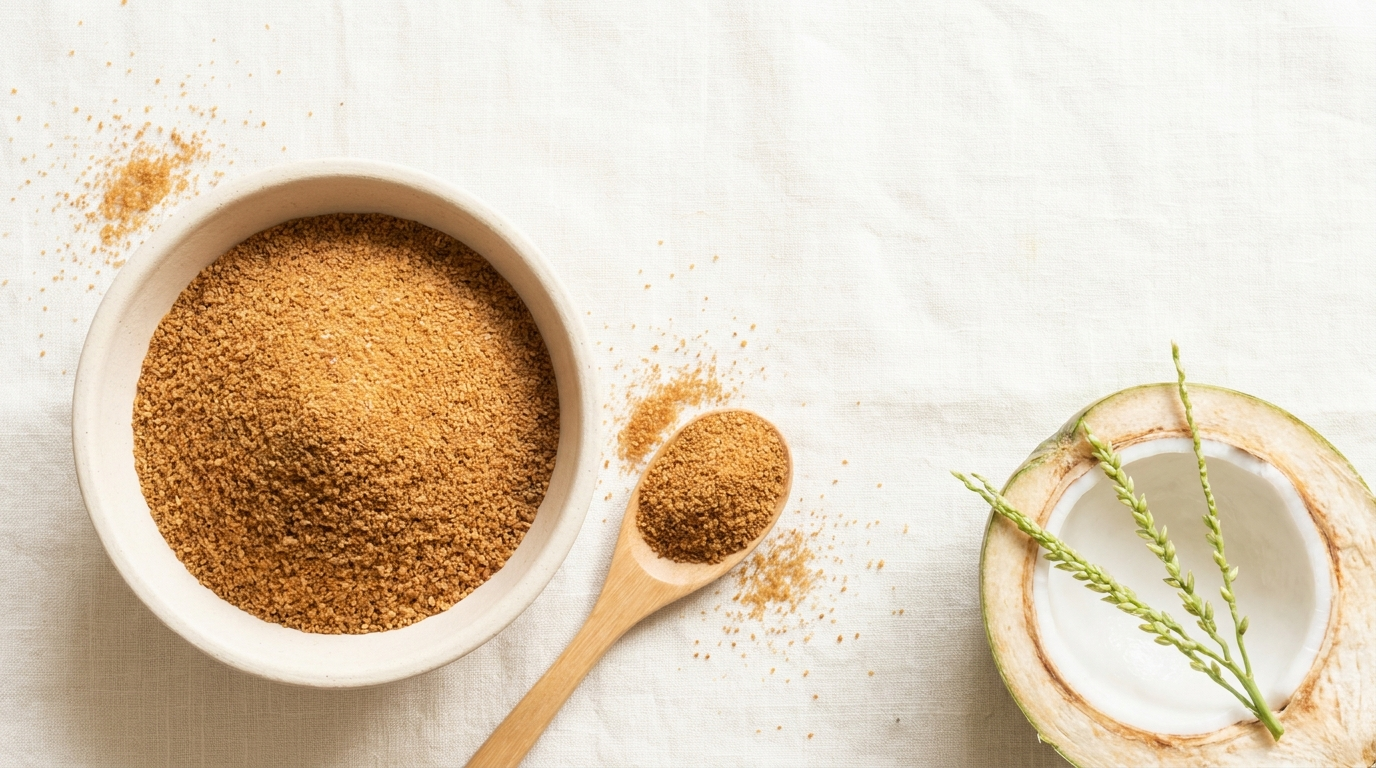
They are related, but not identical. "Palm sugar" is a catch-all that often comes from other palms, like palmyra, date or sago, and jaggery is usually cane or palm sap set into blocks. Coconut sugar specifically comes from the nectar of the coconut palm's flower buds, tapped, then gently boiled down until it crystallises. The source plant, the flavour, and the mineral profile are not the same.
The fix: read the label and look for the word "coconut," not just "palm." If it does not say coconut, it is probably something else.
Look for
Single-origin coconut blossom sap, minimally processed, with nothing added. Ancient Nutra's Coconut Sugar is pure evaporated coconut palm nectar, so what you scoop is the whole thing and nothing else.
Myth 3. Coconut sugar will not spike your blood sugar
This myth is the one worth taking seriously, because people with blood-sugar concerns lean on it. The claim is that coconut sugar is "low GI," so it barely moves the needle.
It does move the needle. Coconut sugar raises blood glucose like any sugar does. What is true is that its glycemic index is lower than white sugar. The most rigorously tested figure puts it around 54, against about 60 for table sugar, helped by a small amount of inulin, a fibre that slows how fast the sugar is absorbed. You will sometimes see a figure as low as 35, but that number comes from a single, weaker study and is not well supported. Lower is not zero. If you are managing diabetes, coconut sugar is a better choice than white sugar, not a food you can treat as free.
The fix: use it sparingly, pair anything sweet with fibre or protein to blunt the rise, and lean on the real tools for steady blood sugar. A pinch of Ancient Nutra's Ceylon Cinnamon in your tea is a good habit, and for a fuller routine the Ancient Nutra Sugar Balance System is built around daily blood-sugar support. The sweetener you pick matters far less than your total sugar for the day.
Myth 4. It is packed with nutrients
You will see coconut sugar sold as a mineral-rich superfood, full of iron, zinc, potassium and antioxidants. Half of that is true.
Because it is barely processed, coconut sugar does hold onto more minerals and plant compounds than refined white sugar, which has essentially none. The catch is the serving size. The amount of iron or potassium in a teaspoon is tiny, and the Cleveland Clinic puts it plainly: you would have to eat so much coconut sugar to get any real benefit from those minerals that the sugar would undo any good long before you got there.
The fix: enjoy the trace nutrients as a small bonus of choosing the less-processed option, and get your actual minerals from food. Nobody should eat more sugar for the iron.
Myth 5. It is just brown sugar with better marketing
The cynical take, and a fair one to check. If coconut sugar is basically brown sugar in nicer packaging, why bother?
Because they are made differently. Brown sugar is refined white sugar with a little molasses stirred back in for colour and flavour. Coconut sugar is coconut-blossom sap simply evaporated down, never stripped and rebuilt, and it carries a genuinely lower glycemic index and a deeper caramel taste. The difference is real, even if it is modest. It is a small, honest upgrade rather than a miracle.
That, in the end, is why the team at Ancient Nutra still uses it. It is a minimally processed, traditional Sri Lankan sweetener that swaps one-to-one for refined sugar and gives you a little more in return. Not a health food. A better everyday default.
How to use coconut sugar the smart way in a week
You do not need a plan to change a sweetener, but a week of small moves makes the swap stick.
- Days 1 to 2: swap white sugar one-to-one for coconut sugar in tea and coffee, and quietly cut the amount by a quarter.
- Days 3 to 4: use it in one baking recipe in place of refined sugar, and pair sweet snacks with nuts or yoghurt.
- Day 5: stir a pinch of Ceylon cinnamon into anything sweetened.
- Days 6 to 7: notice the real win. You have lowered your total sugar, not just changed the type.
By the end of the week most people find the same sweetness costs them less sugar, with steadier energy between meals.
The bottom line
Two myths do the most damage. The first is that coconut sugar is a health food you can use freely, when it is really sugar with a slightly cleaner backstory. The second is that it will not touch your blood sugar, when it lands lower on the glycemic scale but still raises it. Hold both of those honestly and coconut sugar becomes what it should be: a simple, minimally processed swap for refined sugar that tastes better and behaves a little kinder. That is why it stays in the Ancient Nutra pantry, and why it is worth a place in yours.

Coconut Sugar
A low-glycemic, minimally processed sweetener made from pure coconut palm nectar. A clean one-to-one swap for refined sugar.
Shop Coconut SugarSources and further reading
- Czerwony B., "Is Coconut Sugar Good for You?", Cleveland Clinic Health Essentials (2023).
- Saraiva A, et al., "Coconut Sugar: Chemical Analysis and Nutritional Profile," Int. J. Environ. Res. Public Health, 2023.
- Coconut sugar composition and glycemic index (citing the University of Sydney GI database), overview and references.
Written by the Ancient Nutra Wellness Team. The team researches, sources, and tests every ingredient before it earns a place in an Ancient Nutra blend. Questions? Email info@ancientnutra.com or message Ancient Nutra on Instagram.
Medical disclaimer: This article is for educational purposes only and is not medical advice. Statements have not been evaluated by the FDA. Ancient Nutra products are not intended to diagnose, treat, cure, or prevent any disease. Speak with a qualified healthcare provider before starting any new supplement, especially if you take prescription medication or have a medical condition.