Ancient Nutra Wellness Team · 31 July 2026 · 6 min read
Coconut sugar, kithul treacle, or jaggery: which to use when
- Kithul treacle has tested at a glycemic index of 35 in Sri Lankan medical research. Published values for coconut sugar run from 35 to 54. Refined white sugar sits at 65.
- The word jaggery means two different things. In Sri Lanka it usually means kithul jaggery. In India it usually means cane jaggery, which has tested higher than white sugar, not lower.
- The mineral argument does not hold at real serving sizes, and the World Health Organization counts syrups as free sugars. All four draw from the same 25 gram daily budget.
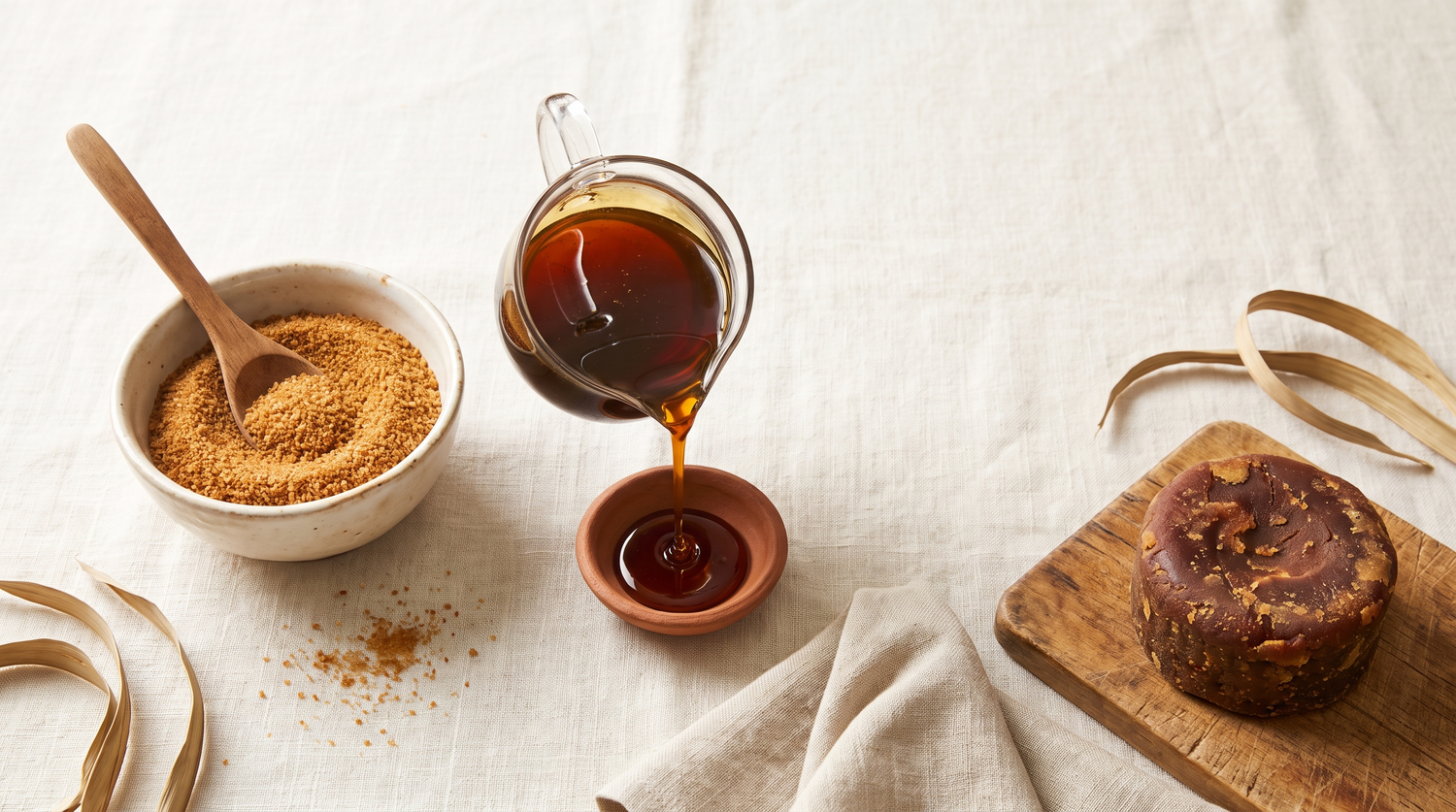
Walk into most Sri Lankan kitchens and you will find at least two sweeteners that are not white sugar. A jar of coconut sugar for the tea. A bottle of kithul treacle for the curd. Maybe a block of jaggery wrapped in paper at the back of a cupboard. All three get called the healthier choice, and two of them genuinely do test better than refined sugar. What almost nobody explains is which one to reach for, and the point at which the health argument quietly stops being true.
Know what each one actually is
All three start as plant sap or juice, and the difference is what plant and how far it gets boiled.
Coconut sugar comes from the sap of coconut palm flower buds. The sap is tapped, boiled down, and left to crystallise into a granulated brown sugar with a light caramel note. By composition it is roughly 80 percent sucrose, which is worth holding on to for later.
Kithul treacle comes from the kithul palm, the fishtail palm that grows through the wet zone. Tappers climb the same tree twice a day and the sap is boiled the same day it is collected, because it starts fermenting within hours. Stop boiling early and you have treacle. Keep going and it sets into kithul jaggery.
Jaggery is the vaguest word of the three. It just means unrefined block sugar, and it can be made from kithul sap or from sugarcane juice.
Sort out which jaggery you are talking about
This is where most online nutrition advice falls apart for a Sri Lankan reader. Ask about jaggery here and you will get kithul jaggery. Search the same word online and almost everything you read is about Indian cane jaggery.
They are different plants and they test in opposite directions. Sri Lankan work puts kithul low on the glycemic index. Indian testing has put cane jaggery above white sugar rather than below it. So a health claim about one is not a health claim about the other. If a pack just says jaggery, check what it was made from before you assume anything.
Compare the glycemic numbers honestly
Kithul treacle is the one with the strongest local evidence. Researchers at the University of Sri Jayewardenepura measured it at a glycemic index of 35, which is firmly in the low category (Ceylon Medical Journal, 2022).
Coconut sugar is less settled. Published values range from 35 to 54. The widely quoted 35 traces back to a single Philippine study, and independent testing has landed nearer the top of that range. Either way it is below refined sugar, which the international glycemic index tables put at 65 (Diabetes Care, 2008).
The same Sri Lankan team did something more useful than testing syrup on its own. They made aluwa two ways. With treacle it came out at 55. With table sugar, 63. Real, but smaller than the gap between the raw sweeteners. Once a sweetener is inside a food, most of the advantage gets diluted by everything else in the recipe.
Keep one limitation in mind. Glycemic index is measured by feeding someone 50 grams of carbohydrate from that one food. Nobody eats 50 grams of treacle in a sitting. The number tells you the direction, not the size of the effect on your actual breakfast.
The mineral story does not survive the arithmetic
Every unrefined sweetener gets sold on minerals, and the numbers do look convincing at first. Coconut sugar carries around 1,000 mg of potassium per 100 g. That reads as a lot.
Then you scale it to how people actually use it. A teaspoon is about 4 grams, so that teaspoon delivers roughly 40 mg of potassium, close to 1 percent of the daily intake the World Health Organization suggests for adults. To reach the full target from coconut sugar you would need something in the region of 350 grams of it a day, which is around 88 teaspoons. The mineral is real. The dose is not.
Kithul is blunter still. Plenty of trade pages describe the treacle as rich in iron and potassium, but the Sri Lankan researchers who actually measured it recorded the total mineral content as negligible. Buy these for flavour and a modestly gentler glycemic response. Do not buy them as a mineral supplement.
Look for
Single ingredient coconut sap sugar with nothing blended in. Cheaper versions are often cut with cane sugar, which quietly removes the only advantage you were paying for. Ancient Nutra's Coconut Sugar is straight coconut sap sugar, nothing else in the pack.
Match the sweetener to the job
Once the health gap between them turns out to be modest, the practical question is the interesting one. They behave completely differently in a kitchen.
Coconut sugar for anything that needs dry sugar
It swaps one for one with white sugar and dissolves the same way, so it is the easy one. Tea and coffee, baking, and any curry or sambol that wants a spoon of sugar to round off the heat. The caramel note works with warm spice, which is why it sits well alongside Ancient Nutra's Ceylon Cinnamon in the same cup.
Kithul treacle for drizzling, not for baking
It is a syrup, so it carries water and will not substitute one for one in a cake. Use it where it stays on the surface: over buffalo curd, on hoppers and pancakes, stirred through plain porridge or yoghurt at the end.
Jaggery when the flavour is the point
Grate it first, or it will sit in a lump and never disperse. It belongs in traditional sweets and in anything that benefits from that deeper, slightly smoky finish. Just remember to check whether the block is kithul or cane, because the two are not interchangeable nutritionally.
Keep the daily total under control
Here is the part that matters more than the choice itself. The World Health Organization defines free sugars to include the sugars naturally present in syrups, and recommends keeping them under 10 percent of daily energy, ideally under 5 percent, which works out at roughly 25 grams or six teaspoons a day for an adult (WHO, 2015).
Coconut sugar, kithul treacle, kithul jaggery and white sugar all draw from that same budget. Two teaspoons in your morning tea, two more in the afternoon, and a drizzle of treacle over curd, and the day is spent.
Which is the honest summary of the whole swap. Moving from white sugar to kithul treacle is a real but small upgrade. It is not a licence to use more of it, and it is not the same thing as using less. That point gets covered in more detail in the piece on the five myths about coconut sugar.
The bottom line
Reach for kithul treacle when you are drizzling and want the lowest tested index. Reach for coconut sugar when you need a dry, one for one sugar swap in tea or baking. Reach for jaggery when the flavour is the reason. Then keep the total honest, because that is the lever that actually moves anything.
And if blood sugar is the real reason you started reading about sweeteners, the sweetener is the smallest lever you have. Sleep, meals, and movement come first, every time. Ancient Nutra's Sugar Balance System was built to support the rest of that picture once the foundation is in place.

Coconut Sugar 250g
Single ingredient coconut sap sugar that swaps one for one for white sugar in tea, baking, and curries.
Shop Coconut SugarSources and further reading
- Weeraratne P, Ekanayake S. Kithul (Caryota urens) treacle: a healthy natural sweetener? Ceylon Medical Journal, 2022.
- Atkinson FS, Foster-Powell K, Brand-Miller JC. International tables of glycemic index and glycemic load values. Diabetes Care, 2008.
- WHO calls on countries to reduce sugars intake among adults and children. World Health Organization, 2015.
- Saraiva A, et al. Coconut sugar: chemical analysis and nutritional profile. International Journal of Environmental Research and Public Health, 2023.
- Guideline: potassium intake for adults and children. World Health Organization, 2012.
Written by the Ancient Nutra Wellness Team. The team researches, sources, and tests every ingredient before it earns a place in an Ancient Nutra blend. Questions? Email info@ancientnutra.com or message Ancient Nutra on Instagram.
Medical disclaimer: This article is for educational purposes only and is not medical advice. Statements have not been evaluated by the FDA. Ancient Nutra products are not intended to diagnose, treat, cure, or prevent any disease. Speak with a qualified healthcare provider before starting any new supplement, especially if you take prescription medication or have a medical condition.