Ancient Nutra Wellness Team · 12 October 2026 · 5 min read
Raw, organic, whole: what these words mean on a seed or spice label
By the Ancient Nutra Editorial Team
- "Organic" is a regulated claim with set tiers. "Natural" has no formal FDA definition. "Raw" is not one of the organic tiers, so it tells you only what the maker chooses to say.
- "Whole" is plain-language shape: the seed or spice is intact, not ground. It says nothing about how the crop was grown or handled.
- The ingredient list is the most reliable line on the pack. It must run in descending order by weight, and a single-ingredient pack should name just one thing.
Walk down a spice aisle and the same handful of words keeps turning up: raw, organic, whole, natural, pure. They look like the same kind of promise. They are not. Some are tied to a certification and a legal rule, and some are simply a description the maker has chosen. Knowing which is which takes about two minutes and changes how you read every pack from here on.
Start with the claim that has rules: organic
In the United States, the USDA organic label comes in tiers. According to the USDA's labeling guide, "100 percent organic" means every ingredient is organic (salt and water excluded), and the guide notes that most raw, unprocessed or minimally processed farm crops can carry it. "Organic" means at least 95 percent organic ingredients. Below that sit "made with organic" claims for partly organic products.
For a single-ingredient seed, the practical reading is simple: the claim is about how the crop was produced and certified, not about taste, freshness or nutrition. It is a farming-method statement. Check the pack for the certifier's mark rather than trusting the word alone.
Treat "natural" and "raw" as descriptions, not guarantees
The FDA states that it has not engaged in rulemaking to set a formal definition for "natural". Its long-standing policy is that the word means nothing artificial or synthetic has been added that would not normally be in the food. That is a statement about additives, not about farming or processing.
"Raw" sits in a similar place for a seed or spice. It does not appear among the organic tiers above, and a label cannot show you the seed's temperature history on its own. If raw matters to you, the honest route is to ask the maker whether the seeds were heated, roasted or steamed before packing, and to expect a direct answer.
Look for
A certifier's mark next to any organic claim, a short ingredient list, and a maker who will tell you plainly how the product was handled. A pack that leans on several vague words and says nothing specific is worth a second look.
Read "whole" as shape, not as a quality grade
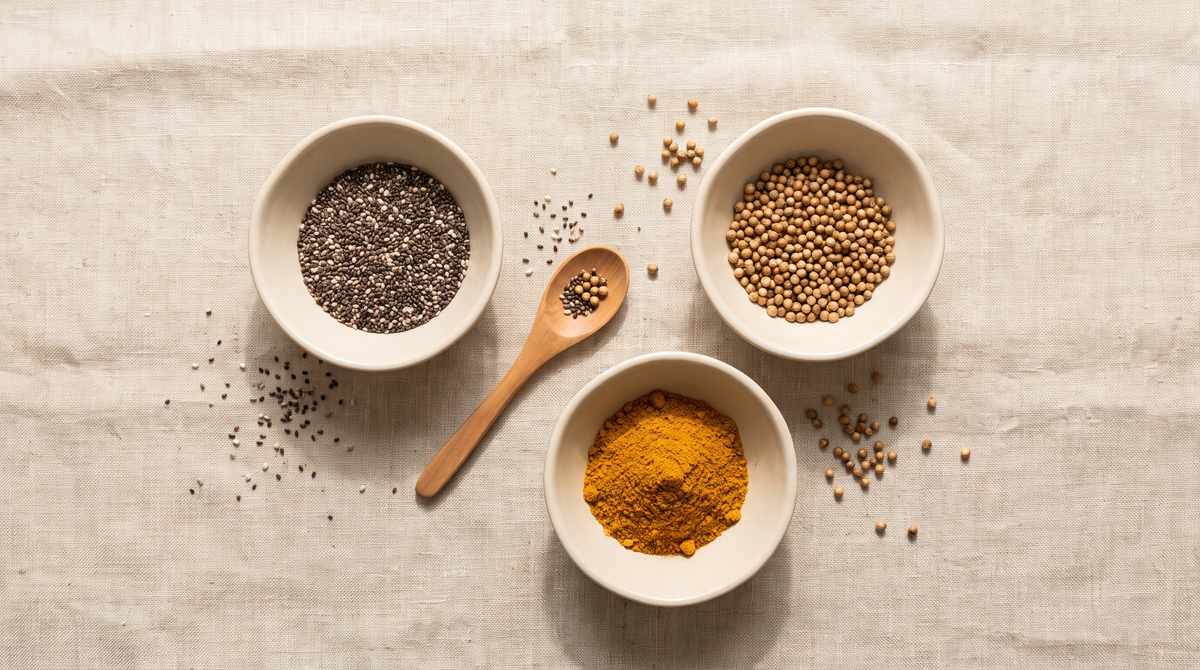
A whole seed is intact. A ground one has been milled. Whole spices keep their shape until you crush them yourself, which is why many cooks buy coriander or cumin whole. Ground products are convenient, and they are not a lesser product, but the word "whole" tells you only about form. It makes no promise about origin, growing method or how the crop was handled afterwards.
Trust the ingredient list over the front of the pack
Under the FDA's rule in 21 CFR 101.4, ingredients must be listed in descending order of predominance by weight. That gives you a quick test. A pure seed or spice should list one ingredient and nothing else. If a pack that claims to be pure carries a second or third line, you have learned something the front label did not say.
The same habit is covered in the team's guide to checking supplements before you buy online, and in how the team grades a health claim: separate what is verifiable from what is only worded to sound reassuring.
A worked example with chia seeds
Take a pack of chia. The seeds are small, so "whole" is simply what they are. The ingredient list should say chia seeds and nothing more. Whether a pack says organic is a question about certification, so look for the mark. The product page for Ancient Nutra's Chia Seeds describes a seed made in Sri Lanka under BRCGS, FSSC 22000 and ISO 22000 and does not make an organic claim, so this article does not make one for it either.
Safety: soak chia before you eat it
Chia absorbs a lot of liquid and swells. Soak it in a liquid, in a pudding or a drink, before eating rather than swallowing dry seeds with a sip of water. Anyone who has trouble swallowing, or a known narrowing of the oesophagus, should avoid dry chia and speak to a doctor first.
The bottom line
Organic is a certified production claim. Natural is a loosely policed description. Raw is a description you can ask the maker to back up. Whole is a shape. Read the ingredient list first, look for a certifier's mark where an organic claim is made, and soak chia before you eat it.

Chia Seeds 100g
Whole chia seeds, a neutral-tasting source of fibre and omega-3 fats for puddings, smoothies and baking.
Shop Chia SeedsSources and further reading
- Labeling Organic Products, USDA Agricultural Marketing Service.
- Use of the Term "Natural" on Food Labeling, U.S. Food and Drug Administration.
- 21 CFR 101.4, Food labeling: ingredient list, Legal Information Institute, Cornell Law School.
Written by the Ancient Nutra Wellness Team. The team researches, sources, and tests every ingredient before it earns a place in an Ancient Nutra blend. Questions? Email info@ancientnutra.com or message Ancient Nutra on Instagram.
Medical disclaimer: This article is for educational purposes only and is not medical advice. Statements have not been evaluated by the FDA. Ancient Nutra products are not intended to diagnose, treat, cure, or prevent any disease. Speak with a qualified healthcare provider before starting any new supplement, especially if you take prescription medication or have a medical condition.