- Welpenela (Cardiospermum halicacabum) is a single Sri Lankan vine traditionally used for inflamed skin, stiff joints, and a flaky scalp, because low-grade inflammation is the common thread across all three.
- Lab work shows the extract calms the same inflammatory signals (COX-2, TNF-alpha, iNOS) that everyday anti-inflammatories target, with the strongest modern evidence on skin.
- A common capsule dose is 400 to 500mg once or twice daily with food. It is a slow, steady herb, so allow at least 90 days and track one or two specific signs.
Most skin and joint complaints get treated from the outside in: a cream for the rash, a gel for the knee, a tablet for the ache. Welpenela works the other way. It is a single Sri Lankan vine that traditional households have leaned on for inflamed skin, sore joints, and a flaky scalp all at once, because the thread running through all three is the same: low-grade inflammation.
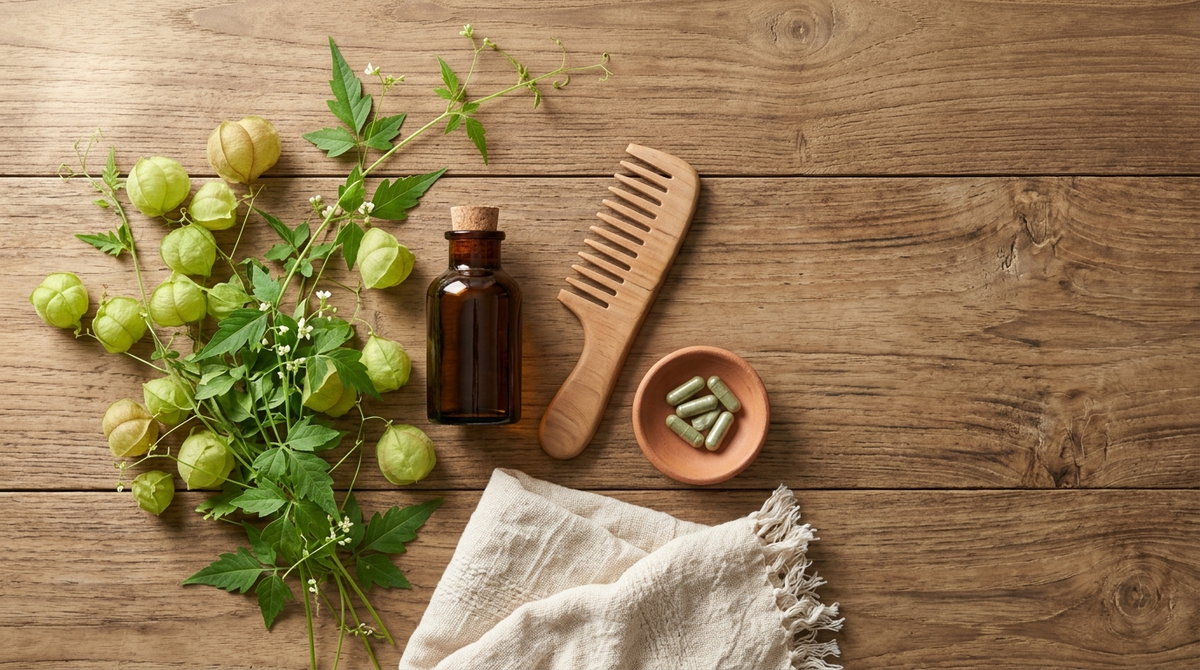
Welpenela (also called balloon vine or Love in a Puff, Cardiospermum halicacabum) is a fast-climbing vine with small white flowers and papery seed pods that grows wild across Sri Lanka, India, and most of the tropics. The leaves and aerial parts are the medicinal portion. In Sri Lankan and Ayurvedic practice it has been used for generations for rheumatism, stiff joints, and itchy, inflamed skin.
What Welpenela actually does
Welpenela's value comes down to one thing it does well: it calms inflammation, the body's overreaction that shows up as redness, swelling, heat, and itch.
In the lab, ethanol extracts of the plant switch off the same inflammatory signals that drive most flare-ups. They lower COX-2, TNF-alpha, and iNOS, the molecular switches the body uses to turn inflammation on (PubMed, 2009). That is the same family of targets everyday anti-inflammatories aim at, reached through plant compounds instead.
On skin specifically, the evidence is unusually good for a traditional herb. A 2020 review in Dermatologic Therapy looked at Cardiospermum creams in eczema and dermatitis and described a cortisone-like calming effect, driven by phytosterols that steady irritated skin-cell membranes, with almost none of the side effects that come with steroid creams (Dermatologic Therapy, 2020).
For joints, the active flavonoids (luteolin and apigenin among them) are the same anti-inflammatory compounds found in other respected joint herbs, and rat studies have shown the leaf extract slows the swelling of chronic, arthritis-style joint inflammation (Journal of Ethnopharmacology, 2012). If targeted joint support is the goal, Welpenela pairs naturally with Ancient Nutra's Turmeric Extract, which works the same pathway from a different angle.
Who should consider Welpenela
Welpenela is a quiet, broad-spectrum anti-inflammatory rather than a fix for one narrow problem. It tends to suit:
- People with recurring skin flare-ups. Eczema, contact dermatitis, heat rashes, and the itchy patches that come with humid weather. This is where the modern evidence is strongest.
- People with stiff, achy joints. The morning stiffness and minor joint swelling that come with age, desk work, or a hard week of training.
- People dealing with an irritated, flaky scalp. Welpenela's traditional reputation for hair is really a scalp story: calmer skin under the hair tends to mean less itch and flaking.
- People who run inflamed in general. If the body seems to answer everything with redness and swelling, a gentle daily anti-inflammatory can take the edge off.
Who does not need it: if your skin is clear, your joints feel fine, and you are not chasing a specific inflammatory issue, Welpenela is not a daily essential. It earns its place when there is something to calm, not as a just-in-case capsule. Foundations first. Sleep, hydration, and an anti-inflammatory diet move the needle more than any single herb.
How to actually take Welpenela
As a daily supplement, Welpenela is usually taken as a standardised leaf-and-aerial-part extract in capsule form. A common range is 400 to 500mg, once or twice daily, with food to keep it gentle on the stomach.
For an active skin or joint flare, the upper end of that range (twice daily) for two to four weeks is the usual approach, then a step down to once daily for maintenance. It is gentle enough for daily use in healthy adults, and the safety record in the research is reassuringly clean.
A note on form: the strongest skin evidence comes from topical creams, while capsules work from the inside on whole-body inflammation. Many people who use it for skin do both, a capsule daily plus a Cardiospermum cream on the patch itself. For joints and general inflammation, the capsule on its own is the simpler route. In the first few weeks, expect subtle changes (less itch, easier mornings) rather than anything dramatic.
Look for
A standardised Welpenela (Cardiospermum halicacabum) leaf extract, 400 to 500mg per capsule, with the species named on the label and an honest milligram dose, not hidden inside a proprietary blend.
Ancient Nutra's Welpenela uses the aerial parts of the plant in a single-herb capsule, so the dose stays clear.
Where Welpenela comes from
Welpenela, "wel" for the vine and the puffy seed pod that earns it the English name Love in a Puff, grows along fences and field edges all over rural Sri Lanka. Most village gardens already have it, usually as a weed before anyone calls it medicine.
In Sri Lankan and Ayurvedic practice the plant has long been a remedy for rheumatism and swollen joints, often as a warm poultice of crushed leaves pressed onto the sore spot, and as a wash or paste for itchy skin. The leaves also turn up in traditional cooking as a mallung, the finely chopped green dish, which is how many households took a small daily dose without ever thinking of it as treatment. Modern lab work has since put names to the compounds the tradition was already using.
What to stack Welpenela with
Welpenela works well alongside herbs that reach inflammation from a different direction, depending on what you are targeting.
For skin, it pairs naturally with Iramusu (also called Sarsaparilla). Where Welpenela calms the inflammation behind a flare, Iramusu works as a gentle blood purifier and cooling herb that Sri Lankan families have long reached for during heat rashes and breakouts. Ancient Nutra's Iramusu is the usual partner for the skin-and-heat side of things.
For joints, the stack is Welpenela plus turmeric. Curcumin is one of the most studied natural anti-inflammatories there is, and it covers a slightly different set of inflammatory signals, so the two together reach more of the pathway than either one alone.
A caveat worth stating plainly: a stack is for a specific job. If you are only dealing with one issue, one herb is usually enough. Adding more herbs is not the same as adding more benefit.
How long Welpenela takes to work
Welpenela is a slow, steady herb, not an overnight fix. For skin, people often notice less itch and redness within two to three weeks of daily use, with the deeper calming building over a couple of months. For joints, the easing of stiffness tends to show up around the four-to-six-week mark, since chronic joint inflammation took a long time to build and unwinds gradually.
The honest guidance is the same as with any herb: give it at least 90 days before deciding whether it is doing anything for you. Track one or two specific things (how often the rash flares, how stiff the first hour of the morning feels) rather than a vague sense of better or worse.
A note from the tradition
In many up-country Sri Lankan villages, the first response to a swollen knee was not a pharmacy. It was a handful of welpenela leaves, crushed, warmed, and bound to the joint overnight. The plant earned its place on the garden fence long before anyone could name a single flavonoid.
The bottom line
Welpenela is one of those quietly useful herbs that does not fit a single headline. It calms the inflammation sitting underneath inflamed skin, stiff joints, and an irritated scalp, which is why Sri Lankan households kept it close for all three at once. For a clean, single-herb capsule with the dose on the label, Ancient Nutra's Welpenela is built for exactly that. Or use the leaves the old way. The science does not care which form it comes in.

Turmeric Extract
A concentrated curcumin extract traditionally used to support a calm, comfortable inflammatory response in skin and joints.
Shop Turmeric ExtractSources
- Fai D et al., Dermatologic Therapy, 2020: Clinical evidence for Cardiospermum halicacabum (Welpenela) in atopic dermatitis, including its cortisone-like, phytosterol-driven anti-inflammatory action on skin.
- Journal of Ethnopharmacology / PubMed, 2009: Cardiospermum halicacabum ethanol extract inhibits LPS-induced COX-2, TNF-alpha, and iNOS expression via NF-kappaB regulation.
- Sheeba MS et al., Journal of Ethnopharmacology, 2012: Anti-arthritic activity of Cardiospermum halicacabum leaf in Wistar rats, with the active phenolic compounds (luteolin and apigenin glucuronides, chrysoeriol) identified.
Further reading:
- Ethnomedical, phytochemical, and pharmacological review of the balloon vine (Cardiospermum halicacabum), Journal of Ethnopharmacology, 2022.
- Antioxidant and anti-inflammatory properties of Cardiospermum halicacabum and its reference compounds, ex vivo and in vivo, Journal of Ethnopharmacology, 2011.
Medical disclaimer: This article is for educational purposes only and is not medical advice. Statements have not been evaluated by the FDA. Ancient Nutra products are not intended to diagnose, treat, cure, or prevent any disease. Speak with a qualified healthcare provider before starting any new supplement, especially if you take prescription medication or have a medical condition.