Written by the Ancient Nutra Wellness Team · Published June 4, 2026 · 6 min read
- Venivel is a bright yellow Sri Lankan vine rich in berberine, the same plant compound now studied for clear skin.
- In lab and animal work, berberine slowed the bacteria behind inflammatory acne and lowered the skin's inflammation signals.
- Most people who use it for skin take a standardized capsule daily, with food, and give it a full 8 to 12 weeks.
- It pairs naturally with other Sri Lankan skin herbs like Iramusu and Welpenela, but real skin still starts with sleep, water, and diet.
Most skin advice starts with what you put on your face. Venivel starts somewhere quieter: a yellow forest vine that Sri Lankan families have leaned on for skin and wounds long before anyone could name the compound inside it. Today that compound has a name, berberine, and a growing pile of research behind it. This is the root almost no one outside the island has heard of, and why it keeps showing up in clear-skin conversations.
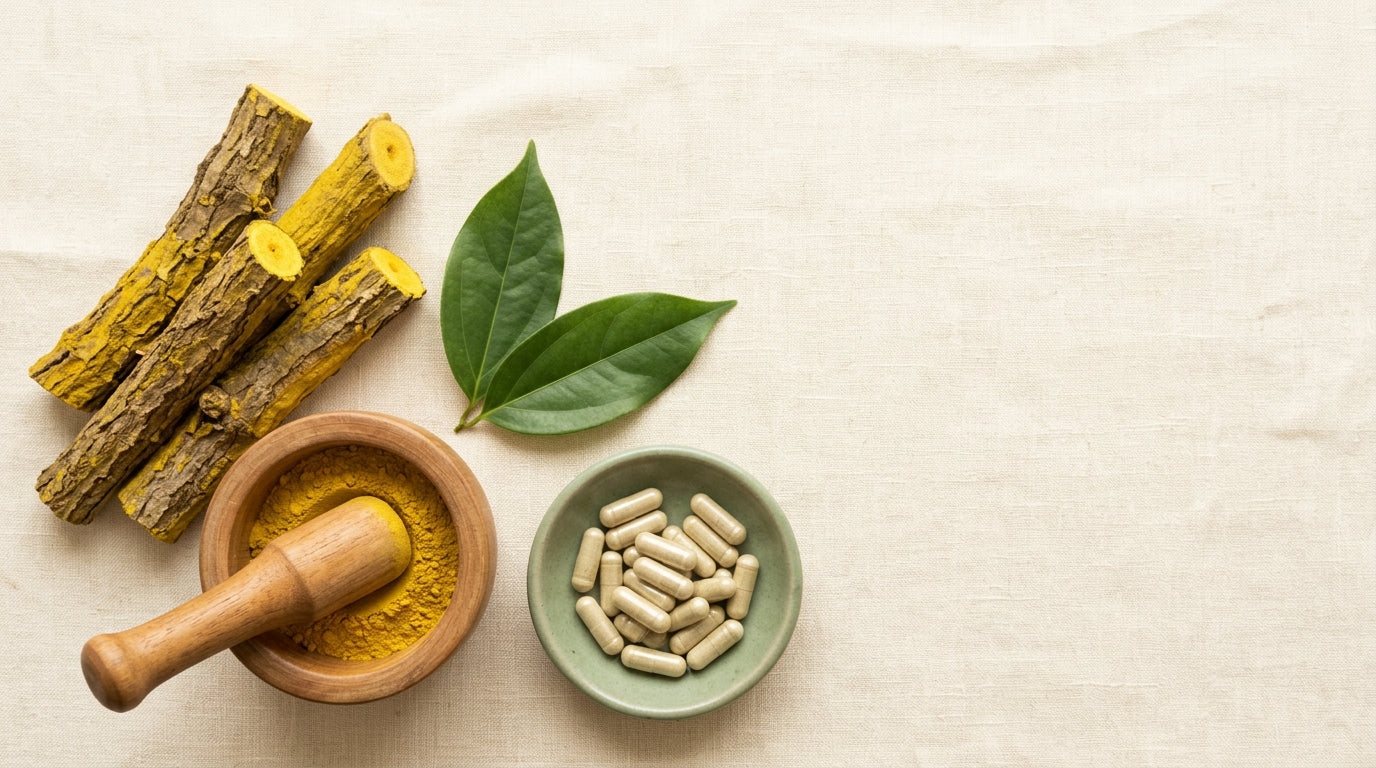
Venivel, also called Weniwel or tree turmeric, is a woody climbing vine from the wet forests of Sri Lanka and the Western Ghats. Snap the stem and it is vivid yellow inside, a sign of the berberine it carries. In traditional Sri Lankan and Ayurvedic medicine, that bitter yellow stem has long been used for skin complaints, slow-healing wounds, and general cleansing.
What Venivel actually does for skin
The short version: most of Venivel's skin reputation traces back to one molecule. Berberine is the deep-yellow alkaloid that gives the cut stem its color, and it is the most studied thing in the plant.
Two things make berberine interesting for skin. First, it is antibacterial. Inflammatory acne is driven in part by a skin bacterium called Cutibacterium acnes, and in a 2023 study berberine slowed the growth of several strains of it at low concentrations. In the same work, treated skin in mice showed less swelling and redness, and lower levels of the inflammation signals IL-6, IL-1 beta, and TNF-alpha (Frontiers in Microbiology, 2023).
That is the second half of the story. Berberine does not only push back on the bacteria, it also seems to calm the inflammation that turns a clogged pore into an angry red one. For skin that flares and stays inflamed, that combination is the part worth paying attention to.
It helps to know what Venivel is not. It is not a spot cream, and it does not bleach, peel, or strip the skin. It works quietly from the inside, which is why it suits people who want to support clearer skin as a daily habit rather than chase an overnight fix. Honest expectations are part of the deal.
Who Venivel is for
Venivel is not a fit for everyone, and that honesty matters. It tends to make the most sense for:
- People with breakout-prone, inflamed skin. The berberine angle is strongest where redness and bacteria are involved, not for dry flaking or sun damage.
- Anyone already eating and sleeping reasonably well who wants a traditional herb to support skin from the inside, rather than a tenth serum.
- People drawn to Sri Lankan and Ayurvedic herbs and the heritage behind them, who want the modern evidence to match.
Who does not need it: anyone whose skin is mostly settled, or whose main issues are dryness, texture, or pigmentation. Those respond more to moisture, sunscreen, and time than to a bitter cleansing root. A clean, simple skin herb cannot out-work a poor diet or chronic short sleep, and Ancient Nutra would rather say that plainly.
How to actually take Venivel
For skin support, most people use a standardized Venivel capsule once a day. Take it with food to soften the bitterness and ease digestion. The bitter taste is the plant being honest about what it is; you do not have to chew it to get the benefit.
Give it room. Skin turns over slowly, so the first month rarely shows much. Think in terms of a full skin cycle or two, not days. Pair it with the unglamorous basics, water, sleep, and steady meals, because those are still doing most of the heavy lifting.
A standardized Venivel (Coscinium fenestratum) capsule, taken once daily with food. The bright color of real Venivel comes from its berberine; that is what you want standardized.
Ancient Nutra's Venivel uses the traditional Sri Lankan stem in a simple 60-capsule format.
Where Venivel comes from
In Sri Lanka, Venivel has never been an exotic import. It grows in the island's wet forests, and the bitter yellow stem has been part of home and Ayurvedic remedies for skin and wounds for generations. The science is now catching up to the kitchen: laboratory testing has confirmed the stem's antibacterial activity comes largely from its berberine content (Fitoterapia, 2005). Tradition opened the door here, and the lab work walked through it.
What to stack Venivel with
Venivel sits in a small family of Sri Lankan skin herbs, and it stacks well with two of them. Ancient Nutra's Iramusu, also called Sarsaparilla, is the classic cooling, blood-purifying root that pairs with Venivel for skin that runs hot and flares in the heat. For the joint and connective-tissue side of skin, Ancient Nutra's Welpenela (Love in a Puff) is the traditional choice.
This stack is for breakout-prone, inflamed skin in a warm climate, not a default everyone needs. If your skin is calm, one herb is plenty.
How long Venivel takes to work
Be patient with skin. Most people notice the calmest changes first: fewer new flare-ups, skin that looks a little less angry, before any dramatic before-and-after. Give it 8 to 12 weeks of daily use before you decide whether it earns a place in your routine.
When the team at Ancient Nutra talks to long-time Venivel users, the most common note is not "my skin transformed." It is quieter than that: the breakouts that used to linger seem to settle a bit faster. That steady, unflashy result is exactly what a traditional cleansing root is supposed to do.
Venivel is one of those Sri Lankan herbs that earns its keep slowly. Ancient Nutra's Venivel keeps the traditional stem simple and standardized, so the berberine that does the work is actually there. Stack it with the basics, or run it on its own. The science does not care which bottle it comes in, only that you give it time.

Sources
- Ma W, et al. The antibacterial activity of berberine against Cutibacterium acnes: its therapeutic potential in inflammatory acne. Frontiers in Microbiology, 2023.
- Nair GM, et al. Antibacterial effects of Coscinium fenestratum. Fitoterapia, 2005.
- Tushar, et al. Coscinium fenestratum: A Review on Phytochemicals and Pharmacological Properties. Springer, 2019.
Medical disclaimer: This article is for educational purposes only and is not medical advice. Statements have not been evaluated by the FDA. Ancient Nutra products are not intended to diagnose, treat, cure, or prevent any disease. Speak with a qualified healthcare provider before starting any new supplement, especially if you take prescription medication or have a medical condition.
Written by the Ancient Nutra Wellness Team. The team researches, sources, and tests every ingredient before it earns a place in an Ancient Nutra blend. Questions? Email info@ancientnutra.com or message Ancient Nutra on Instagram.