Ancient Nutra Wellness Team · 23 October 2026 · 6 min read
Valmi (licorice root): what it soothes, and why caution comes first
By the Ancient Nutra Editorial Team
- Valmi is the Sinhala name for licorice root. Its sweet compound, glycyrrhizin, is also the reason the safety note comes before the benefits.
- The best human evidence is narrow: a licorice gargle roughly halved sore throat after surgery, and a glycyrrhizin-free extract eased indigestion in 30-day trials.
- Keep it to a short course of up to 4 weeks, never stack it with other licorice products, and skip it entirely if you have high blood pressure, heart or kidney disease, or are pregnant.
Most herbs in the Ancient Nutra range get a benefits section first and a safety line at the end. Licorice is the exception. It is sweet, gentle on the throat, and genuinely useful for a few specific things, and it is also the one common kitchen root that can push blood pressure up if you take too much for too long. So the caution goes first here, and the benefits have to earn their place after it.
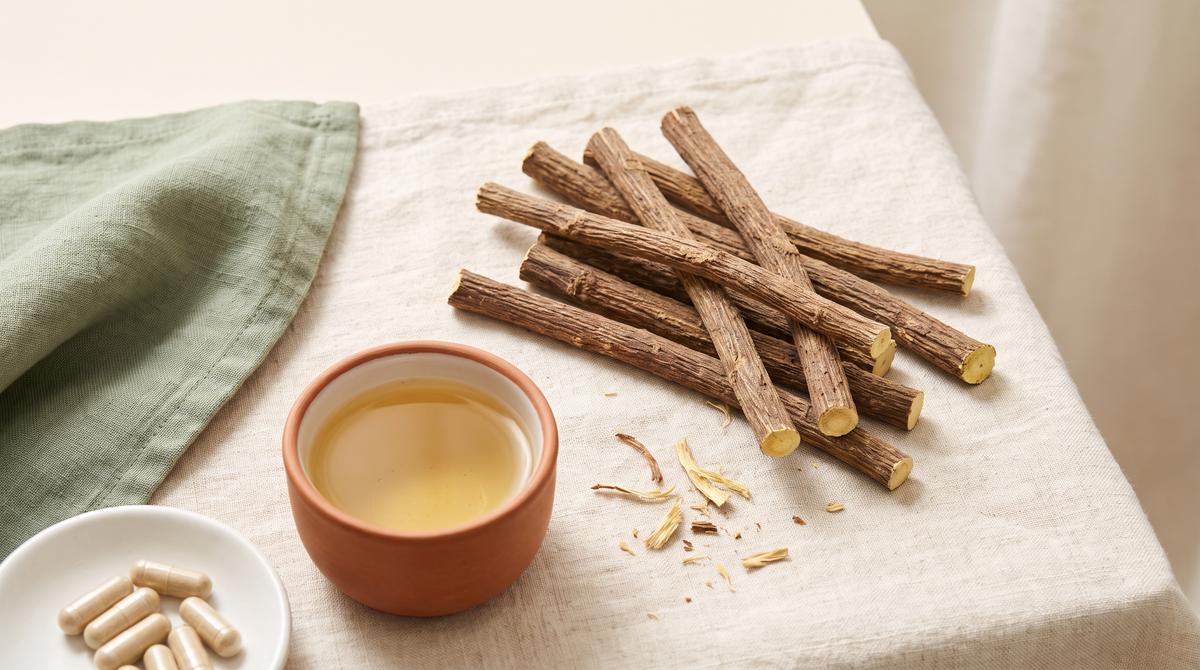
Valmi (වැල්මී in Sinhala, Athimadhuram in Tamil) is the dried root of Glycyrrhiza glabra, a perennial in the bean family. It is not a Sri Lankan native. Its home range runs through West Asia and Southern Europe, and most of the world's supply is farmed in countries like Iran and Turkey, so the root in a Sri Lankan spice drawer has always arrived dried, by trade. Ayurveda calls it Yashtimadhu, roughly "the sweet stick". The compound behind that sweetness, glycyrrhizin, is both the soothing agent and the thing you have to respect.
Read the caution before the benefits
Glycyrrhizin interferes with an enzyme in the kidney that normally keeps cortisol away from the receptors that control salt and water. Block that enzyme and cortisol starts acting like a salt-retaining hormone. The body holds sodium and water, loses potassium, and blood pressure climbs. In most healthy adults a cup of valmi tea does nothing of the sort. The problem is regular, generous intake, and it is why the EU's food-safety committee set a line that regular consumption should not exceed 100 mg of glycyrrhizinic acid a day.
The European Medicines Agency's herbal monograph for licorice root, revised in 2026, adds the practical guardrails. Digestive use is limited to 4 weeks. People with high blood pressure, kidney disease, liver or heart conditions, or low potassium are advised against it. It should not be combined with diuretics, corticosteroids, heart glycosides or stimulant laxatives, and the agency warns against taking two licorice products at once, because teas, sweets and capsules all add up. The US National Center for Complementary and Integrative Health notes that large amounts in pregnancy (around 250 g of licorice a week) have been linked to earlier delivery, so pregnancy is a plain no.
None of that makes valmi dangerous for a healthy adult using it for a few weeks. It makes it a root with a dose and a stop date.
What valmi actually does for the throat
The throat is where the evidence is cleanest, and it is a contact effect, not a systemic one. The root's mucilage and glycyrrhizin coat irritated tissue, which is why grandmothers handed children a piece of valmi to chew when a cough would not settle. The modern test came from an operating theatre. In a randomised trial of 236 adults having chest surgery, a 1-minute gargle with 0.5 g of licorice extract five minutes before the breathing tube went in roughly halved the rate of sore throat afterwards, 21 percent against 45 percent four hours later.
That is a very specific setting. It does not prove valmi shortens a cold, and a 2024 follow-up trial from the same team found no pain benefit after throat surgery. What it does show is that licorice in contact with the throat lining calms it, for a while, in a way sugar water does not. A warm cup of valmi tea sipped slowly on a wet evening is doing exactly that.
What it does for digestion, with one important catch
Licorice has a long traditional record for burning after meals and indigestion, and the EMA monograph recognises that use. The trials that back it used a particular form. In a 30-day randomised, placebo-controlled study, 75 mg twice daily of a flavonoid-rich licorice extract with the glycyrrhizin removed lowered indigestion symptom scores at day 15 and day 30. A larger 2025 trial of 200 adults with reflux symptoms used the same extract for 28 days and saw heartburn and regurgitation ease faster than placebo, within two weeks.
The catch is the form. Those results belong to a deglycyrrhizinated, standardised extract, not to whole root. A whole-root capsule or tea keeps the glycyrrhizin, which is where both the soothing feel and the blood-pressure caution come from. NCCIH puts it plainly: it is still unclear whether licorice alone has an effect on digestive symptoms. So think of whole valmi for digestion as a traditional short-course remedy, not a trial-proven therapy.
Who should consider it, and who should leave it on the shelf
- Leave it on the shelf if you have high blood pressure, heart disease, kidney disease or low potassium, if you are pregnant or breastfeeding, or if you take diuretics, steroids, heart medication or regular laxatives. There are gentler roots for you (ginger, for one).
- A short course makes sense if you are a healthy adult with a scratchy, tickly throat in the wet season and want something warm and traditional rather than a lozenge.
- It also makes sense if you get occasional burning after heavy meals and want to try the traditional root for a couple of weeks.
- You probably do not need it if your digestion is fine and you are shopping for a general daily herb. Valmi was never meant to be a daily-forever supplement.
How to take it, and when to stop
For Ancient Nutra's Licorice Root (Valmi) capsules, the label direction is 1 capsule after meals, up to three times a day. After food is the traditional timing for the root. For a throat, a cup of valmi tea sipped slowly does more than a swallowed capsule, because the benefit there is contact.
Set a stop date on day one. The EMA bound for digestive use is 4 weeks, and the trials above ran 28 to 30 days, so there is no evidence case for going longer. If the burning or the cough has not settled after 2 weeks, see a doctor rather than taking more. And do not add licorice tea, licorice sweets or a second blend that lists valmi while you are on it. One source at a time.
Stop early and seek advice if you notice headaches, puffy ankles, muscle weakness or cramps, a racing or irregular heartbeat, or a blood-pressure reading above your usual. Those are the early signs of too much glycyrrhizin, and they settle once the root is stopped.
Look for
Know which licorice you are buying. A product labelled DGL or deglycyrrhizinated has had the glycyrrhizin stripped out, which is what the indigestion trials used and which carries less of the blood-pressure concern. A whole-root powder keeps the glycyrrhizin, keeps the traditional sweetness and throat-coating feel, and keeps the 4-week limit. Ancient Nutra's Licorice Root (Valmi) capsules are the whole root in a vegetarian capsule, so read them as the traditional form and use them as one.
Where valmi sits in Sri Lankan tradition
Valmi turns up in Sri Lankan home medicine mostly as a throat and cough root: a sliver chewed slowly, or a few pieces simmered with coriander seed and ginger into a sweet, dark decoction for a child who will not take anything bitter. In Ayurveda, Yashtimadhu is one of the classic softeners added to harsher formulas to make them easier on the stomach. The tradition got the use right. The modern monographs added the dose ceiling and the stop date.
What to pair it with
For after-meal burning, the more natural daily partner is Ancient Nutra's Ginger, which has no duration limit on safety grounds and can carry on after the valmi course ends. The 60-second pre-meal ginger ritual covers the timing. If the issue is loose or unsettled digestion rather than burning, Ancient Nutra's Beli is the better-matched root. Not everyone needs a stack. If valmi is only on throat duty for a week, it does not need company.
An earlier post on this blog covers the everyday uses of licorice root in general terms. Read this one as its safety-first companion.
Safety
Not recommended during pregnancy, or for anyone with high blood pressure, heart disease, or kidney disease. Not for daily long-term use -- chronic high intake of glycyrrhizin can cause dangerously low potassium and high blood pressure.
The bottom line
Valmi is a good throat root and a reasonable short-course digestive one, with a dose ceiling and a 4-week stop date that are not optional. If your blood pressure is normal and none of the exclusions apply, Ancient Nutra's Licorice Root (Valmi) capsules are the traditional whole root in a clean capsule. Use them after meals, for a few weeks, then stop. The root does not care which jar it comes from, only how long you take it.

Licorice Root (Valmi), 60 capsules
Whole valmi root in a vegetarian capsule, for a short throat or after-meal course.
Shop Licorice Root (Valmi)Sources and further reading
- Scientific Committee on Food, Opinion on glycyrrhizinic acid and its ammonium salt (2003), European Commission.
- European Union herbal monograph on Glycyrrhiza glabra L. radix, Revision 1 (EMA/HMPC/108399/2024), European Medicines Agency.
- Ruetzler K et al., licorice versus sugar-water gargle for prevention of postoperative sore throat, Anesthesia and Analgesia 2013, PubMed.
- Raveendra KR et al., an extract of Glycyrrhiza glabra alleviates symptoms of functional dyspepsia, Evidence-Based Complementary and Alternative Medicine 2012, PubMed.
- Raj JP et al., GutGard in managing gastroesophageal reflux-related symptoms, Complementary Medicine Research 2025, PubMed.
- Licorice Root, National Center for Complementary and Integrative Health.
Written by the Ancient Nutra Wellness Team. The team researches, sources, and tests every ingredient before it earns a place in an Ancient Nutra blend. Questions? Email info@ancientnutra.com or message Ancient Nutra on Instagram.
Medical disclaimer: This article is for educational purposes only and is not medical advice. Statements have not been evaluated by the FDA. Ancient Nutra products are not intended to diagnose, treat, cure, or prevent any disease. Speak with a qualified healthcare provider before starting any new supplement, especially if you take prescription medication or have a medical condition.