Ancient Nutra Wellness Team · 26 July 2026 · Updated 6 August 2026 · 5 min read
Pre-monsoon prep: 4 Sri Lankan herbs to fortify before the rains
- The Maha (second) monsoon brings a fresh wave of colds, sinus trouble, and gut bugs. More than half of human infectious diseases can worsen around floods and heavy rain.
- Start a small herb routine one to two weeks before the rains settle in, not after you are already down with something.
- Four Sri Lankan staples come up in this season: Beli for the gut, Iramusu for cooling and skin, a daily Shield Shot to keep the habit, and Guduchi, which is traditional, but carries a liver-safety caution you should read below before considering it.
The second rains arrive quietly. One week the afternoons are dry and bright, the next the sky closes in and the Maha monsoon settles over the island for months. With it comes the familiar cycle: the blocked noses, the throat that scratches by evening, the stomach that turns after one street meal too many. Sri Lankan households have always kept a small shelf of herbs for exactly this window. Here are four worth knowing about before the rains, not after.
Why the second rains hit your immunity harder
The Maha monsoon does more than soak the garden. Standing water, damp air, and crowded indoor spaces give viruses and waterborne bugs an easier path. A 2025 review of flood seasons across tropical Asia found that more than half, roughly 58 percent, of known human infectious diseases can be made worse by floods and other climate hazards, from respiratory infections to typhoid and leptospirosis (Frontiers in Microbiology, 2025).
Your body feels the shift too. Cooler, wetter days change appetite, sleep, and how much you move. Meals get heavier and fried food more tempting, while the sun that normally tops up your vitamin D goes missing for weeks. None of this means you will get sick. It means the season asks a little more of your defences, and the smart move is to prepare the foundation before the first heavy downpour, not scramble once the cold has already landed.
4 herbs Sri Lankan households reach for
None of these is a cure. Think of them as the steady base you build under good sleep, warm home-cooked food, and clean drinking water. Pick one or two that match where you tend to struggle in the wet months.
Beli, for a steadier monsoon gut
Beli, also called Bael, is the classic Sri Lankan answer to a rainy-season stomach. The fruit and its extract have been brewed and taken for generations to settle loose digestion and calm an irritable gut, which is exactly the complaint that spikes when water quality dips and heavier food creeps in. Kept as a daily capsule, Ancient Nutra's Beli gives the digestion a gentle anchor through the months when the tap water runs cloudier and the appetite runs richer.
Iramusu, to cool and clear
Iramusu, also called Sarsaparilla, is the cooling root South Asian families have leaned on for skin and blood for a very long time. The wet season is humid and sticky, and skin often flares with the trapped heat and damp. Iramusu is traditionally used to cool the body from the inside and support clearer skin through that muggy stretch. Ancient Nutra's Iramusu fits the person whose monsoon problem shows up on the skin, not in the chest.
Shield Shot, the daily habit that sticks
The best routine is the one you actually keep. A capsule is easy to forget on a busy wet morning, but a small ready-to-drink shot is hard to skip. Ancient Nutra's Shield Shot is built as a daily immunity ritual, a single-gulp habit you take with breakfast so the rest of the routine has an anchor. In a season when discipline slips, that one fixed cue matters more than any single ingredient.
Guduchi: traditional, with an important caution
Guduchi, known in Sinhala as Rasakinda, is the herb Ayurvedic households historically reached for at the first sign of a seasonal fever, and it belongs in any honest account of this season's shelf. The immune-modulating activity reported for the plant comes from laboratory and animal work rather than large human trials.
It also carries a documented safety signal that we are not going to leave out of a seasonal routine article. The US National Institutes of Health LiverTox database lists Tinospora cordifolia as a well-established cause of clinically apparent liver injury, with reported cases appearing anywhere from a few weeks to six months into use (NIH LiverTox, 2025). A monsoon routine runs for months, which is precisely that window, so we no longer suggest Guduchi as the daily anchor of a season-long habit. If you are considering it, speak to your doctor first, avoid it entirely if you have liver disease or take other medicines affecting the liver, and stop and seek medical attention if you notice yellowing of the eyes or skin, dark urine, persistent nausea, or unusual tiredness. Our fuller write-up is here.
Look for
One habit you will actually keep through the wet months, taken with breakfast. Ancient Nutra's Shield Shot is a single-gulp daily ritual, which is usually easier to sustain across a long season than a capsule you have to remember.
A note from the old kitchen
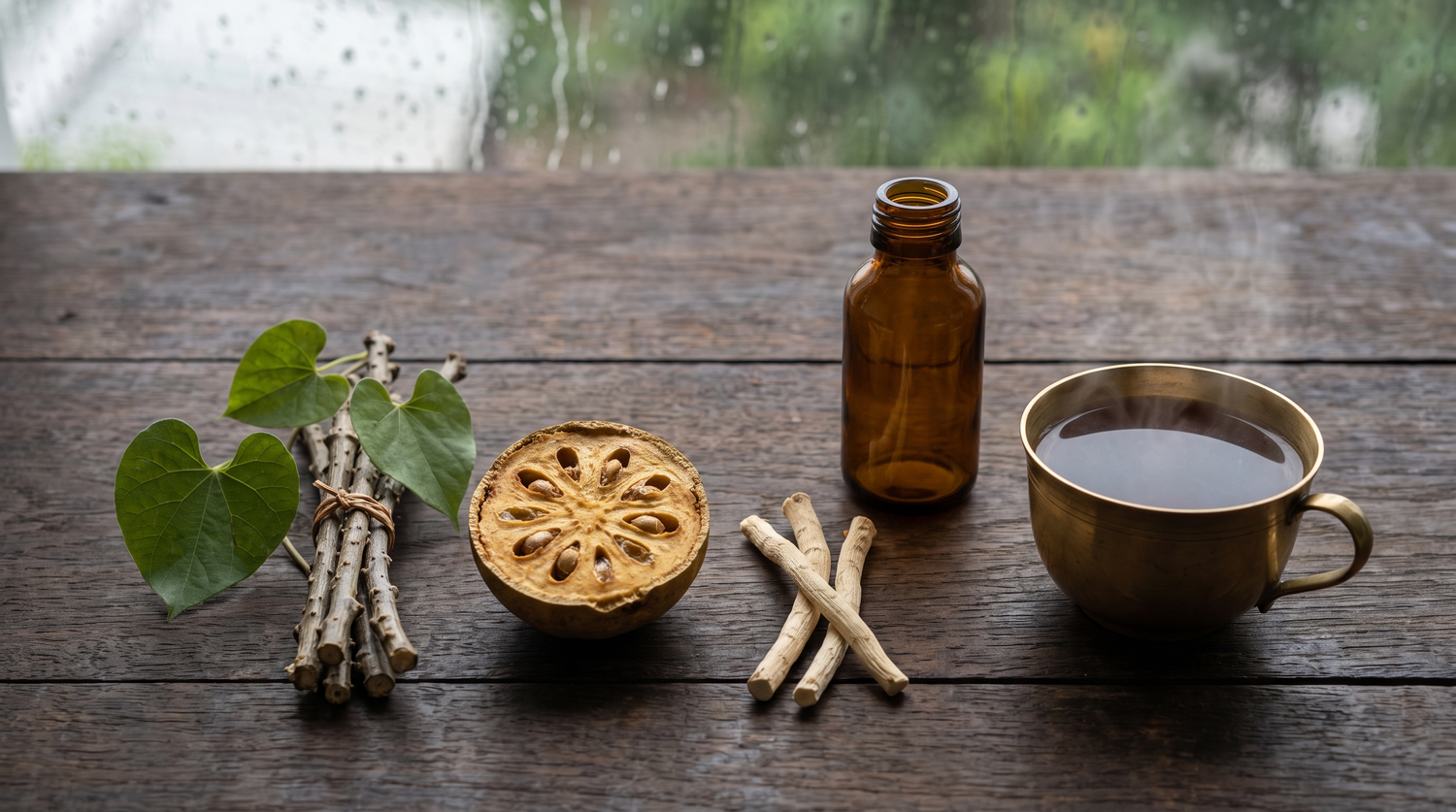
In older Sri Lankan homes, none of this was framed as immunity. It was just what you did when the weather turned. Rasakinda vine was cut from the garden fence and boiled when a fever went around. Beli was halved, dried, and kept for the stomach. Iramusu went into cooling drinks in the sticky months. The plants were chosen by season and by symptom, passed down without a single label. Worth saying plainly, though: those remedies were short, symptom-led and occasional. That is not the same as taking a concentrated capsule of the same plant every day for months, which is where the modern safety questions come in.
When to start, when to stop
Begin one to two weeks before the rains fully settle, so the routine is already a habit when the first cold makes its rounds. A single daily dose is plenty; this is a foundation, not a megadose sprint. Carry it through the wettest stretch of the Maha season, then taper off as the weather dries and the daily risk drops. This is a seasonal routine, not a year-round one, and for any herb with a documented safety signal, such as Guduchi above, a months-long continuous run is exactly what to avoid without a doctor's oversight. If you are pregnant, on medication, or managing a health condition, check with your doctor before adding any herb.
The bottom line
The second rains are predictable, and so is the wave of colds and gut trouble that rides in with them. Prepare the base early. Beli steadies the gut, Iramusu cools and clears the skin, and a daily Shield Shot keeps the whole thing on the rails. Guduchi has the deepest traditional roots of the four and the clearest modern caution: read it above before you decide. Pick what matches your usual monsoon weak spot, start a week or two out, and let the routine do its quiet work while the rain does its own.

Shield Shot (5 pack)
A single-gulp daily immunity ritual, the habit anchor for a wet-season routine.
Shop Shield ShotSources and further reading
- National Institute of Diabetes and Digestive and Kidney Diseases, Tinospora cordifolia, NIH LiverTox, updated 2025. Liver-safety data on Guduchi.
- Sharma et al., Therapeutic Application, Phytoactives and Pharmacology of Tinospora cordifolia, Chinese Journal of Integrative Medicine (2023). Preclinical evidence on Guduchi's immunomodulatory activity.
- Flood-associated disease outbreaks and transmission in Southeast Asia, Frontiers in Microbiology (2025). On how monsoon and flood seasons drive infection surges.
Written by the Ancient Nutra Wellness Team. The team researches, sources, and tests every ingredient before it earns a place in an Ancient Nutra blend. Questions? Email info@ancientnutra.com or message Ancient Nutra on Instagram. Last reviewed 6 August 2026.
Medical disclaimer: This article is for educational purposes only and is not medical advice. Statements have not been evaluated by the FDA. Ancient Nutra products are not intended to diagnose, treat, cure, or prevent any disease. Speak with a qualified healthcare provider before starting any new supplement, especially if you take prescription medication or have a medical condition.