By the Ancient Nutra Wellness Team · June 3, 2026 · 6 min read
- Maila Kola is the Sinhala name for Piper sarmentosum, a leafy cousin of pepper used across Sri Lanka and Southeast Asia for joint aches and cooling.
- Lab and animal studies point to real anti-inflammatory and antioxidant activity, though human trials are still thin.
- It is a daily, gentle herb, not a painkiller. Give any anti-inflammatory herb at least 8 to 12 weeks before you judge it.
Most herbs that calm inflammation are loud about it. Turmeric stains everything yellow. Ginger bites. Maila Kola does its work quietly, which is probably why most people outside a Sri Lankan home garden have never heard of it. The leaf has been chewed, brewed, and cooked into curries for generations, mostly for stiff joints and a body that runs hot. The science is finally catching up to what the kitchen already knew.
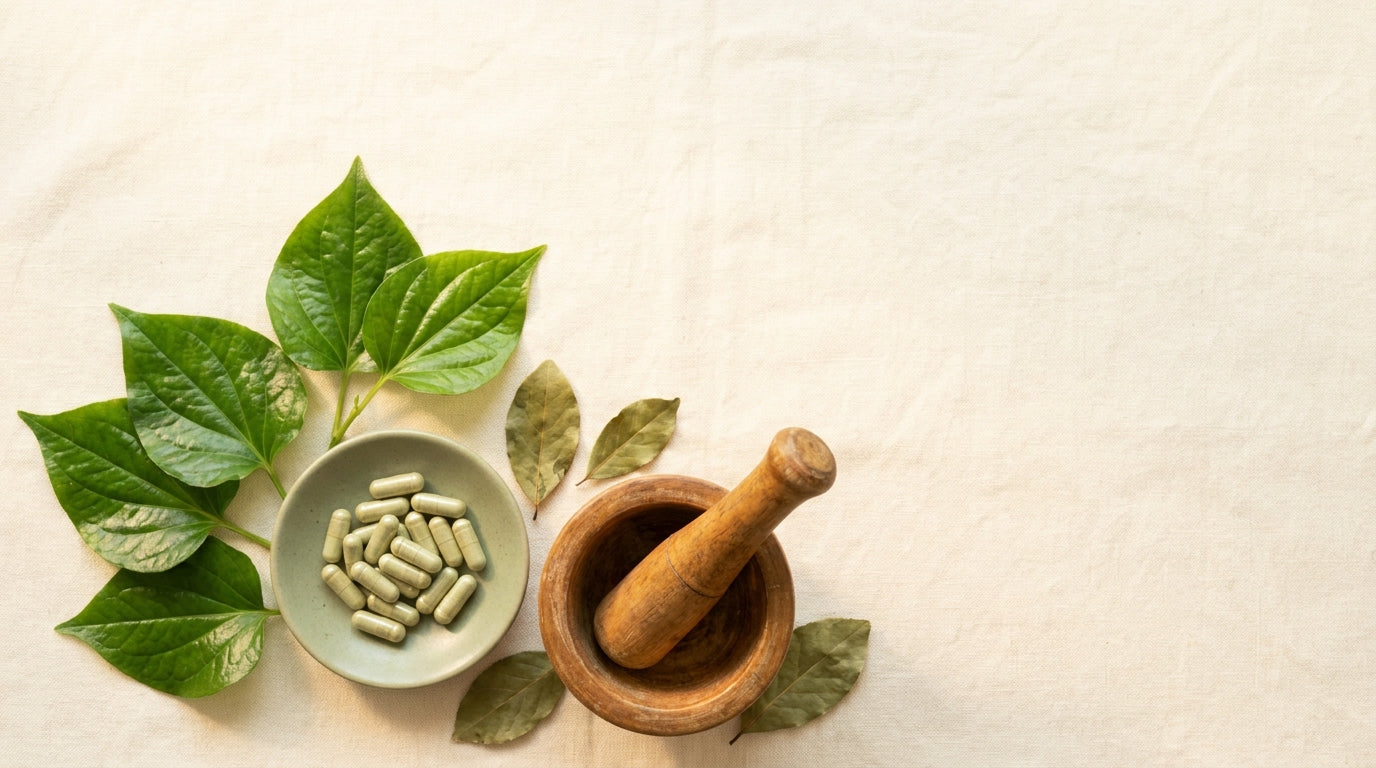
Maila Kola is the Sinhala name for Piper sarmentosum, a low, creeping plant in the same family as black pepper and betel. It grows in the damp shade of South and Southeast Asia, including the wet zone of Sri Lanka. Across the region the heart-shaped leaves have long been used for joint pain, rheumatism, and what traditional healers simply call cooling the body.
What Maila Kola actually does
Inflammation is not the enemy. It is how your body responds to stress, injury, and the daily wear of being alive. The problem is when it never switches off. Low, constant inflammation is the slow burn behind stiff joints, sluggish mornings, and a gut that never feels settled.
Maila Kola leaves are dense with antioxidant compounds, including flavonoids and amides that appear to dial down the signals that keep inflammation running. In a 2025 analysis, leaf extracts of Piper sarmentosum reduced swelling in animal models and lowered key inflammatory markers like TNF-alpha and nitric oxide (Journal of Ethnopharmacology, 2025). That is the lab version of what grandmothers meant by cooling.
It is worth being honest here. Most of the strong evidence is still from cell and animal work, not large human trials. That does not make the herb useless. It makes it a sensible daily addition rather than a treatment. For a better-studied anti-inflammatory in the same spirit, Ancient Nutra's Welpenela covers the skin and joint angle.
Who should consider Maila Kola
This is a gentle, foundational herb. It suits some people more than others.
- People with stiff, achy joints in the morning. The traditional use across the region centres on rheumatism and joint comfort.
- People whose bodies run hot. In a 30-degree climate, a cooling herb earns its place in a daily routine.
- People watching blood sugar and digestion. Maila Kola is traditionally tied to post-meal balance and gut comfort, areas where the pepper family tends to help.
- People who want one simple daily herb, not a shelf of supplements.
Who does not need it? If your joints feel fine, your digestion is steady, and you sleep well, you do not need another capsule. Fix sleep, food, and movement first. A herb helps at the margins, not in place of the basics.
How to actually take it
In the kitchen, Maila Kola is eaten as a leaf, fresh in salads and sambols or steeped into a mild tea. As a daily wellness herb it is usually taken with a meal and water, the same way you would take any pepper-family extract, so it sits easy on the stomach.
Take it with food, once a day, and keep it consistent. If you take medication for blood sugar, check with your doctor first, since cooling digestive herbs can nudge those numbers. Do not expect a painkiller effect. The point is steady, background support over weeks, not a hit you feel in an hour.
A standardised daily anti-inflammatory herb, taken with food. Maila Kola capsules are still rare, so until they are on more shelves, a standardised turmeric is the easiest daily anti-inflammatory to find.
Ancient Nutra's Turmeric Extract is standardised to 95 percent curcumin, the active most of the research is built on.
Where Maila Kola comes from
Maila Kola grows wild in the shade and home gardens of Sri Lanka's wet zone, and the same plant turns up across Vietnam, Thailand, and Malaysia under names like wild betel. In every one of those kitchens it lands in roughly the same place: joint aches, gut comfort, and cooling a body that runs hot. A 2024 review of the plant's chemistry confirmed the leaf is rich in the antioxidant and anti-inflammatory compounds that traditional use leaned on for centuries (Phytochemistry Reviews, 2024).
What to stack it with
Maila Kola plays well with other cooling, anti-inflammatory herbs rather than stimulants. For a body that runs hot, pairing it with Ancient Nutra's Iramusu, Sri Lanka's classic cooling root, covers the same traditional ground from two angles.
For joint comfort specifically, a standardised turmeric alongside it gives you the well-researched curcumin pathway plus the traditional leaf. This stack is for people dealing with daily stiffness and heat, not something everyone needs. If you only want one, start with the turmeric and add the leaf later.
How long until you feel something
Anti-inflammatory herbs are slow by nature. The first thing most people notice is easier digestion and a body that feels a little less hot, often within the first few weeks. Joint comfort and the deeper anti-inflammatory effects take longer, usually 8 to 12 weeks of daily use.
Give it 90 days before you decide. Herbs that work at the level of inflammation work quietly, and quiet changes are easy to miss until you stop and look back.
There is an old habit in Sri Lankan home gardens of plucking a few Maila Kola leaves straight off the plant and chewing them after a heavy meal. No measuring, no label, just the leaf and the knowledge passed down that it settles things. The capsule is only the modern, measured version of a very old gesture.
The bottom line
Maila Kola is a quiet, traditional anti-inflammatory worth knowing about, especially if your joints are stiff and your body runs hot. The research is early but pointed in the right direction. While Maila Kola capsules work their way onto more shelves, the everyday anti-inflammatory Ancient Nutra leans on is standardised turmeric. Ancient Nutra's Turmeric Extract delivers 95 percent curcumin in a single daily capsule. Or eat the leaf, brew the tea, and stack them yourself. The science does not care which bottle they come in.

A daily anti-inflammatory standardised to 95 percent curcumin, the active most of the research is built on.
Shop Turmeric ExtractSources
- Journal of Ethnopharmacology (2025). Metabolomic profiling of Piper sarmentosum Roxb. extracts reveals potent xanthine oxidase inhibition and anti-inflammatory effects. PubMed
- Phytochemistry Reviews (2024). The metabolites of Piper sarmentosum and their biological properties: a recent update. Springer
- Further reading: The Anti-Inflammatory and Antimicrobial Potential of Selected Ethnomedicinal Plants from Sri Lanka. PMC, 2020
These statements have not been evaluated by the Food and Drug Administration or equivalent authorities. This product is not intended to diagnose, treat, cure, or prevent any disease. Always consult a qualified healthcare professional before starting a new supplement, especially if you are pregnant, nursing, or taking medication.
Written by the Ancient Nutra Wellness Team. The team researches, sources, and tests every ingredient before it earns a place in an Ancient Nutra blend. Questions? Email info@ancientnutra.com or message Ancient Nutra on Instagram.