Ancient Nutra Wellness Team · 2 August 2026 · 7 min read
Where a herb grows changes what ends up in the capsule
- The same herb species grown in two different regions can carry very different levels of the compounds you are actually buying, so origin is a potency question, not a romantic one.
- A JAMA analysis of 193 Ayurvedic products sold online found that 20.7% carried detectable lead, mercury or arsenic, and every one of those exceeded an accepted safety limit. Traceable sourcing is the control that prevents this.
- A named origin, a named grower, a harvest season and a batch test are checkable. "Premium quality" and "sourced from the Himalayas" are not.
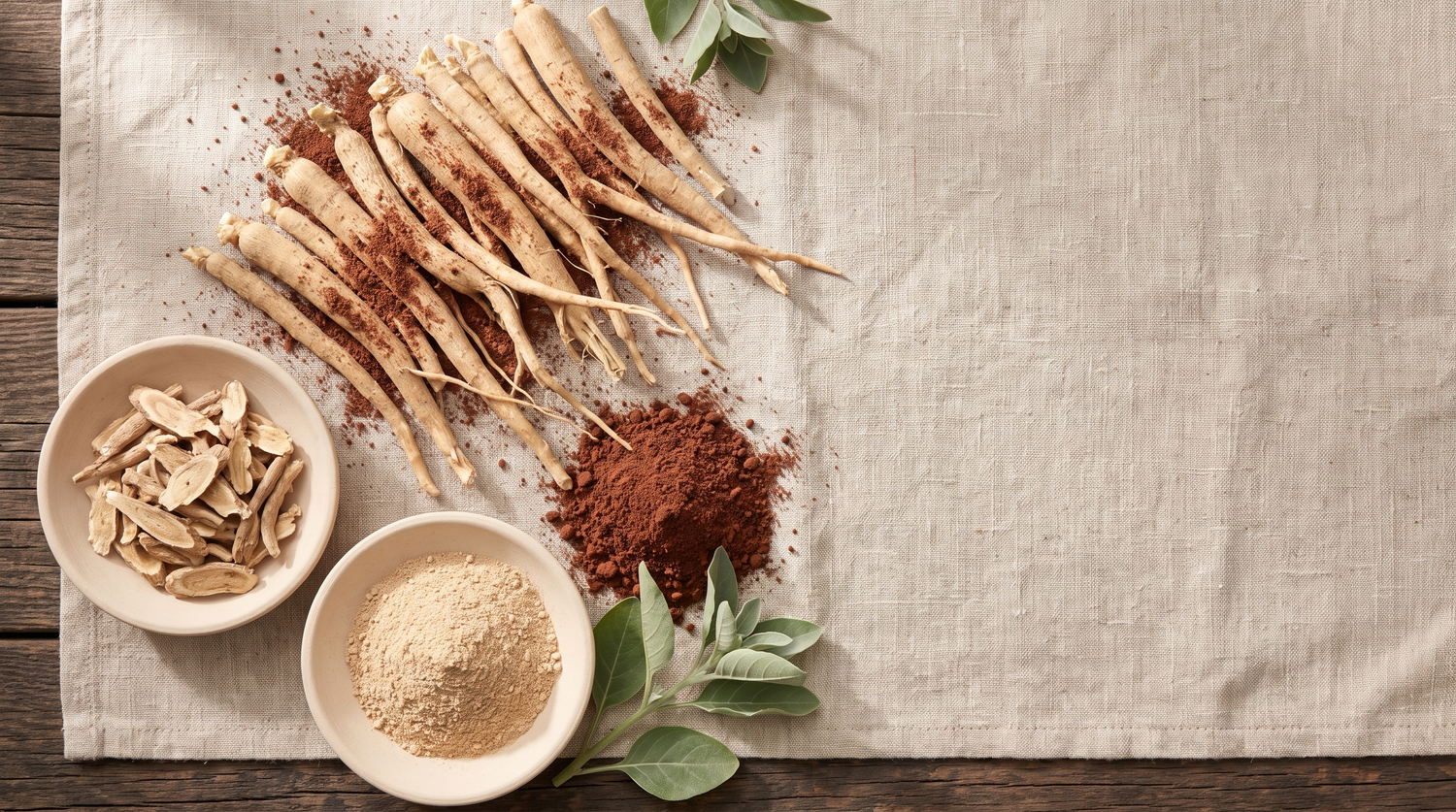
Two jars of ashwagandha root powder can look identical, smell close enough, cost within a few hundred rupees of each other, and still not be the same product. One came from a mature root lifted at the right season on a farm that keeps records. The other came through three intermediaries who bought whatever was in the warehouse that week. Nothing on either label tells you which is which. This is the reason Ancient Nutra is moving every hero ingredient towards a named origin: not because a valley name sounds good on a pouch, but because a valley name is the only part of a sourcing claim a customer can actually hold anyone to.
Does where a herb is grown actually change what is in it?
Yes, and the effect is larger than most supplement marketing admits. A medicinal plant is not a manufactured molecule. It is a living thing that builds its active compounds in response to soil chemistry, altitude, rainfall, day length, heat stress and the age at which it is harvested. Change those inputs and the plant changes its output.
Ashwagandha is a well-studied example. Researchers profiling Withania populations collected from different regions of India found that the withanolide array, the family of compounds most closely linked to the herb's stress and recovery effects, differed measurably from population to population, which is exactly why breeders screen for high-withanolide genotypes rather than assuming one root is as good as another. Published comparisons of roots from separate growing districts have reported withanolide-A content spanning roughly 0.4% to 1.3%, a threefold spread inside a single species. Cultivation method moves the number too: a controlled trial of organically grown ashwagandha found that vermicompost-fed plants produced both more biomass and a higher content of active withanolides than the conventional treatment.
Put that in practical terms. If a daily dose is built around a root at the bottom of that range, a customer is taking roughly a third of the active material they would get from a root at the top, at the same capsule count, at the same price, with the same label. Origin is not a story. It is the difference between a supplement working in eight weeks and a supplement doing nothing you can feel.
What does a named valley tell you that a label claim cannot?
A label claim is a sentence. A named origin is an address, and an address can be visited, audited and, if the product goes wrong, traced backwards.
The World Health Organization published guidance on good agricultural and collection practices for medicinal plants that reads less like botany and more like accounting. It asks growers to document species identity, the site, the soil and previous crops, the agrochemicals used, the harvest timing, the drying and the storage conditions. The reason for all that paperwork is simple: when a batch fails a test, the only way to find the cause is to know precisely where and when the material came from. A supply chain that cannot answer "which farm, which season" cannot fix its own problems. It can only replace the batch and hope.
This is also where the phrase "wild-crafted" deserves more scrutiny than it usually gets. Wild collection can be excellent, and in Sri Lanka a good deal of traditional plant knowledge lives with collectors rather than farmers. It can also mean an unidentified species picked by whoever was available, dried on a roadside, and sold by weight. The difference between those two versions is documentation, not virtue.
Provenance is a safety control before it is a quality one
The strongest argument for traceability is not potency. It is contamination. In an analysis of 193 Ayurvedic medicines bought over the internet, published in JAMA, 40 products, or 20.7% of the sample, contained detectable lead, mercury or arsenic, and all 40 exceeded at least one accepted regulatory limit for those metals. Heavy metals do not appear from nowhere. They come from the soil the plant grew in, the water it was irrigated with, the road it was dried beside, or the equipment it was milled on. Every one of those is a location. Which means every one of them is answerable if you know the location, and unanswerable if you do not.
Look for
A brand that names the species in Latin, the growing district, the plant part, the harvest season and the batch. If a pouch names only a country and a marketing adjective, treat it as an unverified claim. Ancient Nutra's Ashwagandha is a whole-root capsule, which is the format where root quality shows up most directly, since there is no extraction step to mask a weak starting material.
What belongs in a real provenance record?
Ancient Nutra's internal standard for a hero ingredient has six lines, and each one exists because leaving it out has burned somebody in this industry.
Botanical name and plant part. Withania somnifera, root. Not "ashwagandha, herb". Species substitution and part substitution (leaf sold as root, because leaf is cheaper and heavier) are the two oldest tricks in the botanical trade.
Growing district and elevation. The valley, not the country. Elevation and rainfall drive the compound profile, and a country is far too large a unit to mean anything.
Grower or collective. A person or a farmer group who can be contacted. This is the line that converts a supply chain into a relationship, and it is the line most often missing.
Harvest season and plant age. Root withanolide content rises as the plant matures, so a root pulled early to hit a shipping date is a weaker root regardless of where it grew.
Drying and processing method. Shade dried, sun dried, mechanically dried at a stated temperature. Heat destroys some compounds and concentrates others.
Batch identity and test results. A batch code that links the finished pouch back to a lab report for identity, microbial load and heavy metals.
None of those six are exotic. Every serious food exporter in Sri Lanka already keeps them for a spice shipment. The gap in the supplement category is that consumers were never handed the record, so brands stopped feeling obliged to keep one.
Read a supplement label like a sourcing manager
Four checks take about thirty seconds in a shop.
First, look for a Latin binomial. Its absence is not proof of a bad product, but its presence tells you somebody in the company thinks about identity. Second, look for the plant part. Third, look for a standardisation figure if the product is an extract, because an extract without a percentage is just a powder with a bigger price. Ancient Nutra's Ashwagandha Extract exists for exactly that reason, and the choice between root powder, capsule and extract is a separate decision covered in this format comparison. Fourth, look for a batch code and a date. A product that cannot tell you when it was made cannot tell you anything about where it came from either.
The same logic already decides a much more familiar purchase. Ceylon cinnamon and cassia are sold under one English word in most of the world, and the difference between them is a matter of origin and species rather than branding, which is why the label genuinely matters for daily use. Provenance has been the deciding factor in that aisle for two centuries. It is only in supplements that it became optional.
Does any of this change how a herb works for you?
It changes whether the herb gets a fair test. Ashwagandha has been studied in randomised, placebo-controlled trials using standardised root extracts, with reported reductions in serum cortisol alongside improvements in self-reported stress. Those results were produced with material of a known specification, taken at a known dose, for a known duration. A customer taking an unspecified root of unknown maturity for three weeks is not running that experiment. They are running a different one, and then concluding the herb does not work.
Sri Lanka's own traditional medicine kept this straight for centuries by naming the village, the season and the collector as part of the remedy itself. That was not sentiment. It was quality control before laboratories existed.
Does the country of origin change how strong a herbal supplement is?
It can, but the useful unit is smaller than a country. Soil, elevation, rainfall and harvest timing drive the compound profile, and those vary between districts inside one country. Published comparisons of ashwagandha roots from different Indian growing regions have reported roughly a threefold spread in withanolide-A content.
Is imported ashwagandha better than locally grown ashwagandha?
Neither wins automatically. What matters is whether the material is the right species, the right plant part, harvested at maturity, dried properly and tested. A documented local root beats an undocumented imported one, and the reverse is equally true.
Are heavy metals a real risk in Ayurvedic supplements?
They are a documented one. A JAMA analysis of 193 Ayurvedic products sold online found 20.7% contained detectable lead, mercury or arsenic above at least one accepted limit. Traceable sourcing and batch testing are the controls that manage it, which is why origin records matter for safety and not only for potency.
How can a buyer verify a provenance claim?
Ask for the batch code and the certificate of analysis for that batch. A brand that keeps proper records can produce both within a day. A brand that answers with adjectives has told you what you needed to know.
The bottom line
Naming a valley is a commitment, not a decoration. It means the harvest month is recorded, the grower can be called, and a bad batch can be traced instead of quietly replaced. Ancient Nutra is applying that standard hero ingredient by hero ingredient, starting with the ones customers take every single day, and the daily whole-root ashwagandha capsule is the first place it shows.

Ashwagandha, 60 capsules
Whole-root ashwagandha for daily stress, sleep and steady energy.
Shop AshwagandhaSources and further reading
- WHO guidelines on good agricultural and collection practices (GACP) for medicinal plants, 2003, World Health Organization.
- Saper RB et al., Lead, mercury, and arsenic in US- and Indian-manufactured Ayurvedic medicines sold via the internet, 2008, JAMA.
- Withanolides array of Withania populations from India, Industrial Crops and Products, 2014, ScienceDirect.
- Organic cultivation of ashwagandha with improved biomass and high content of active withanolides: use of vermicompost, 2018, PLOS ONE.
- Salve J et al., An investigation into the stress-relieving and pharmacological actions of an ashwagandha extract, 2019, Cureus, via PubMed Central.
Written by the Ancient Nutra Wellness Team. The team researches, sources, and tests every ingredient before it earns a place in an Ancient Nutra blend. Questions? Email info@ancientnutra.com or message Ancient Nutra on Instagram.
Medical disclaimer: This article is for educational purposes only and is not medical advice. Statements have not been evaluated by the FDA. Ancient Nutra products are not intended to diagnose, treat, cure, or prevent any disease. Speak with a qualified healthcare provider before starting any new supplement, especially if you take prescription medication or have a medical condition.