Ancient Nutra Wellness Team · 3 September 2026 · 8 min read
Gurmar and Sweet Taste: What the Bitter Leaf Really Does
By the Ancient Nutra Editorial Team
Key takeaways
- Gymnemic acids from the gurmar leaf bind the human sweet taste receptor on the tongue and switch sweetness off for a short window. That effect is real, local and reversible.
- The tongue effect is not a metabolic effect. NIH states that gurmar's overall effectiveness in treating diabetes has not been shown, and the best designed trial of 600 mg a day for 12 weeks found no change to insulin sensitivity or insulin secretion.
- Trials run 12 weeks, so a course should run 12 weeks and then pause. NIH LiverTox rates gurmar likelihood score D, a possible rare cause of clinically apparent liver injury, and it may add to the effect of glucose lowering medication.
Gurmar has one of the most quotable names in the herb cabinet. The Hindi word translates roughly as sugar destroyer, and in Sinhala the plant is masbedda. That name has done a great deal of marketing work over the last decade, most of it unearned. The leaf does something genuinely unusual, something you can feel within seconds of chewing it, and that real effect is far more specific and far more limited than the name suggests. This article separates the part that is demonstrated from the part that is still only hoped for, and sets out how long a sensible course actually runs.
What is gurmar, and which part of the plant is used?
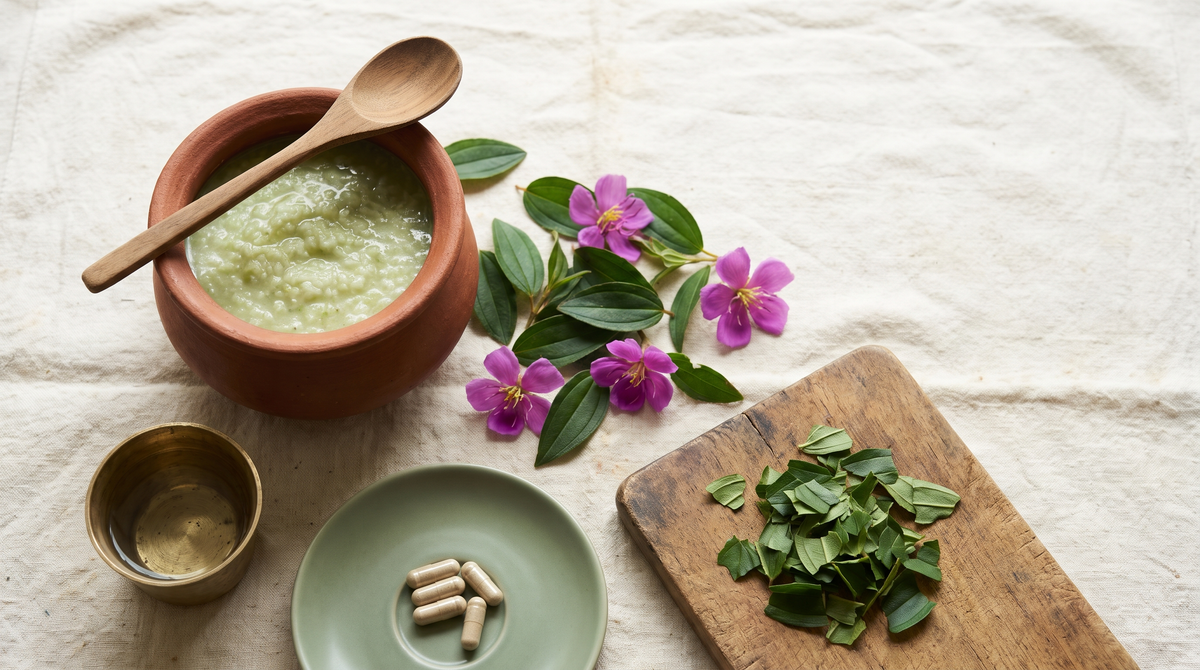
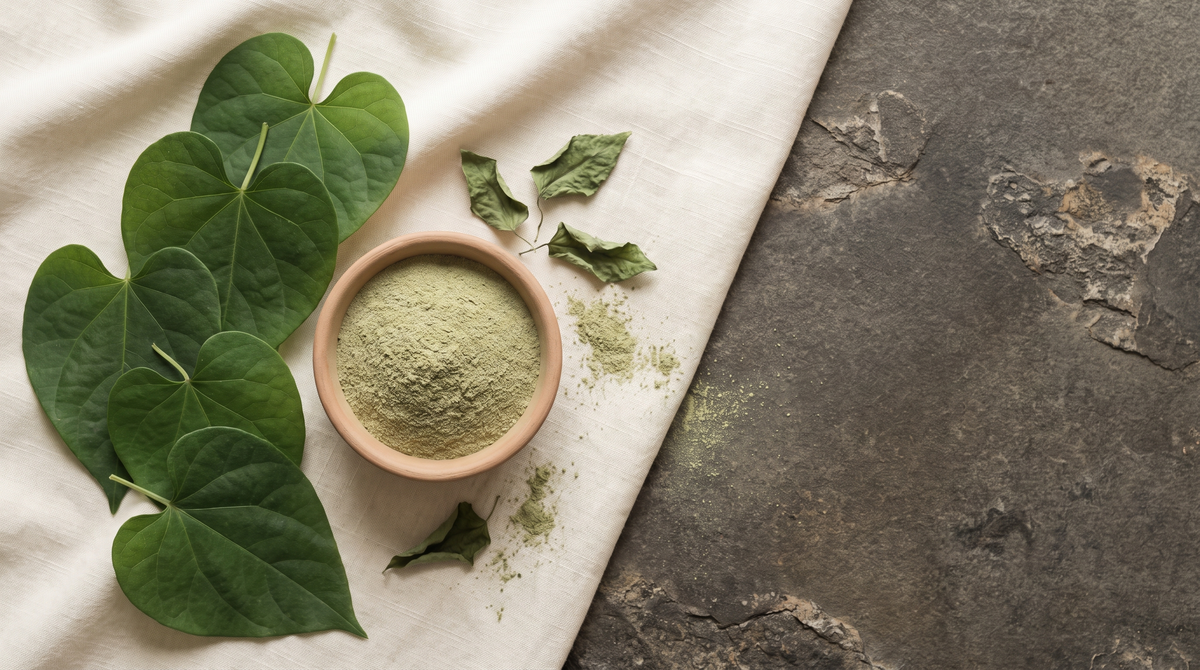
Gurmar is Gymnema sylvestre, a woody climbing vine in the Apocynaceae family with small yellow flowers. It is native across tropical and subtropical Asia, Africa and Australia, so it is not a Sri Lankan exclusive, and any brand that frames it as one is stretching. The leaves, fruits and seeds have all been used traditionally, but the leaf is the part that goes into modern capsules, and the leaf is where the active saponins, the gymnemic acids, are concentrated.
That is the honest heritage frame. The plant has a long recorded use in Ayurvedic practice across the region, and the name it carries is a description of what people noticed on the tongue, not a description of what it does to the bloodstream.
How gymnemic acids switch off sweet taste
Sweetness is detected by a single receptor pair on the tongue, T1R2 joined to T1R3. Work published in the Journal of Biological Chemistry took human embryonic kidney cells, made them express the human version of that receptor pair, and then applied gymnemic acids. Sweet responses were blocked. The same treatment did not block the mouse version of the receptor, and the researchers traced the binding site to the transmembrane domain of the human T1R3 subunit, the same pocket used by the known sweet blocker lactisole. Rinsing the cells cleared the effect quickly.
Three things follow from that, and they matter. The effect is on the human receptor specifically. It happens at the surface of the tongue, not inside the body. And it wears off. NIH LiverTox describes the same finding in plain language, noting that gymnemic acids bind and inhibit human sweet taste receptors and can suppress the taste response to sweet substances.
The practical experience is strange the first time. Chew a gurmar leaf or hold a gymnemic acid preparation on the tongue, then eat something sweet, and the sugar registers as texture and nothing else. The sweetness is simply absent. Published figures for how long that lasts trace back to manufacturer guidance rather than a measured study, usually quoted as roughly half an hour, so treat any precise number with suspicion.
Does gurmar lower blood sugar?
This is where the honest answer disappoints. The strongest single piece of evidence is a randomised, double blind, placebo controlled trial published in the Journal of Medicinal Food in 2017. Twenty four adults aged 30 to 60 with metabolic syndrome, taking no diabetes medication, received 300 mg twice a day, so 600 mg daily, for 12 weeks. Body weight fell (from about 81.3 kg to 77.9 kg) and BMI fell with it. Very low density lipoprotein fell. And then the sentence that most write ups leave out: this happened without modifying the components of metabolic syndrome, insulin secretion, or insulin sensitivity.
In other words, the best controlled trial of gurmar at a sensible dose over a sensible period was a negative result for the thing gurmar is best known for.
Two meta analyses have pooled the wider literature and both report improvements in fasting glucose and related markers. Both also undercut themselves. The 2023 analysis in Phytotherapy Research drew on only six randomised trials and its authors state directly that notable heterogeneity, low quality of studies, and lack of diversity among participants should be considered when interpreting the results, and that larger, longer, higher quality trials are needed before clinical efficacy can be established. NIH's Endotext chapter reaches the same place in one line, that there are minimal human studies evaluating gurmar's efficacy. LiverTox is blunter still: overall effectiveness in the treatment of diabetes has not been shown.
There is also a claim, repeated on a great many retail pages, that gurmar blocks sugar absorption in the intestine the same way it blocks sweetness on the tongue. That claim has cell culture and rodent work behind it and no human trial. It should not be stated as fact, and it is not stated as fact here. If you want the same evidence treatment applied across the whole category, Ancient Nutra's ranking of 4 blood sugar herbs by how strong the evidence is covers where each one actually sits.
What the craving research actually measured
The craving claim is the one with the most support, and it is still narrower than the packaging implies. A crossover study in Nutrients gave 56 adults a gymnemic acid mint and then offered chocolate. Desire for another serving dropped by about 22.7 percent, and participants ate about 21.3 percent less chocolate. The window measured was 15 minutes. The design was single blind, with the placebo always given at the first visit, which the authors acknowledge as a limitation, and they note plainly that no evidence exists on the effects of long term intake.
So gurmar can reasonably be described as taking the edge off the next sweet thing in front of you, minutes after you take it. It cannot reasonably be described as curing a sweet tooth.
Look for
A product that names the plant part (leaf) and gives a daily milligram figure you can compare against the 600 mg a day used in controlled trials. Vague blend totals hide the actual dose. Ancient Nutra's Gurmar (Masbedda) capsules are single herb, which makes the arithmetic straightforward.
How long should you take gurmar?
Twelve weeks, then stop and reassess. That is not a house rule, it is the length of the trial that tested it properly. There is no published evidence supporting continuous daily use beyond that window, and the craving research explicitly says nothing is known about long term intake. A course with an end date also gives you something an open ended habit never does, which is a clean comparison: you find out what the herb was contributing only when you take it away.
If gurmar sits alongside other herbs in a routine, apply the same discipline to each of them. Ancient Nutra's guide to how much Ceylon cinnamon to take per day and for how long works through the same arithmetic for a different leaf.
Who should check with a doctor first
Anyone taking medication that lowers blood glucose. NIH's Endotext chapter states that gurmar may potentiate the effects of other agents that lower glucose, which means a dose that was correct on its own can become too much when gurmar is added. That conversation belongs with the prescriber, before the first capsule, not after a difficult afternoon.
On the liver, NIH LiverTox assigns gurmar a likelihood score of D, a possible rare cause of clinically apparent liver injury. LiverTox also records that the compounds responsible are not known and that attribution to the herb itself in reported cases has usually been weak. D is a low rung, well below the ratings carried by several far more popular herbs, but it is not a null rating and it is the reason the 12 week bound above is a bound rather than a suggestion. Stop taking it and speak to a doctor if you notice yellowing of the skin or eyes, dark urine, persistent nausea, or unusual tiredness. Gurmar is a food supplement and is not a substitute for prescribed treatment.
Where gurmar fits in a daily routine
Given all of the above, the sensible place for gurmar is small and specific. It is taken before the meals most likely to end in something sweet, for a bounded course, as one supporting element beside the things that actually move a post meal glucose curve: what is on the plate, how much of it is refined carbohydrate, and whether you move afterwards. Nothing in the evidence supports treating the capsule as the main intervention.
Ancient Nutra's Sugar Balance System is built on that reading. It pairs gurmar with Ceylon cinnamon and venivel across a bounded routine rather than selling any one of the three as a solution, and its own instructions put a pause at the end of the cycle instead of assuming you keep going forever.
The bottom line
Gurmar blocks sweet taste on the tongue, briefly and reversibly, and that is the part that is properly demonstrated. It has not been shown to treat diabetes, its best controlled trial was a negative result for insulin sensitivity, and its craving effect was measured over 15 minutes rather than 15 weeks. Taken for a bounded 12 week course, with a doctor consulted first if you are on glucose lowering medication, it is a modest and interesting addition to a routine. Sold as a sugar destroyer, it is a name doing work the evidence has not done.
Frequently asked questions
Does gurmar really stop you tasting sugar?
Yes, briefly. Gymnemic acids bind the transmembrane domain of the human sweet taste receptor subunit T1R3 and block the sweet response. The effect is local to the tongue and reversible, and quoted durations of around half an hour come from manufacturer guidance rather than a measured trial.
Does gurmar lower blood sugar?
It has not been shown to. NIH LiverTox states that overall effectiveness in the treatment of diabetes has not been shown, and a 12 week randomised placebo controlled trial at 600 mg a day found no change in insulin secretion or insulin sensitivity. Meta analyses that report improvements also report low study quality and high heterogeneity.
How long should a gurmar course last?
Twelve weeks, then a pause and a reassessment. That is the length of the best controlled trial, and there is no published evidence supporting continuous use beyond it.
Can gurmar be taken with diabetes medication?
Not without asking the prescriber first. NIH's Endotext chapter notes that gurmar may potentiate the effects of other glucose lowering agents, so it can push a correctly set medication dose too far.
Is gurmar safe for the liver?
NIH LiverTox rates it likelihood score D, a possible rare cause of clinically apparent liver injury, while noting that attribution in reported cases has usually been weak. Stop and seek medical advice if yellowing of the skin or eyes, dark urine, persistent nausea, or unusual tiredness appear.

Sugar Balance System
Gurmar, Ceylon cinnamon and venivel in one bounded routine, with a pause built into the end of the cycle.
Shop Sugar Balance SystemSources and further reading
- Gymnema. LiverTox: Clinical and Research Information on Drug-Induced Liver Injury, NIDDK, National Institutes of Health.
- Sanematsu K, et al. Molecular mechanisms for sweet-suppressing effect of gymnemic acids. Journal of Biological Chemistry, 2014, PubMed.
- Zuñiga LY, et al. Effect of Gymnema sylvestre administration on metabolic syndrome, insulin sensitivity, and insulin secretion. Journal of Medicinal Food, 2017;20(8):750-754, PubMed.
- Zamani M, et al. The effects of Gymnema sylvestre supplementation on cardiometabolic markers. Phytotherapy Research, 2023;37(3), PubMed.
- Turner S, et al. Consuming Gymnema sylvestre reduces the desire for high-sugar sweet foods. Nutrients, 2020;12(4):1046, PubMed Central.
- McKennon SA. Complementary and integrative health approaches. Endotext, updated 2024, NCBI Bookshelf, National Institutes of Health.
Written by the Ancient Nutra Wellness Team. The team researches, sources, and tests every ingredient before it earns a place in an Ancient Nutra blend. Questions? Email info@ancientnutra.com or message Ancient Nutra on Instagram.
Medical disclaimer: This article is for educational purposes only and is not medical advice. Statements have not been evaluated by the FDA. Ancient Nutra products are not intended to diagnose, treat, cure, or prevent any disease. Speak with a qualified healthcare provider before starting any new supplement, especially if you take prescription medication or have a medical condition.