By the Ancient Nutra Editorial Team
- Gotukola (Centella asiatica) is a creeping plant of damp ground, and the leaves and stalks above the soil are the part that gets gathered and used.
- A pooled review of 11 randomised trials found no clear difference from placebo on thinking tests, with small signs of better alertness and calmer mood an hour after a dose.
- NIH LiverTox rates it a probable rare cause of liver injury, so keep capsules to a bounded course, and keep the fresh leaf on your plate as food.
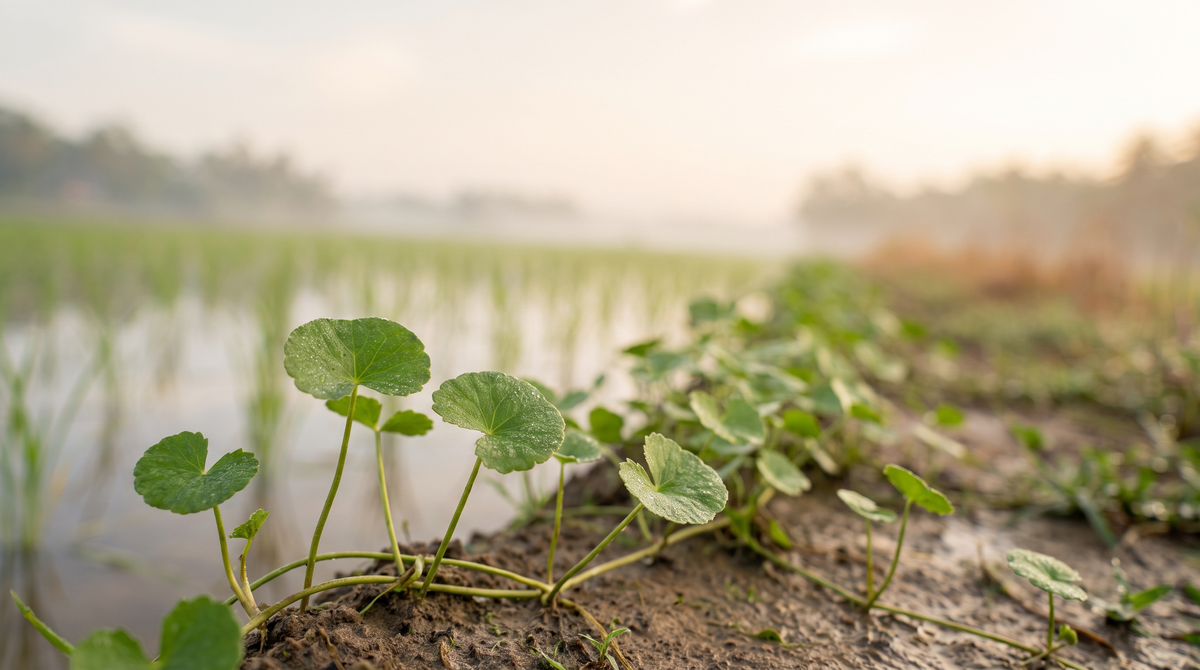
Walk the edge of a rice paddy in Sri Lanka and you will step on gotukola. It roots wherever the ground stays damp, it spreads without being asked, and it ends up in the sambol. That everyday ordinariness sits oddly beside the grand claims made for it.
Here is what the plant is, what gets gathered from it, what has been tested in people, and where it sits next to the Focus & Cognition System. The short version: gotukola is a lovely leaf with a modest research record, and it is not Brahmi.
Know the plant at the paddy edge
Gotukola is Centella asiatica, a member of the Apiaceae family. The European Medicines Agency's assessment report describes a slender, creeping perennial that roots at the nodes and grows in damp areas of tropical countries, and it lists Sri Lanka among the Asian countries where the plant is native (EMA, 2022). The leaves are small, rounded and scalloped, held up on long thin stalks.
What gets harvested is the aerial part: the leaves and their stalks, cut above the roots. Dried, that material is graded by its triterpene content. The pharmacopoeia standard cited in the EMA report asks for at least 6.0 percent total triterpenoid derivatives, expressed as asiaticoside. It explains why two products both labelled "gotukola" can differ in what they contain.
Read the focus research for what it shows
The most useful single number comes from a 2017 systematic review and meta-analysis in Scientific Reports. It pooled 11 randomised trials, five testing gotukola on its own and six testing products that contained it. It found no significant difference from placebo in any cognitive domain. It did find that people reported feeling more alert (a standardised effect of 0.71) and less angry one hour after a dose. No liver problems showed up in the trials it included (Puttarak et al., 2017).
There is one trial people like to quote. In a 2008 randomised, placebo-controlled study, 28 healthy older adults took 250, 500 or 750 mg of an extract daily for two months, and the highest dose improved working memory on a computer test (Wattanathorn et al., 2008). It is a small group with many outcomes measured, so a few positive results can turn up by chance, and the larger pooled analysis above did not find the same thing across trials.
A fair reading: gotukola may help you feel a little more awake and settled, and it has not been shown to sharpen thinking. The team's guide to what focus herbs can honestly claim grades it the same way, as calm alertness rather than memory.
Keep the leaf on your plate, and the capsule bounded
Eating gotukola as food and swallowing a concentrated capsule are different exposures. A handful of leaves in a sambol is a vegetable. A capsule is a supplement dose, and it deserves a plan.
- Use a course, not a habit. The directions on Ancient Nutra's Gotukola capsule are 1 capsule with a meal, once or twice daily, as a 30 day course, then a break of at least 1 to 2 weeks before any new course.
- Take it with a meal. It is not a stimulant, so there is no need to time it like coffee.
- Change one thing at a time. If you add gotukola, a new sleep schedule and a new routine in the same week, you will not know what helped.
A label that names Centella asiatica, the plant part and the amount per capsule, and directions that set a course length. Ancient Nutra's Gotukola capsule is a leaf powder in a vegetarian capsule.
Know the safety note before you start
NIH LiverTox gives Centella asiatica a likelihood score of C, meaning a probable rare cause of clinically apparent liver injury. The reported cases showed jaundice starting 3 to 8 weeks after oral use began, a liver-cell pattern, and recovery 1 to 2 months after stopping. LiverTox also notes that contamination of the commercial products could not be excluded in those cases (NIH LiverTox). Most people take it without trouble, which is what rare means.
Stop and see a doctor if you notice yellowing of the eyes or skin, dark urine, persistent nausea or unusual tiredness. Speak with your doctor before use if you are pregnant or breastfeeding, or if you take blood-thinning medication. The European herbal monograph for gotukola covers use on the skin, not swallowing it for focus, so treat the capsule as a food supplement with a bounded course.
See where it sits next to the Focus & Cognition System
Gotukola and Brahmi are different plants that get mixed up because both are used for the mind. Gotukola is Centella asiatica. The Brahmi in Ancient Nutra's range is Bacopa monnieri, known in Sinhala as Lunuvila.
That matters here, because gotukola is not one of the herbs in the Focus & Cognition System. The System pairs Lion's Mane, Brahmi (Bacopa monnieri) and Ginkgo Biloba. Gotukola is a separate product that some people take on its own, and the team's morning focus ritual explains why it is kept out of the morning set.
The bottom line
Gotukola is a good leaf to eat and a modest one to test. Enjoy it fresh, treat the capsule as a short, deliberate course, and keep sleep, daylight and food ahead of any herb. If you want the herbs built for focus as a set, the System is the place to start.

Focus & Cognition System
Lion's Mane, Brahmi and Ginkgo Biloba capsules, 60 of each.
Shop Focus & Cognition SystemSources and further reading
- Puttarak P, et al. Effects of Centella asiatica (L.) Urb. on cognitive function and mood related outcomes: a systematic review and meta-analysis, Scientific Reports, 2017.
- Wattanathorn J, et al. Positive modulation of cognition and mood in the healthy elderly volunteer following the administration of Centella asiatica, Journal of Ethnopharmacology, 2008.
- Assessment report on Centella asiatica (L.) Urb., herba, European Medicines Agency.
- Centella asiatica, NIH LiverTox.
Written by the Ancient Nutra Wellness Team. The team researches, sources, and tests every ingredient before it earns a place in an Ancient Nutra blend. Questions? Email info@ancientnutra.com or message Ancient Nutra on Instagram.
Medical disclaimer: This article is for educational purposes only and is not medical advice. Statements have not been evaluated by the FDA. Ancient Nutra products are not intended to diagnose, treat, cure, or prevent any disease. Speak with a qualified healthcare provider before starting any new supplement, especially if you take prescription medication or have a medical condition.