Ancient Nutra Wellness Team · 9 August 2026 · 6 min read
Gotukola: the Ceylon herb that never had to be imported
- Gotukola (Centella asiatica) is native to Sri Lanka, and the Department of Agriculture names the low country wet zone as the most suitable growing area, so the island has never needed to source it from abroad.
- Potency is not fixed. Total triterpene content has been measured anywhere from 0.5% to 11% by weight across different plant lines and growing conditions, a 22 fold spread.
- Drying temperature decides how much of that survives. Leaves dried around 28°C to 34°C held their triterpene glycosides, while leaves dried at 55°C held less.
- The strongest human evidence sits in circulation and vein studies, not cognition. A 2017 meta-analysis of 11 trials found no strong evidence for cognitive improvement.
- Concentrated extracts deserve normal caution: liver injury is documented but very rare, with onset at 3 to 8 weeks of use and full recovery after stopping.
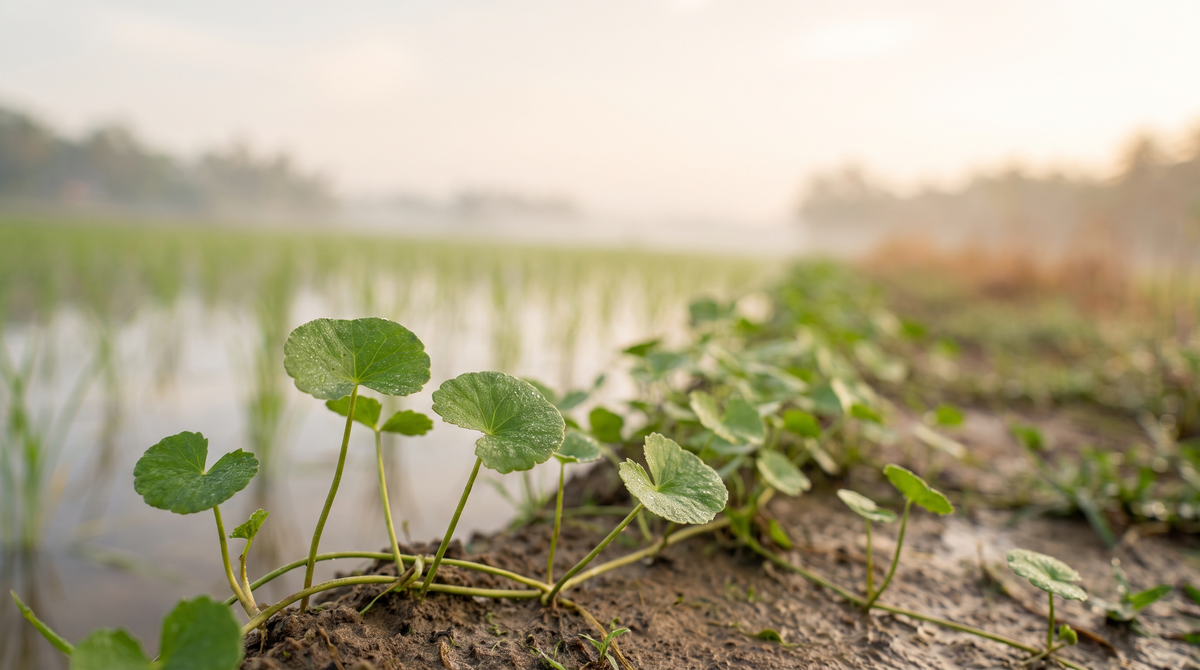
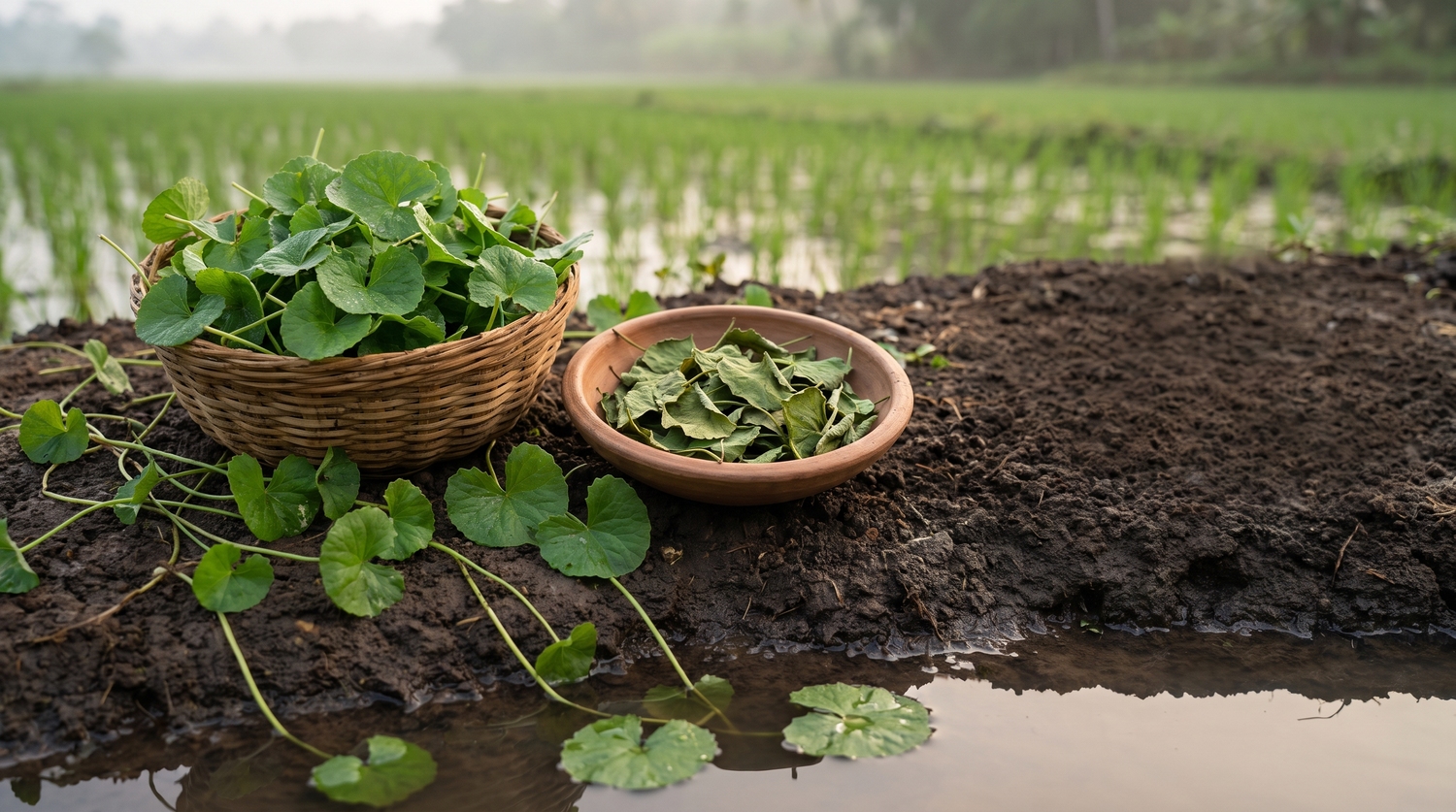
Gotukola grows in ditches, along paddy bunds, and in the damp corner of half the home gardens in the low country. Most Sri Lankan kitchens treat it as a vegetable rather than a supplement, chopped fine into mallung with coconut and lime. That everyday status hides something unusual. Of all the botanicals that sit in the Ayurvedic cabinet, this is one of the very few that the island has never had to buy from anywhere else. Its native range covers Sri Lanka, its preferred habitat is exactly the wet lowland it already has, and there is a published government protocol for growing it. This article stays on that ground: where gotukola actually comes from, what growing and drying do to it, and what the human research does and does not support.
Start with the plant, not the powder
The accepted botanical name is Centella asiatica (L.) Urb., in the Apiaceae family, which makes it a relative of carrot, celery, and coriander rather than of any mint. Older labels still carry the synonym Hydrocotyle asiatica. The same plant is vallarai in Tamil, mandukaparni in Sanskrit, and Asiatic pennywort in English. The part used is the leaf, taken with its creeping runners.
One naming point causes constant confusion on ingredient panels. In Ayurvedic texts the word brahmi has been applied to two different plants: Centella asiatica and Bacopa monnieri. They are not interchangeable, they belong to different families, and their active compounds are unrelated. Ancient Nutra keeps them as separate products for that reason, with Ancient Nutra's Brahmi Capsule made from lunuvila (Bacopa monnieri) and gotukola sold under its own name. If a label says brahmi and does not print a binomial, that label is not telling you what is inside it.
Trace gotukola back to Ceylon's own wetlands
Kew's Plants of the World Online records the native range of Centella asiatica as the Caucasus and the tropical and subtropical Old World, extending east to Australia and the western Pacific. Sri Lanka sits inside that range. This is a wetland plant by nature, at home along river edges, in swampy ground, in ditches, and in and around paddy fields, which is precisely why it turns up uninvited in so many Sri Lankan gardens.
The Department of Agriculture's own crop record puts numbers on it. The low country wet zone is named as the most suitable area for cultivation, well drained low land is the preferred land type, and the soil target is pH 6 to 7. The first harvest comes about 100 days after planting, and a single planting stays productive for 2 to 3 years. The department also names the cultivated types: a bush type and a vine type, the latter covering the large leaf Giant selection, the medium leaf Meerigama selection, described as the one most commercially grown, and the small leaf Wel Gotukola.
That combination is rarer than it sounds. Compare it with Madagascar, which is the world's dominant export source, sending out roughly 600 tonnes of dried leaf a year. That trade is still built on wild collection along rivers and rice fields rather than farming, and the sourcing organisations working there are candid that large scale cultivation while holding a high level of active principles has not been achieved. Sri Lanka's position is the quiet opposite: a plant that is native, a habitat that already exists, and a state agronomy protocol with named selections and planting densities. Nothing had to be introduced, acclimatised, or imported.
Expect potency to shift with where and how it grew
Gotukola's characteristic compounds are four triterpenes: the glycosides asiaticoside and madecassoside, and their aglycones asiatic acid and madecassic acid. How much of them a leaf carries is not a constant.
A 2021 review in Frontiers in Nutrition, written specifically about the problem of preparing a consistent Centella asiatica product for clinical trials, reported total triterpene content varying from 0.5% to 11% by weight across accessions. That is a 22 fold range inside one species, and it is the single most useful fact anyone buying this ingredient can hold on to.
Growing conditions are only half of it. A 2022 study in Scientific Reports grew 50 accessions side by side under identical conditions for six generations and still found asiaticoside ranging from 0.04% to 2.41% and madecassoside from 0.15% to 5.27%, with asiatic acid absent entirely from 28 of the 50 lines. Plant line matters independently of soil and climate. Provenance, properly understood, is genetics plus growing conditions plus handling, not a postcode.
Protect the actives at the drying stage
The step most likely to undo a good harvest is the least photogenic one. Work published in the South African Journal of Botany found that leaves dried at 28°C or 34°C accumulated triterpene glycosides, while leaves dried at 55°C contained less of them. Comparative drying studies point the same way: heated and oven drying reduce total centelloside content and total phenolics compared with gentler methods, and leaf colour degrades noticeably once the temperature climbs.
Read commercially, that means low temperature shade drying is not a romantic detail on a label. It is the difference between keeping the compounds the plant made and cooking them off in a hurry to move a lot faster. It is also why a bright green, clean smelling dried leaf is a better signal than a dark, dusty, over baked one.
Look for
A gotukola product that prints the binomial (Centella asiatica), states the plant part as leaf, and can say how the leaf was dried. Whole leaf or leaf powder tells you more than an unspecified "herbal blend", and a stated cultivar tells you more again. Ancient Nutra's Gotukola capsules are made from Sri Lankan grown leaf, dried whole and encapsulated without fillers.
Read the human evidence honestly
Gotukola's reputation in Sri Lanka is as a brain food, and that reputation is old and genuine. The clinical picture is narrower than the reputation, and it is worth saying so plainly.
The strongest human evidence is in circulation. A systematic review in Evidence-Based Complementary and Alternative Medicine pooled 8 randomised trials covering 483 people with chronic venous insufficiency and found transcutaneous oxygen improved against placebo (weighted mean difference 6.63, 95% CI 4.30 to 8.96), with ankle swelling reduced at 8 weeks. The authors flag an unclear risk of bias across most of the included studies, so this is a promising signal rather than a settled result.
On cognition, a 2017 meta-analysis in Scientific Reports pooled 11 randomised trials and concluded there is not strong evidence to support the use of Centella asiatica for improving cognitive function in any single cognitive domain. It did pick up short term mood and alertness signals measured an hour after dosing. If you have read the earlier piece on gotukola as a calming, mind clearing herb, treat that as the traditional and culinary case for it, and treat this paragraph as the state of the trial evidence. Both are true at once, and they are not the same claim.
Trial duration is worth borrowing too. The venous studies ran between about 4 and 8 weeks, and most of the cognition and mood trials ran 60 to 120 days, with a single 180 day outlier. Anything longer than that is beyond what has actually been tested, so treat a defined stretch of a few weeks as a trial period rather than opening an indefinite daily habit.
Treat a concentrated extract differently from a leaf in mallung
Eating gotukola as a leafy vegetable and taking a concentrated extract every day for weeks are two different exposures, and the safety record follows that split. The NIH LiverTox database assigns Centella asiatica a likelihood score of C, meaning a probable but rare cause of clinically apparent liver injury, and describes the reports as very rare. In the published cases, all involving supplement preparations rather than food use, the onset came after 3 to 8 weeks of use, the pattern was hepatocellular, and the injury resolved completely within 1 to 2 months of stopping.
The practical version is short. The organ to watch is the liver. If yellowing of the eyes or skin, unusually dark urine, persistent abdominal pain, or unexplained fatigue appear while taking a concentrated gotukola product, stop taking it and see a doctor, and do not restart it afterwards. Anyone with existing liver disease, or taking prescription medication, should ask their doctor before starting. None of this applies to a plate of mallung, and none of it makes the herb unsafe. It simply means a concentrated extract earns the same attention as any other concentrated ingredient.
The bottom line
Gotukola is the rare case where the supply chain question answers itself. The plant is native, the habitat is the wet zone the island already has, and the agronomy is published rather than proprietary. What is left to get right is everything after the harvest: the plant line, the drying temperature, and honest labelling about the part used. For an everyday leaf, cook it into a mallung as generations have. For a measured daily dose, Ancient Nutra's Gotukola capsules keep it simple: Sri Lankan leaf, encapsulated, nothing added.

Gotukola, 60 capsules
Sri Lankan grown gotukola leaf, dried and encapsulated with no fillers.
Shop GotukolaSources and further reading
- Crop profile: Gotukola, Department of Agriculture, Sri Lanka (HORDI).
- Centella asiatica species profile and native range, Plants of the World Online, Royal Botanic Gardens Kew.
- Wright KM et al. (2021), Developing a rational, optimized product of Centella asiatica for examination in clinical trials, Frontiers in Nutrition.
- Kunjumon R et al. (2022), Assessment of major centelloside ratios in Centella asiatica accessions grown under identical ecological conditions, Scientific Reports.
- Chong NJ and Aziz Z (2013), A systematic review of the efficacy of Centella asiatica for chronic venous insufficiency, Evidence-Based Complementary and Alternative Medicine.
- Puttarak P et al. (2017), Effects of Centella asiatica on cognitive function and mood related outcomes, Scientific Reports.
- Effect of drying temperature on centelloside content, South African Journal of Botany.
- Centella asiatica (gotu kola) record, LiverTox, National Institute of Diabetes and Digestive and Kidney Diseases.
Written by the Ancient Nutra Wellness Team. The team researches, sources, and tests every ingredient before it earns a place in an Ancient Nutra blend. Questions? Email info@ancientnutra.com or message Ancient Nutra on Instagram.
Medical disclaimer: This article is for educational purposes only and is not medical advice. Statements have not been evaluated by the FDA. Ancient Nutra products are not intended to diagnose, treat, cure, or prevent any disease. Speak with a qualified healthcare provider before starting any new supplement, especially if you take prescription medication or have a medical condition.