By the Ancient Nutra Wellness Team
- Gotukola (Centella asiatica) is a leafy herb used for centuries in Sri Lankan and Ayurvedic tradition as a medhya rasayana, or brain tonic.
- A 2017 meta-analysis of 11 randomised trials found no strong evidence that gotukola improves cognitive function in any domain, with only short-term mood and alertness gains seen around an hour after dosing.
- For steady daily use, a standardized extract such as Ancient Nutra's Gotukola Extract delivers a consistent dose of the leaf's active compounds.
In many Sri Lankan home gardens, gotukola grows almost on its own, a low carpet of small fan-shaped leaves near the well or along a shady wall. For generations it has landed on the lunch plate as a finely shredded sambol, and somewhere along the way a grandmother almost certainly pointed to it and said it was good for the brain. That piece of kitchen wisdom is genuinely old and real, even if the clinical trial evidence behind it is more modest than the folklore suggests.
Gotukola, the green hiding in plain sight
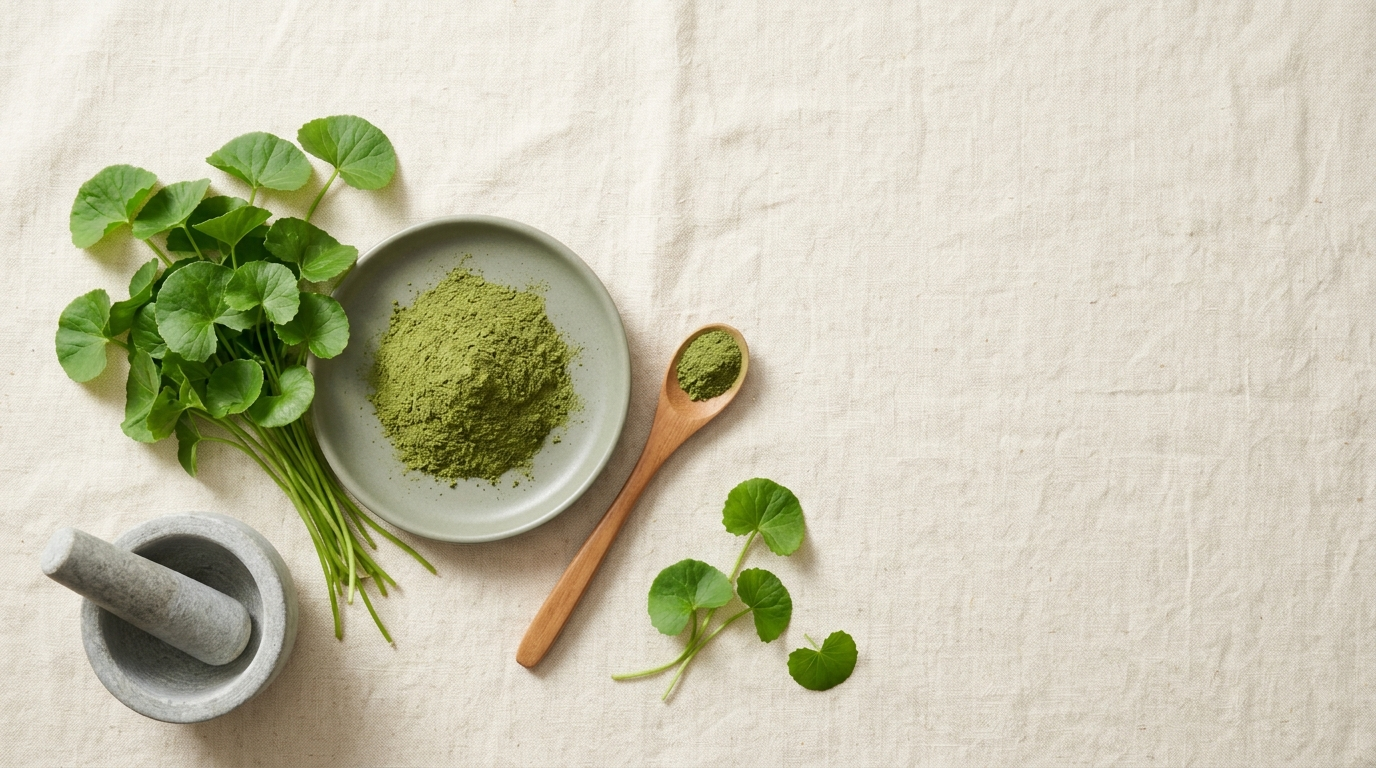
Gotukola is the Sri Lankan name for Centella asiatica, a creeping herb that thrives in the warm, damp corners of the tropics. In Ayurveda it belongs to a small group of plants known as medhya rasayana, herbs traditionally used to sharpen the mind and steady the memory. In Sri Lanka it has long been eaten as food first and medicine second, which is part of its charm: a traditional brain tonic you can grow by the back step and toss into a salad.
You can recognize it by its small, rounded, fan-shaped leaves that spread across the ground in low mats, often confused with the unrelated penny-wort weeds that grow alongside it. The taste is fresh and faintly bitter, which is why it is usually finely shredded and balanced with coconut, lime, and chili in a classic gotukola sambol rather than eaten on its own.
The leaf carries a family of natural compounds called triterpenoid saponins, the best known being asiaticoside and madecassoside. These are the molecules researchers tend to focus on when they study what gotukola does in the body, and they are also the reason a good extract is measured by more than just weight.
What the trial evidence actually says
Most of gotukola's traditional reputation rests on a simple idea: it helps the mind feel clearer and calmer at the same time. That traditional use is genuine and centuries old. The clinical trial evidence is narrower than the reputation. A 2017 systematic review and meta-analysis in Scientific Reports pooled 11 randomised controlled trials and concluded there is not strong evidence to support Centella asiatica for improving cognitive function in any single cognitive domain. It did pick up short-term mood and alertness signals, measured around an hour after dosing.
One smaller, earlier controlled trial in healthy older adults, folded into that same 2017 meta-analysis, reported improvements in working memory and self-rated mood after two months of a Centella asiatica extract. It is one data point inside a body of evidence that, taken as a whole, did not clear the bar for a reliable cognitive effect, so it is worth noting rather than leaning on.
How might a humble garden leaf do any of this? In laboratory and animal studies, the triterpenoid saponins in gotukola act as antioxidants in nervous tissue and appear to support the brain's own growth signals, including pathways linked to brain-derived neurotrophic factor and the branching of nerve cells. This is early-stage mechanistic work, not proof of a cognitive benefit in people. Gotukola is not a treatment for any medical condition, and it is better understood as a traditional daily practice than a proven nootropic.
That framing matters more than ever in a world of constant notifications and half-finished tabs. The traditional appeal of gotukola was never a sudden jolt of energy, but the opposite: a steadier, less scattered attention that holds up through a long afternoon. It is the difference between forcing focus and quietly making space for it, which is exactly what the older Ayurvedic idea of a medhya rasayana was always pointing at.
A gotukola extract standardized to its active compounds (asiaticoside and madecassoside), grown without a heavy pesticide load, and processed to keep the whole-leaf profile rather than a single isolated fraction. A clear dose per serving on the label matters more than a big number on the front.
The right way to take gotukola
Gotukola can be eaten fresh, brewed as a mild tea, or taken as a concentrated extract. Fresh leaves are wonderful when you have a garden and the time, but the dose changes with every handful, and the bitterness is not for everyone. A standardized extract solves both problems by delivering a steady amount of the active compounds in each serving.
Ancient Nutra's Gotukola Extract is made for exactly this kind of everyday use, a consistent daily dose without the guesswork of the garden. Many people take the extract in the morning, when a little extra clarity is welcome, and pair it with food.
Because gotukola leans toward calm focus rather than stimulation, it sits naturally alongside other grounding herbs. Some readers combine it with Ancient Nutra's Ashwagandha Extract for steady daytime composure, or reach for a related in-stock adaptogen, Maca Root Extract, while Reishi Extract is out of stock. As with any herb, consistency over a few weeks tends to matter more than any single dose.
Who gotukola suits, and who should be cautious
Gotukola suits people who want gentle, traditional support for a calmer, clearer head during busy stretches, whether that is a student in exam season or anyone juggling a demanding week, with realistic expectations about what the trial evidence does and does not show. It is food-derived and has a long history of culinary use, which is part of why it feels approachable.
A few people should take more care. Anyone who is pregnant or nursing, has a liver condition, or takes medication that affects the liver should speak with a qualified healthcare professional before using a concentrated extract, since culinary amounts and supplemental doses are not the same thing. If gotukola ever causes stomach upset or drowsiness, it is sensible to lower the amount or stop.
None of this changes the older, simpler picture. Gotukola is still the slightly bitter green by the garden wall, the leaf a grandmother pointed to with quiet confidence. Used steadily, as a traditional daily practice and with realistic expectations, it remains one of the easiest ways to bring a little Sri Lankan garden wisdom into a modern morning.

Gotukola Extract
A standardized daily dose of Sri Lanka's traditional brain-tonic leaf, for calm, steady focus.
Shop Gotukola ExtractSources
- Puttarak P, Dilokthornsakul P, Saokaew S, et al. Effects of Centella asiatica (L.) Urb. on cognitive function and mood related outcomes: A Systematic Review and Meta-analysis. Scientific Reports, 2017.
- Wattanathorn J, Mator L, Muchimapura S, et al. Positive modulation of cognition and mood in the healthy elderly volunteer following the administration of Centella asiatica. Journal of Ethnopharmacology, 2008.
The information in this article is for educational purposes only and is not intended as medical advice. Ancient Nutra products are food supplements, not medicines, and are not intended to diagnose, treat, cure, or prevent any disease. Consult a qualified healthcare professional before starting any supplement, especially if you are pregnant, nursing, taking medication, or managing a health condition. Last reviewed 10 August 2026.