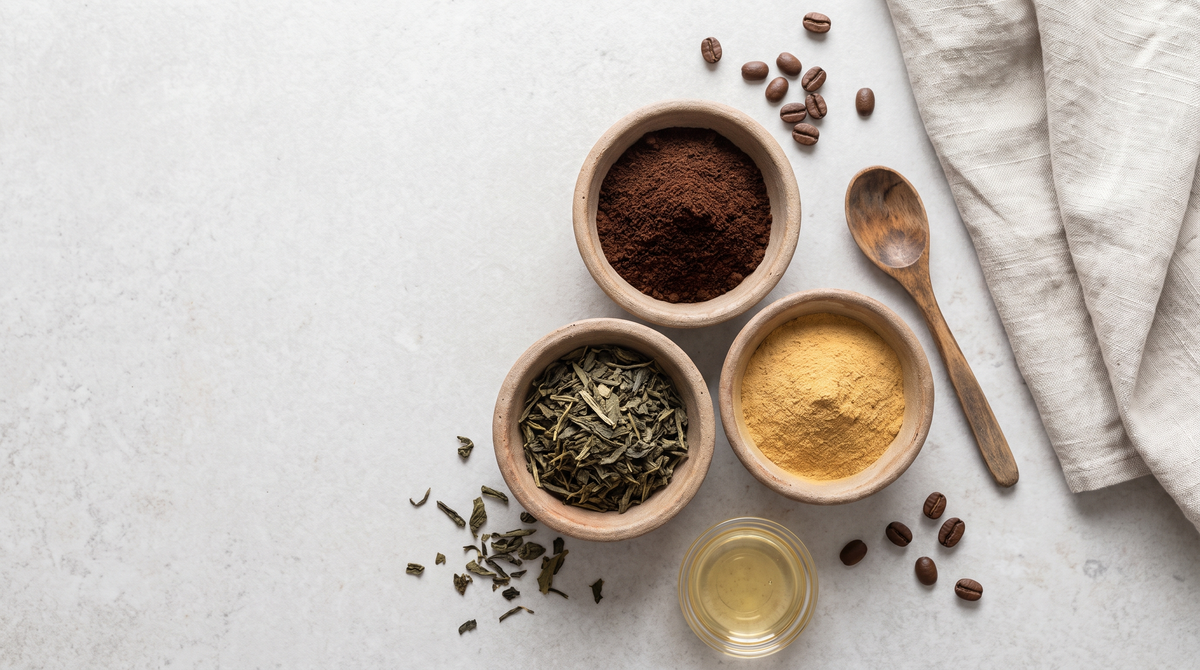
Ancient Nutra Wellness Team · 17 September 2026 · 6 min read
Coffee Scrubs and Green Tea on Skin: What the Research Shows
By the Ancient Nutra Editorial Team
Key takeaways
- A kitchen coffee or green tea scrub does two different things: the grit exfoliates the surface, and the chemistry (caffeine, catechins) only matters if it stays on the skin at a known strength.
- In a controlled trial of 40 women with sun-damaged skin, 8 weeks of a green tea regimen produced no visible difference compared with placebo, although skin biopsies showed some change.
- The strongest green tea skin result comes from a standardised prescription ointment, not a home mask, and most people using it still had skin reactions.
Coffee grounds rubbed on the thighs, a cooled green tea bag pressed under each eye, a matcha face mask on a Sunday. These are some of the most shared skincare habits there are, and most come with a confident promise: tighter skin, less puffiness, fewer signs of age. The honest position is less exciting and more useful. Caffeine and green tea compounds do interesting things in a laboratory, and a handful of real human trials exist. But what those trials tested is rarely what ends up on a bathroom shelf. This piece separates the two, so you can keep the habits that make sense and drop the promises that do not.
Separate the scrub from the chemistry
Any homemade scrub is really two products in one. The first is physical: small, firm particles that loosen dead surface cells when you rub them over damp skin. Coffee grounds, sugar, fine wood powders and oats all do this, and the smooth feeling afterwards comes mostly from that mechanical step.
The second is chemical. Coffee carries caffeine, and green tea carries catechins, the antioxidant compounds most often studied in tea. For those to do anything, they have to reach the skin at a meaningful strength and stay there long enough to be absorbed. A scrub that is rubbed on for a minute and rinsed off is poorly designed for that job, however good it smells.
Understand what caffeine does on skin
Caffeine is one of the better understood cosmetic ingredients, largely because it passes through the skin barrier well enough that researchers use it as a standard test substance in absorption experiments. A review in Skin Pharmacology and Physiology notes that commercial topical caffeine products normally contain around 3% caffeine, and that it is added to anti-cellulite products because, in laboratory work, it encourages fat cells to break down stored fat. The same review describes antioxidant activity and increased blood flow in the skin.
Two things are worth noticing. First, those are mechanisms, mostly shown in cells and lab models, not proof of a visible change on a person's legs. Second, they describe leave-on formulas with a measured caffeine content. Wet coffee grounds have no stated strength, and they spend a minute or two on the skin before going down the drain.
The team searched PubMed, the US National Library of Medicine's research index, for a controlled human trial of a coffee-ground body scrub and did not find one. That does not mean a coffee scrub does nothing. It means the smoother feel is best explained by exfoliation, and any claim about cellulite or firming from the grounds themselves is running ahead of the evidence.
Read the green tea trials for what they tested
Green tea has more human research behind it than coffee does, and it is instructive precisely because the results are mixed.
In a double-blind, placebo-controlled trial published in Dermatologic Surgery, 40 women with moderate sun damage were given either a green tea regimen or a placebo for 8 weeks. The green tea group used a 10% green tea cream alongside green tea capsules. When dermatologists graded the skin by eye, there was no significant difference between the groups, and the green tea group reported more irritation. Skin biopsies did show a statistically significant improvement in elastic tissue. Because the regimen combined a cream with capsules, the trial cannot tell you what the cream achieved on its own.
The clearest green tea success on skin is a different kind of product altogether. Sinecatechins, a defined and standardised green tea extract, is made into a prescription ointment for external genital warts. In a randomised trial of 502 adults published in Obstetrics and Gynecology, complete clearance was reached in 57.2% of people using the 15% ointment and 56.3% using the 10% ointment, compared with 33.7% on the inactive base. It was applied three times a day for up to 16 weeks, and about 87% of people using the active ointment had reactions where it was applied.
The lesson carries over well. When green tea does something measurable on skin, it is as a precisely standardised medicine, used for a specific condition under a doctor's direction, and it still irritates most users. A home tea mask is not a gentler version of that product. It is simply an unmeasured one.
One note on scope: this article is about applying coffee and green tea to the skin only. Drinking tea, or taking green tea extract by mouth, is a separate question with separate evidence, and nothing here speaks to it.
Build a skin routine that does the heavy lifting
If the goal is skin that looks healthier over months, the habits with the best track record are plain ones:
- Daily sun protection. Sun exposure is a major driver of visible skin ageing, which is why the green tea trial above enrolled women with sun damage in the first place.
- Gentle cleansing. Skin that is stripped twice a day tends to get drier and more reactive, not clearer.
- Scrubbing no more than once or twice a week. More often than that is a common route to redness.
- Sleep. Several of the complaints people blame on their products are really sleep problems showing up on the face.
A weekly scrub can still earn a place, for the ritual and the smooth finish. Just choose it on texture and on how your skin tolerates it, rather than on antioxidant promises. A scrub fits naturally into a slower evening skin ritual, once or twice a week.
Look for
A fine, even powder rather than coarse, sharp grounds, especially for the face, and a product you patch test on the inner arm before the first full use. Sri Lankan households have long mixed wood and herb powders into face packs, and Ancient Nutra's Venivel Powder follows that tradition: mixed with water and honey into a paste, used once or twice a week. For what is and is not known about the vine itself, read Venivel: what we actually know.
Know when to see a dermatologist instead
A scrub or mask should never be the answer to a skin change that worries you. Stop using a product and speak to a doctor or dermatologist if you notice burning, swelling, a spreading rash or redness that lasts beyond a day. See a doctor promptly about any new, growing or changing mole or patch, about acne that leaves marks or is not improving, and about warts in the genital area, which need a proper diagnosis and treatment rather than anything from the kitchen.
The bottom line
Coffee and green tea contain compounds that do real things in the lab, but a scrub that is rinsed off in a minute mostly works by exfoliation, and no controlled trial shows a coffee-ground scrub changing cellulite or firmness. The green tea research is more developed and more humbling: no visible difference in a combined cream and capsule trial, and a genuine result only from a standardised prescription ointment that most users found irritating.
- Protect your skin from the sun every day.
- Scrub gently, once or twice a week at most.
- Choose a scrub for texture and tolerance, not for antioxidant claims.
For a traditional weekly face pack or body scrub, Ancient Nutra's Venivel Powder is one simple option to patch test and try.

Venivel Powder 100g
A traditional Sri Lankan face pack and body scrub powder, mixed with water and honey, for a once or twice weekly ritual.
Shop Venivel PowderSources and further reading
- Herman A, Herman AP. Caffeine's mechanisms of action and its cosmetic use. Skin Pharmacol Physiol. 2013;26(1):8-14, PubMed, US National Library of Medicine.
- Chiu AE, Chan JL, Kern DG, et al. Double-blinded, placebo-controlled trial of green tea extracts in the clinical and histologic appearance of photoaging skin. Dermatol Surg. 2005;31(7 Pt 2):855-60, PubMed, US National Library of Medicine.
- Tatti S, Swinehart JM, Thielert C, et al. Sinecatechins, a defined green tea extract, in the treatment of external anogenital warts: a randomized controlled trial. Obstet Gynecol. 2008;111(6):1371-9, PubMed, US National Library of Medicine.
Written by the Ancient Nutra Wellness Team. The team researches, sources, and tests every ingredient before it earns a place in an Ancient Nutra blend. Questions? Email info@ancientnutra.com or message Ancient Nutra on Instagram.
Medical disclaimer: This article is for educational purposes only and is not medical advice. Statements have not been evaluated by the FDA. Ancient Nutra products are not intended to diagnose, treat, cure, or prevent any disease. Speak with a qualified healthcare provider before starting any new supplement or skincare product, especially if you take prescription medication or have a medical condition.