Ancient Nutra Wellness Team · 18 September 2026 · 6 min read
Turmeric extract: why a short course beats a daily habit
By the Ancient Nutra Editorial Team
- Turmeric extract is a concentrated form of a kitchen spice, standardised to about 95% curcuminoids. That concentration is the whole point, and it is also why it is not a forever supplement.
- The strongest human trial ran for four weeks: 1,500 mg a day of turmeric extract performed as well as ibuprofen for knee pain, with fewer stomach complaints.
- NIH's LiverTox database rates turmeric category A for liver injury, with cases typically appearing between one and four months of use. A short, purposeful course is the honest way to take it.
Most people take turmeric the way they take a multivitamin: one capsule, every morning, forever, on the vague understanding that it is anti-inflammatory and therefore good. That is the wrong shape for this particular herb. Turmeric extract is a targeted tool, not a background habit. It has real human evidence behind it, and it has a real liver signal attached to it, and both of those facts point in the same direction: take it for a reason, for a set length of time, then stop.
What turmeric extract actually is
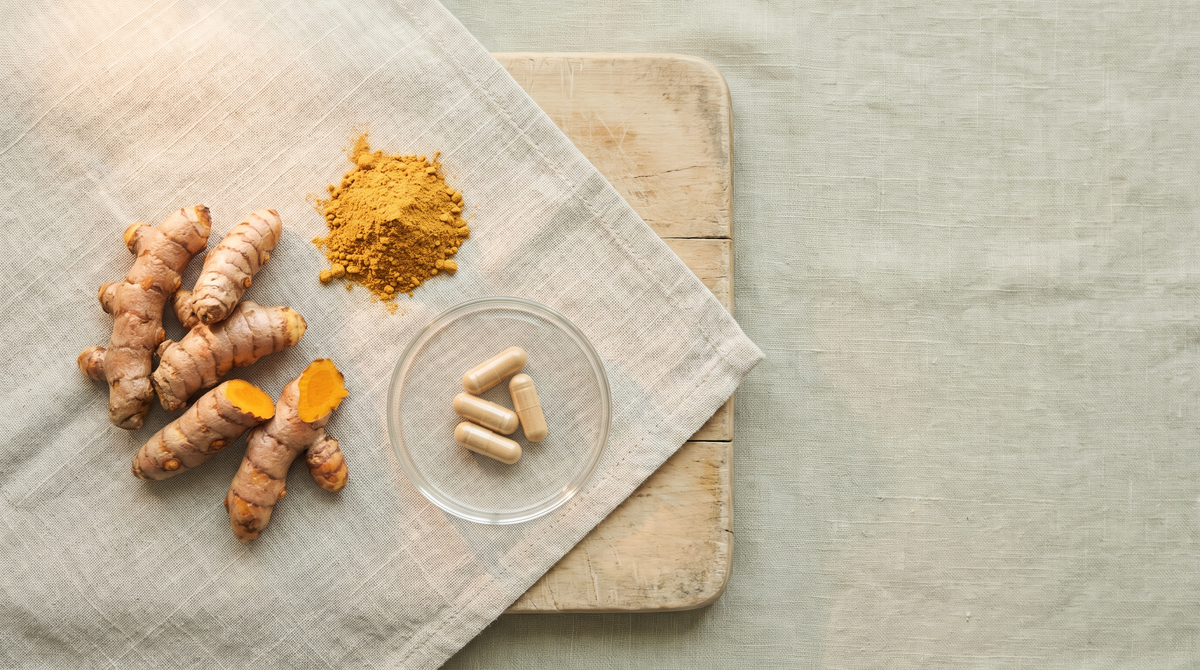
Turmeric comes from the rhizome, the knobby underground stem, of Curcuma longa, a plant native to India and grown across Southern Asia and Central America. The bright yellow colour comes from curcuminoids, and curcumin is the one that gets studied.
Here is the part that matters. A pinch of turmeric in a curry is roughly 3% curcuminoids. A standardised extract is around 95%. Those are not the same ingredient in different packaging. They are two very different exposures, and every claim and every caution on this page is about the second one.
What the evidence actually shows
The cleanest human result is a Thai trial published in Clinical Interventions in Aging. Researchers gave 367 people with knee osteoarthritis either 1,500 mg a day of turmeric extract or 1,200 mg a day of ibuprofen, and followed them for four weeks. The turmeric group did as well as the ibuprofen group on pain, stiffness and function, and reported fewer stomach side effects (Kuptniratsaikul et al., 2014).
That is a genuinely useful finding, and it is worth reading precisely. It is four weeks, in people with knee pain, at a specific dose. It is not evidence that turmeric does something for you every day for a year, and it is not evidence for the other things turmeric gets sold for. The US National Center for Complementary and Integrative Health puts the wider picture plainly: not enough is known to conclude that turmeric or curcumin is beneficial for any health purpose. One good trial for one use case is exactly what it looks like.
Curcumin is also poorly absorbed and quickly cleared by the body. That is a plain fact about the molecule, and it is the reason extracts exist at all.
The liver signal, stated straight
NIH's LiverTox database rates turmeric category A, which is its wording for a well documented cause of clinically apparent liver injury. Injury usually showed up between one and four months into use, and the reported cases have clustered around concentrated supplements rather than food, particularly formulations built to push absorption higher (LiverTox, NIH).
This is not a reason to be frightened of turmeric. It is a reason to treat the extract as a course rather than a habit, and to know what to watch for. Stop taking it and see a doctor if you notice yellowing of the eyes or skin, dark urine, persistent nausea, or unusual tiredness. Those four are the ones that matter.
Who a short course actually suits
- People with a specific, ongoing joint complaint. Knee stiffness that shows up on stairs and after long sitting is closest to what the trial measured.
- People coming off a hard training block. A defined few weeks of soreness is a defined problem, which is the shape turmeric fits.
- People who want an alternative to reaching for ibuprofen daily. The trial's own comparison, and worth a conversation with your doctor rather than a swap made alone.
And who does not need it: anyone taking it as a general wellness insurance policy. If nothing specific hurts, a daily curcumin capsule is not quietly protecting you, and given the liver data, open-ended use is the one pattern actively worth avoiding. Turmeric in your food is a different matter entirely, and you can keep cooking with it.
How to run a course without running it forever
The trial dose was 1,500 mg a day of extract, split across the day and taken with meals. Take it with food, not on an empty stomach. Give a course four weeks before you judge whether it is doing anything for the specific thing you started it for, because four weeks is the window the evidence actually covers.
Then set an end. Ancient Nutra's own label guidance is the plain version: it is recommended to take a 1-week break after every 8 to 12 weeks of continuous use. Read that alongside the LiverTox latency window of one to four months and the logic becomes obvious. A course has a finish line. A habit does not.
Look for
An extract standardised to a stated curcuminoid percentage, with the milligrams per capsule printed on the label, not a vague "turmeric blend". Ancient Nutra's Turmeric Extract states 95% standardised curcuminoids and carries its liver caution on the same page.
What to pair it with, and what not to
Ginger sits in the same culinary family and the same kitchen, and it is the gentler daily companion of the two. If you want something you actually can keep in a morning routine, Ancient Nutra's Ginger is the easier long-term member of the pair, while turmeric does its shorter, more pointed job.
One pairing to be clear about: turmeric is not a liver herb. It is sometimes marketed that way, and the evidence points the other direction. If liver support is what you are actually after, that is a separate goal with a separate herb. Milk thistle, from the seeds of Silybum marianum, has been used for liver complaints for centuries, and NIH's LiverTox rates it category E, its lowest tier, meaning an unlikely cause of liver injury. It is not an anti-inflammatory substitute for turmeric, and it is not a reason to take turmeric for longer.
The bottom line
Turmeric extract has one solid human trial behind it, at a real dose, over four weeks, for a real problem. It also has a documented liver signal that shows up over months. Both facts are true at once, and together they describe a supplement you pick up for a reason and put down on schedule. If you have been taking it every morning for a year without a specific reason, the useful change is not a different brand. It is a finish line. For more on the everyday misreadings of this herb, 6 things people get wrong about turmeric covers the rest.
And if the goal was liver support all along, the honest answer is that you were shopping in the wrong aisle.

Milk Thistle Extract
Silymarin from milk thistle seed, the traditional choice for liver support, rated category E by NIH LiverTox.
Shop Milk Thistle ExtractSources and further reading
- Kuptniratsaikul V, et al. "Efficacy and safety of Curcuma domestica extracts compared with ibuprofen in patients with knee osteoarthritis," Clinical Interventions in Aging, 2014.
- Turmeric monograph, LiverTox, National Institutes of Health.
- Milk thistle monograph, LiverTox, National Institutes of Health.
- Turmeric fact sheet, National Center for Complementary and Integrative Health.
- Daily JW, et al. "Efficacy of turmeric extracts and curcumin for alleviating the symptoms of joint arthritis," Journal of Medicinal Food, 2016.
Written by the Ancient Nutra Wellness Team. The team researches, sources, and tests every ingredient before it earns a place in an Ancient Nutra blend. Questions? Email info@ancientnutra.com or message Ancient Nutra on Instagram.
Medical disclaimer: This article is for educational purposes only and is not medical advice. Statements have not been evaluated by the FDA. Ancient Nutra products are not intended to diagnose, treat, cure, or prevent any disease. Speak with a qualified healthcare provider before starting any new supplement, especially if you take prescription medication or have a medical condition.