Ancient Nutra Wellness Team · 29 July 2026 · 5 min read
Ashwagandha hot chocolate: the cup for cold, wet evenings
Key takeaways
- Six ingredients, one saucepan, about six minutes from cold milk to a warm cup.
- Cocoa is bitter and earthy, which is exactly why it hides the taste of ashwagandha root better than fruit or vanilla ever will.
- One teaspoon of powder per cup is the working dose. More does not taste better and does not work faster.
- This is an evening drink, not a sleeping pill. It helps the wind-down, it does not force it.
NIH LiverTox rates ashwagandha (Withania somnifera) likelihood score B, a likely cause of clinically apparent liver injury. Onset is typically 2 to 12 weeks after starting, with a cholestatic or mixed pattern, often with jaundice and itching. About 23 documented cases have been reported since 2017. Most were self-limited, but rare fatal cases, emergency transplant, and 3 deaths from acute-on-chronic liver failure have been reported in an Indian case series. Serious outcomes are uncommon relative to how widely ashwagandha is used, but they are real, so take the herb in a bounded course, not indefinitely.
Stop and seek medical help if you notice yellowing of the eyes or skin, itching, dark urine, persistent nausea, or unusual tiredness.
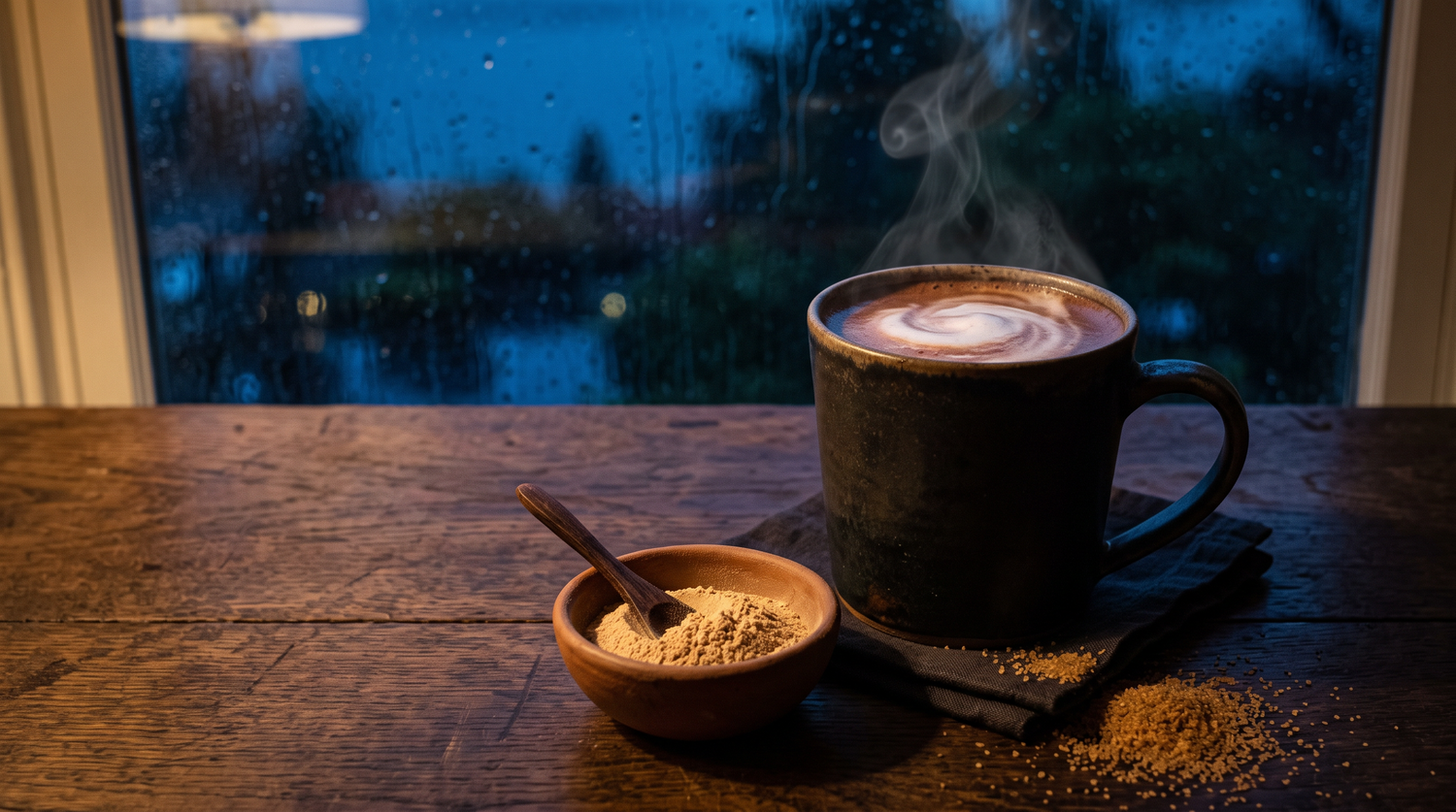
Sri Lanka does not really do winter, but it does do wet. From late May the hill country goes grey by four in the afternoon, the rain sets in against the windows, and the house drops just enough degrees to make a hot drink feel necessary rather than indulgent. That is the cup this recipe is built for. It is cocoa, warm milk, a spoon of coconut sugar, and one teaspoon of ashwagandha root, stirred in while the milk is still below a simmer. It takes about six minutes, it uses one pan, and it tastes like a proper hot chocolate rather than a supplement someone tried to disguise.
What you need
Ingredients (serves 1)
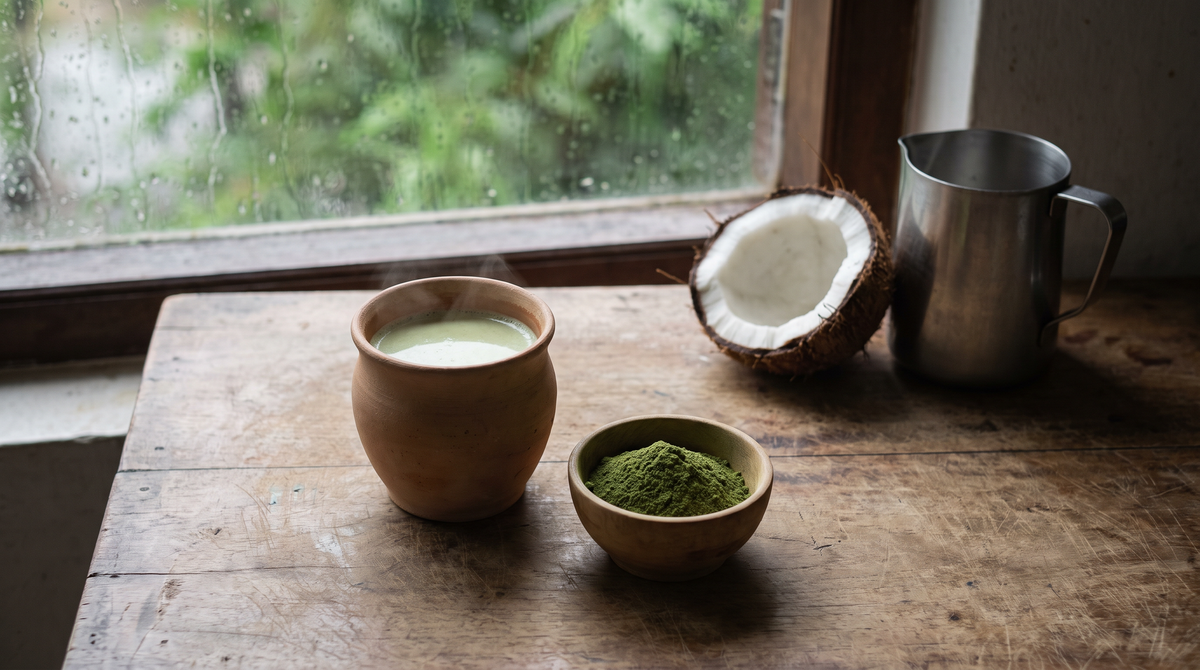
- 1 cup (240 ml) milk, dairy or thick coconut milk
- 2 teaspoons unsweetened cocoa powder, or 2 heaped teaspoons of Ancient Nutra's Hot Chocolate Mix
- 1 teaspoon Ancient Nutra's Ashwagandha Powder
- 2 teaspoons Ancient Nutra's Coconut Sugar, adjusted to taste
- 1 pinch ground Ceylon cinnamon
- 1 small pinch of salt
If the Hot Chocolate Mix is already in the cupboard, use it in place of the plain cocoa and drop the coconut sugar to one teaspoon, since the mix is lightly sweetened on its own. Everything else stays the same.
How to make it
- Make a paste first. In the cold pan, whisk the cocoa, ashwagandha powder, coconut sugar, cinnamon and salt with 2 tablespoons of the milk until it is a smooth, glossy paste with no dry pockets. Skipping this step is the single most common reason hot chocolate turns out lumpy.
- Add the rest of the milk. Pour it in slowly while whisking, so the paste loosens evenly instead of seizing.
- Warm it gently. Medium to low heat, whisking every 20 seconds or so, for 3 to 4 minutes. Stop when the surface steams and the edges just begin to move. It should be hot enough to fog a spoon but never bubbling.
- Whisk hard for 20 seconds. This is what builds the light foam on top and keeps the root powder suspended instead of sitting at the bottom of the cup.
- Pour and taste. Add a quarter teaspoon more coconut sugar only if it needs it. Cocoa tastes more bitter at the first sip than at the fifth, so wait before sweetening again.
Yields one warm cup, about 240 ml. Best sipped slowly, roughly 60 to 90 minutes before bed.
Why cocoa and ashwagandha work together
Ashwagandha root has a flavour problem. It is bitter, faintly horsey, and it clings to anything light and sweet, which is why it disappears into vanilla or banana smoothies badly and into dark cocoa well. Cocoa is already bitter and already earthy, so it does not fight the root, it absorbs it. The pinch of salt is not there for saltiness, it is there because a small amount of salt makes cocoa read as rounder and less sharp, which buys room for the ashwagandha.
On the herb itself, ashwagandha is an adaptogen studied mainly for stress load. In a 60-day randomised, double-blind trial in chronically stressed adults, a standardised root extract was associated with a significant reduction in serum cortisol against placebo (Chandrasekhar et al., Indian Journal of Psychological Medicine, 2012). That trial used a concentrated extract in capsule form, not a teaspoon of loose root in a mug, so read this cup as a comfortable way to keep the herb in the daily routine, not as a clinical dose. The routine is the part that matters: ashwagandha is a build-up herb and needs weeks of consistency, not one good night.
Warm milk with a spice and a sweetener before bed is an old habit across South Asia, and the version most Sri Lankan households know leans on cardamom and jaggery rather than cocoa. This is that habit with a cocoa base.
Look for
Loose ashwagandha for drinks should be plain milled root with nothing else in the pack: no fillers, no flavouring, no added sweetener. It should smell strongly of the root and taste bitter on its own, because a powder that tastes of nothing is usually cut with something. Ancient Nutra's Ashwagandha Powder is single-ingredient milled root, which is what makes it usable by the teaspoon in food and drinks. If capsules suit the routine better, the trade-offs are set out in powder versus capsules.
Three ways to change it
- Dairy-free and richer: use thick coconut milk instead of dairy and cut the coconut sugar to one teaspoon, since coconut milk reads sweeter on its own.
- No added sugar: drop the coconut sugar entirely and add half a teaspoon more cocoa plus a second pinch of cinnamon. It is a darker, more adult cup.
- Spiced Ceylon version: warm a bruised cardamom pod and a small piece of cinnamon bark in the milk for two minutes, lift them out, then continue from step one.
For batch prep, mix eight portions of the dry ingredients (cocoa, ashwagandha, coconut sugar, cinnamon, salt) in a clean jar and shake well. Three heaped teaspoons of that mix per cup of milk gets the same result on a night when nobody wants to measure anything.
When to drink it
Evenings, once a day, ideally 60 to 90 minutes before bed, as a bounded eight to twelve week course, then a break, so the drink is finished well before lights out. Cocoa carries a small amount of caffeine and theobromine, so anyone who is genuinely caffeine-sensitive should move the cup to late afternoon rather than 10pm. It sits well after a light dinner and badly after a heavy one. And the honest caveat: this is a warm drink with a herb in it. It supports a calmer wind-down as part of a routine, it does not sedate anyone, and it will not undo a day that ended with a screen at midnight. For the evening structure around it, there is a 5-minute evening sleep routine the drink fits neatly into.
The bottom line
A cup of cocoa is the easiest place to hide a daily teaspoon of ashwagandha, and hiding it well is most of the battle, because the herb only pays out with consistency. The minimum version needs three things, not six: milk, cocoa, and one teaspoon of ashwagandha powder. Coconut sugar, cinnamon and salt make it taste like something worth looking forward to on a wet evening. If bedtime is the specific goal rather than the evening in general, the ashwagandha moon milk recipe is the cardamom-led alternative to this one.

Ashwagandha Powder 100g
Single-ingredient milled root, measured by the teaspoon into drinks and food.
Shop Ashwagandha PowderWho should check with a doctor first: ashwagandha can interact with thyroid medication (it may raise thyroid hormone levels), sedatives (it can add to drowsiness), and immunosuppressants (it may counteract them by stimulating the immune system). Avoid it in pregnancy. If someone has a thyroid or autoimmune condition, they should check with a doctor before starting.
Sources: NIH LiverTox, Ashwagandha (NBK548536).
This article is for general information and is not medical advice. Speak with a doctor before starting ashwagandha, especially if pregnant, on thyroid medication, sedatives, or immunosuppressants, or if managing a thyroid or autoimmune condition. Last reviewed 6 August 2026.
Sources and further reading
- Chandrasekhar K, Kapoor J, Anishetty S. A prospective, randomized double-blind, placebo-controlled study of safety and efficacy of a high-concentration full-spectrum extract of ashwagandha root in reducing stress and anxiety in adults, Indian Journal of Psychological Medicine, 2012.
Written by the Ancient Nutra Wellness Team. The team researches, sources, and tests every ingredient before it earns a place in an Ancient Nutra blend. Questions? Email info@ancientnutra.com or message Ancient Nutra on Instagram.
Medical disclaimer: This article is for educational purposes only and is not medical advice. Statements have not been evaluated by the FDA. Ancient Nutra products are not intended to diagnose, treat, cure, or prevent any disease. Speak with a qualified healthcare provider before starting any new supplement, especially if you take prescription medication or have a medical condition.