Most people who try Ashwagandha quit before it has a chance to work. Not because it failed, but because they ran the protocol wrong. The clinical trials that made this Ayurvedic root famous all share three traits: standardized extract, daily dosing, and at least eight weeks of patience. Skip any of those and the bottle on your shelf is doing nothing for you.
Here are the five mistakes the team at Ancient Nutra hears about most often, and the one-step fix for each.
- The clinical trials behind Ashwagandha used standardized extract at 300mg to 600mg a day, taken daily for at least 8 weeks, so quitting after a week is the most common reason it seems to do nothing.
- Take it with a meal that has some fat, ideally at dinner, since the active withanolides are fat-soluble and the herb supports sleep and recovery rather than instant energy.
- It can interact with thyroid medication, sedatives, and blood pressure medication, so mention it to a doctor before stacking it on prescriptions.
NIH LiverTox rates ashwagandha (Withania somnifera) likelihood score B, a likely cause of clinically apparent liver injury. Onset is typically 2 to 12 weeks after starting, with a cholestatic or mixed pattern, often with jaundice and itching. About 23 documented cases have been reported since 2017. Most were self-limited, but rare fatal cases, emergency transplant, and 3 deaths from acute-on-chronic liver failure have been reported in an Indian case series. Serious outcomes are uncommon relative to how widely ashwagandha is used, but they are real, so take the herb in a bounded course, not indefinitely.
Stop and seek medical help if you notice yellowing of the eyes or skin, itching, dark urine, persistent nausea, or unusual tiredness.
The short version
- Quitting after a week because nothing happened
- Taking it with morning coffee on an empty stomach
- Buying raw root powder when the dose data is on extract
- Treating it like a pre-workout for instant energy
- Stacking it with sleep meds, thyroid meds, or sedatives without telling a doctor
Mistake 1. Quitting after a week because nothing happened
Most people open the bottle on Monday and expect to feel something by Friday. That is not how the herb works.
Ashwagandha is a slow adaptogen. It does not jolt the nervous system the way caffeine does. Instead, it shifts the way the body handles stress over weeks. The two best-known trials, an 8-week dose-response study and a meta-analysis covering thousands of participants, both measured cortisol drops at the 8-week mark, not at day 5 (Lopresti et al., Medicine, 2019; Akhgarjand et al., 2024 systematic review).
The fix: commit to 60 days before you decide it does not work. Mark the start date on a calendar. Take one capsule, same time, every day, for a bounded eight to twelve week course, then take a break. Reassess at week 8. Most of the people who say "it did nothing" stopped on day 9. If the thing most likely to end the course early is an empty bottle in week six, the three-month Ashwagandha Power Pack covers the whole window in one order.
Mistake 2. Stacking it with morning coffee on an empty stomach
This one is sneaky because it sounds like a smart routine. Morning, supplements, coffee, go.
Two problems. First, caffeine raises cortisol in the morning and Ashwagandha works to bring cortisol down. The two herbs are not enemies, but the timing pulls in opposite directions if you want the calming effect. Second, the active compounds in Ashwagandha (the withanolides) are fat-soluble. An empty stomach with black coffee is the worst absorption window in the day.
The fix: move Ashwagandha to dinner. Take it with a meal that has some fat in it. Olive oil on a salad, ghee on rice, a piece of fish. If you want a calmer evening and a deeper sleep, that is the dose timing the trials used. For a morning-friendly format that pairs well with coffee, Ancient Nutra's Power Coffee + Ashwagandha was built to balance the caffeine instead of fighting it.
Mistake 3. Buying raw root powder when the dose data is on extract
This is the most expensive mistake by far, because the bottle was usually cheap.
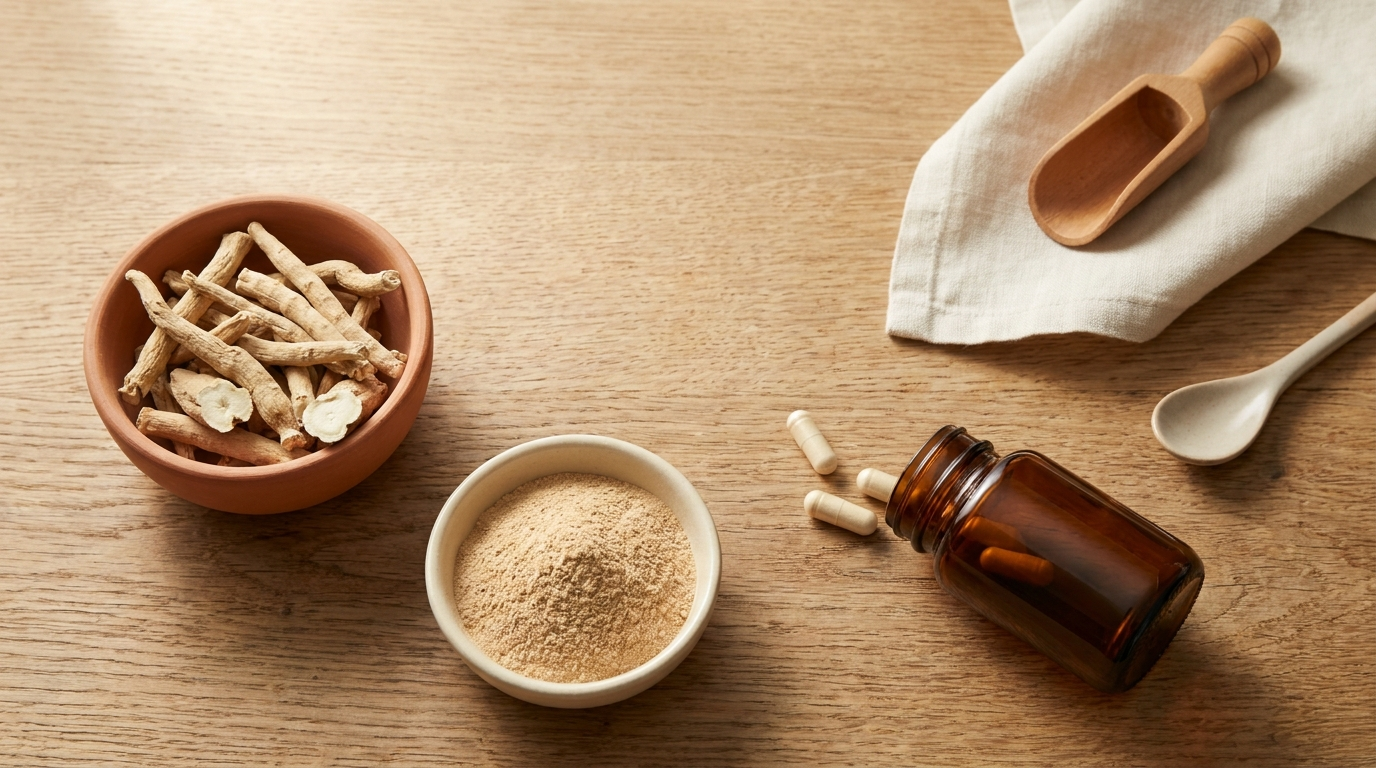
Raw Ashwagandha powder and standardized extract are not the same product. Powder is the milled root, sold by the gram. Extract is a concentrated form, usually standardized to a percentage of withanolides (the active compounds). The clinical trials that prove the cortisol effect almost all use standardized extract at 300 to 600mg per day. To get the same withanolide load from raw powder you would need several grams, taken consistently. Most people scoop half a teaspoon and call it good.
The fix: read the label. If you want the clinical dose, buy a standardized extract and follow the 300 to 600mg per day range. If you want a milder daily tonic in moon milk or tea, raw powder is fine, but expect a softer effect.
Look for
Standardized extract with at least 5% withanolides, 300 to 600mg per day.
Ancient Nutra's Ashwagandha Extract is a standardized root extract dosed in that range. For a softer daily tonic, Ancient Nutra's Ashwagandha Powder is the kitchen-format version.
Mistake 4. Treating it like a pre-workout for instant energy
Ashwagandha is not a stimulant. It does not give you a buzz, a pump, or a 30-minute window of focus. People who take it before a workout expecting that effect end up disappointed and quietly stop after a month.
What the research actually shows is on the recovery side: better sleep, lower morning cortisol, less perceived stress, and in some trials, modest gains in strength and recovery measured over 8 to 12 weeks of training. That is a different category. Pre-workout is acute. Ashwagandha is chronic.
The fix: stop dosing it for energy. Dose it for sleep and recovery instead. Take it with dinner or 60 minutes before bed. The strength gains the trials measured were a side effect of recovering harder, not of feeling fired up at 6 PM.
Mistake 5. Stacking it with sleep meds or thyroid meds without telling a doctor
Ashwagandha is well tolerated for most people. It is also active in the body, which means a few interaction categories deserve attention before you stack it on top of prescription medication.
The herb can affect thyroid hormone levels in some people (usually a small bump in T3 and T4), which matters if you take levothyroxine or have Hashimoto's. It can potentiate sedatives, which matters if you take benzodiazepines or sleep aids. It also has a mild blood-pressure-lowering effect, which matters if you are already on antihypertensives, and it can counteract immunosuppressants by stimulating the immune system. It should be avoided in pregnancy. None of these are reasons to avoid the herb outright, but they are reasons to mention it at your next appointment and to keep the course bounded rather than indefinite.
The fix: tell your doctor or pharmacist you are adding it. One sentence on the intake form. The point is not to ask permission. The point is to make sure no one is flying blind on a dose adjustment.
How to course-correct in a week
If you have been making any of the five mistakes above, here is the minimum-viable reset:
- Day 1: switch from raw powder to a standardized extract (or confirm the dose on what you already have).
- Day 2: move the dose to dinner, with a meal that has some fat in it.
- Day 3 to 7: take it every day, same time, no skipping.
- End of week 1: notice nothing dramatic. That is normal. Keep going.
- Week 4: first real check-in. Sleep usually shifts first.
- Week 8: the trial endpoint. Reassess honestly.
When the team at Ancient Nutra tested early batches of the Ashwagandha extract in 2018, the most common feedback was not about energy or libido. It was sleep. People started sleeping through the night around week three, and by week six they had stopped reaching for the second coffee in the afternoon. That is the curve the herb runs on.
The bottom line
The two mistakes that ruin most Ashwagandha routines are the same two that ruin most supplement routines: quitting too early, and using the wrong format at the wrong time of day. Fix those two and you have already done more than 80% of the people who buy the bottle. The herb has spent thousands of years on Ayurvedic shelves for a reason. Run it for eight to twelve weeks the way the clinical trials ran it, then take a break, and the reason will start to make sense.
For the standardized extract dosed in the clinical range, that is what Ancient Nutra's Ashwagandha Extract was built for. Take it with dinner for a bounded eight to twelve week course, then take a break. Give it 60 days. Then decide.

Power Coffee + Ashwagandha
A morning coffee blended with Ashwagandha, built to balance the caffeine rather than fight it.
Shop Power CoffeeSources: NIH LiverTox, Ashwagandha (NBK548536).
This article is for general information and is not medical advice. Speak with a doctor before starting ashwagandha, especially if pregnant, on thyroid medication, sedatives, or immunosuppressants, or if managing a thyroid or autoimmune condition. Last reviewed 6 August 2026.
Sources
- Lopresti AL, Smith SJ, Malvi H, Kodgule R. An investigation into the stress-relieving and pharmacological actions of an ashwagandha (Withania somnifera) extract: A randomized, double-blind, placebo-controlled study. Medicine (Baltimore). 2019;98(37):e17186.
- Akhgarjand C, Asoudeh F, Bagheri A, et al. Effects of Ashwagandha Supplements on Cortisol, Stress, and Anxiety Levels in Adults: A Systematic Review and Meta-Analysis. 2024.
- Chandrasekhar K, Kapoor J, Anishetty S. A Prospective, Randomized Double-Blind, Placebo-Controlled Study of Safety and Efficacy of a High-Concentration Full-Spectrum Extract of Ashwagandha Root in Reducing Stress and Anxiety in Adults. Indian J Psychol Med. 2012;34(3):255-262.
Medical disclaimer: This article is for educational purposes only and is not medical advice. Statements have not been evaluated by the FDA. Ancient Nutra products are not intended to diagnose, treat, cure, or prevent any disease. Speak with a qualified healthcare provider before starting any new supplement, especially if you take prescription medication or have a medical condition.
Written by the Ancient Nutra Wellness Team. The team researches, sources, and tests every ingredient before it earns a place in an Ancient Nutra blend. Questions? Email info@ancientnutra.com or message Ancient Nutra on Instagram.