Ancient Nutra Wellness Team · 11 August 2026 · 6 min read
What Ginger Actually Does to a Stomach That Feels Off
Key takeaways
- Ginger works mostly below the neck. It speeds the stomach's emptying and dampens the serotonin signal that registers in the brain as nausea.
- The clinical evidence is short-term. Trials used roughly 0.5 g to 2 g of ginger a day across 4 to 21 days, not months.
- It suits a stomach that feels heavy or unsettled after eating. It is the wrong tool for nausea that keeps returning, which needs a clinician rather than a capsule.
Ginger has been the standard answer to a bad stomach for so long that almost nobody asks how it works. The usual assumptions are that it settles the nerves, or that it is warming, or that the sharpness simply distracts from the feeling. None of those is the mechanism. Ginger acts almost entirely inside the digestive tract, on two specific systems that produce the sensation of nausea in the first place. Knowing which two changes how the spice is used: when it helps within the hour, when it does nothing at all, and when it is quietly covering something that deserves a proper look.
Start with what nausea actually is
Nausea is not a stomach problem in the way most people picture it. It is a signal. The gut lining, the inner ear, and the bloodstream all feed information into a small region of the brainstem that decides whether the body should stop eating and empty out. Nausea is what that decision feels like while it is still being made. Anything that changes the quality of the information going in can change the outcome.
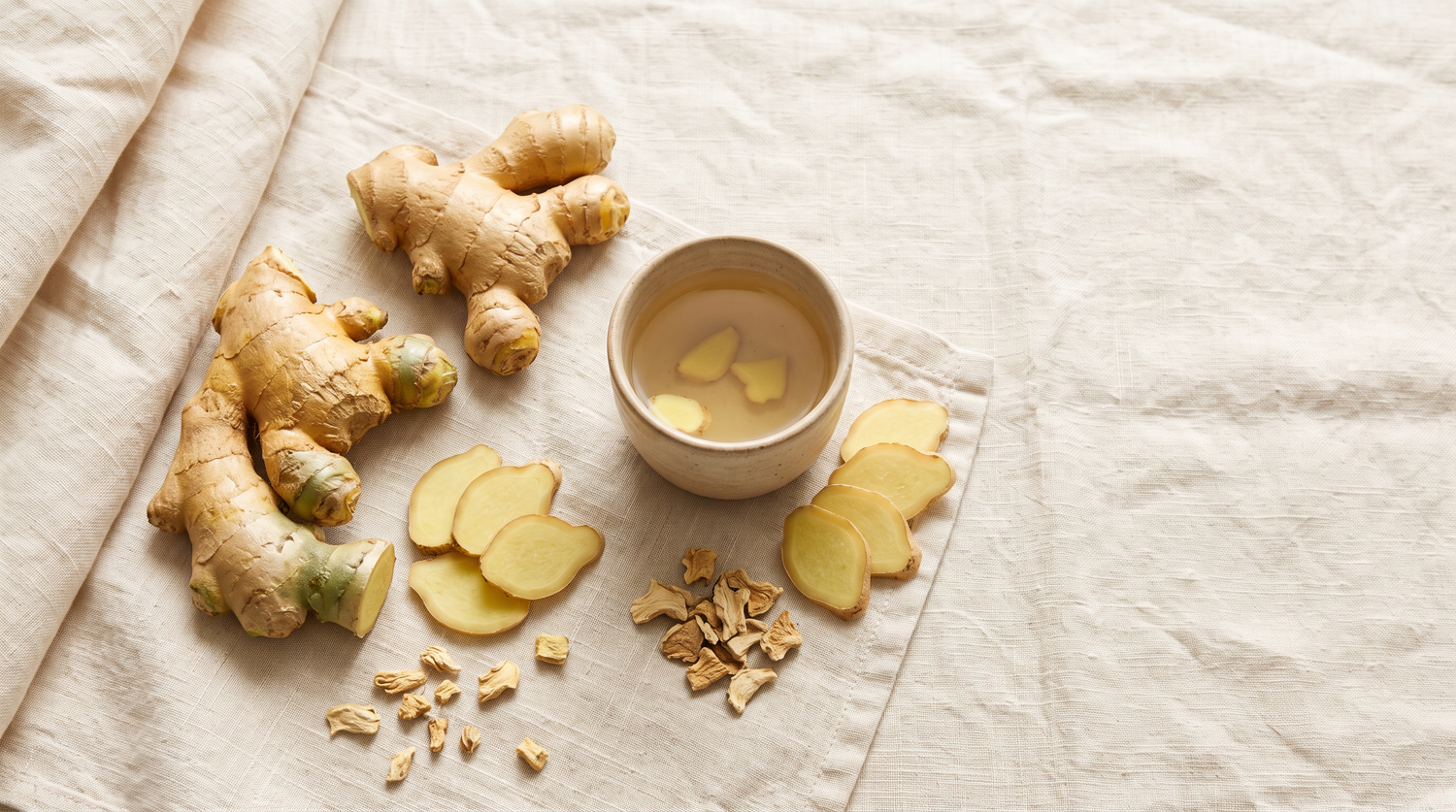
Ginger is the dried underground stem, called a rhizome, of Zingiber officinale, a perennial native to Southeast Asia and now grown across the tropics. India alone accounted for roughly 45 percent of the world's 4.9 million tonnes of production in 2023. The compounds that matter are the gingerols found in fresh rhizome and the shogaols that form as it dries, which is why dried ginger and fresh ginger do not behave identically.
Follow the two routes ginger takes
The first route is mechanical. Ginger accelerates gastric emptying and stimulates the contractions of the lower stomach, an effect measured in healthy volunteers and repeated in people with functional dyspepsia (Nikkhah Bodagh et al., Food Science and Nutrition). Food that sits too long in the stomach is one of the most dependable ways to feel queasy, so moving it along removes a trigger rather than masking one. This is the part people notice fastest, usually as the heavy, still feeling after a large meal starting to lift.
The second route is chemical. Serotonin released by the gut lining binds to 5-HT3 receptors on nerve endings sitting just underneath, and that binding is the message that travels up and arrives as nausea. Gingerols and shogaols interfere with those receptors, which is the same receptor family that prescription anti-sickness drugs are built around. Ginger is far weaker than any of them, and nobody should read the shared target as equivalence, but it explains why the effect is specific to nausea rather than being general comfort.
There is a third, smaller contribution from cholinergic and substance P pathways, which is likely why the effect on the gut feels broader than motility alone would suggest. Taken together, the picture is a spice that works on the gut end of the signal and only indirectly on the brain end.
That distinction has a practical consequence. Nausea that begins in the stomach, after a heavy meal, an unfamiliar dish, or eating too fast, is the version ginger addresses most directly. Nausea that begins in the inner ear, on a winding road or a boat, is a different input into the same brainstem region, and the results there are far less consistent. Absorption differs between spice compounds too, which is a separate subject covered in the guide to turmeric and black pepper.
See why this comes up more often now
The modern eating pattern is close to a purpose-built nausea generator. The largest meal of the day lands late, often after eight, and is followed by sitting or lying down within the hour. Portions arrive faster than the stomach clears them. Long commutes on uneven roads add a vestibular layer on top of a full stomach. Several common medications, including some painkillers and antibiotics, list nausea among their frequent effects.
Pregnancy nausea is the most heavily studied version of the problem, and it is where the numbers are clearest: reviewed trials found ginger outperformed placebo at doses under 1,000 mg a day given for at least four days. That is a modest, specific result from a short window, and it is worth reading it as exactly that rather than as a general endorsement of the spice for everything.
For the ordinary version, an unsettled gut that follows the rhythm of the week, the pattern is usually behavioural before it is anything else. Ancient Nutra's Beli sits in the same territory for people whose complaint is a generally restless digestion rather than nausea specifically.
Change the inputs before reaching for a capsule
Five adjustments do most of the work, and all of them target the same emptying rate ginger does:
- Move the last substantial meal earlier, so the stomach is not still working at bedtime.
- Reduce volume per sitting rather than total food per day.
- Stay upright for half an hour after eating instead of reclining.
- Sip fluids across the meal rather than drinking a large glass at the end of it.
- Step away from strong cooking smells, which feed the same signal from a different direction.
If those are already in place and the feeling persists, ginger is a reasonable next step. The trials used roughly 0.5 g to 2 g of dried rhizome equivalent per day, almost always split into two to four smaller doses rather than taken all at once, and they ran for days to about three weeks. That short window is the evidence base, so treat ginger as something used deliberately through an unsettled stretch, not as an open-ended daily fixture. Ancient Nutra's Ginger capsules exist because splitting doses that way is difficult with fresh rhizome and unpleasant with powder. For a slower, general digestive routine rather than acute queasiness, Triphala is the more usual choice.
Look for
A stated milligram quantity of ginger rhizome per capsule, not a proprietary blend that hides the amount. The trial range is 0.5 g to 2 g a day in divided doses, so a label that does not tell you what one capsule contains cannot be matched to it. Ancient Nutra's Ginger capsules state the quantity on the pack.
Know when ginger is the wrong tool
Nausea that lasts more than a couple of days, or arrives with weight loss, repeated vomiting, blood, severe or localised abdominal pain, fever, or a recent head injury, is not a spice problem. That combination needs a doctor promptly, and reaching for ginger first mainly costs time. Nausea from a known cause, including chemotherapy, should be managed with the prescribed anti-sickness medication; the ginger trials in that setting produced conflicting results and none of them support substitution. Motion sickness is the other weak spot, where the evidence is genuinely mixed. Anyone taking anticoagulants, anyone with gallstones, and anyone approaching surgery should raise ginger with their own clinician before adding it, and in pregnancy it should only be used on medical advice.
The bottom line
Ginger is not a calming herb that happens to help the stomach. It is a gut-acting spice that speeds emptying and interferes with the serotonin signal behind nausea, which is why it works quickly on some kinds of queasiness and barely at all on others.
- It targets nausea that starts in the stomach, not in the inner ear.
- The useful range in trials was 0.5 g to 2 g a day, split, across days to about three weeks.
- Persistent or severe nausea belongs with a clinician, not a capsule.
For an unsettled stretch where the mechanism fits, Ancient Nutra's Ginger is a straightforward way to hold a divided dose.

Ginger, 60 capsules
Dried ginger rhizome in a stated dose, made to be split through the day.
Shop GingerSources and further reading
- Nikkhah Bodagh M, et al. Ginger in gastrointestinal disorders: a systematic review of clinical trials, Food Science and Nutrition, via PubMed Central. Retrieved 11 August 2026.
- Ginger, LiverTox, NIH National Institute of Diabetes and Digestive and Kidney Diseases. Retrieved 11 August 2026.
- Ginger constituent 6-shogaol attenuates vincristine-induced activation of gastroesophageal vagal afferent C-fibers, PubMed Central. Retrieved 11 August 2026.
- A multidimensional analysis of global ginger (Zingiber officinale) production, trade and the research impact gap, Discover Plants, Springer Nature. Retrieved 11 August 2026.
Written by the Ancient Nutra Wellness Team. The team researches, sources, and tests every ingredient before it earns a place in an Ancient Nutra blend. Questions? Email info@ancientnutra.com or message Ancient Nutra on Instagram.
Medical disclaimer: This article is for educational purposes only and is not medical advice. Statements have not been evaluated by the FDA. Ancient Nutra products are not intended to diagnose, treat, cure, or prevent any disease. Speak with a qualified healthcare provider before starting any new supplement, especially if you take prescription medication or have a medical condition.