Written by the Ancient Nutra Wellness Team · Published June 8, 2026 · Updated August 6, 2026 · 6 min read
- Curcumin, the active compound in turmeric, is barely absorbed when you swallow it on its own.
- Piperine, the active compound in black pepper, raises curcumin absorption by up to 2,000 percent (Shoba, 1998).
- That same raised absorption is why concentrated, high-absorption curcumin supplements carry a liver-safety caution. Turmeric in food is not the concern. See the safety note below.
Here is the part nobody mentions when they tell you to add more turmeric to your food: most of it leaves your body before it ever does anything. Turmeric looks like a health win on the spice rack, but the compound everyone is after, curcumin, is one of the worst-absorbed nutrients in the natural world. Take it alone and your gut waves most of it straight through.
The fix is almost comically simple, and it has been sitting in the same kitchen cupboard for centuries. Black pepper. Not a lot of it. Just enough to change the math entirely.
What turmeric actually does, and why absorption is the catch
Turmeric is the golden root in the ginger family that gives curry its color. Its headline compound is curcumin, a plant antioxidant that has been studied for how it supports the body's normal inflammatory response, joint comfort, and recovery after hard training. That research is the reason turmeric went from spice shelf to supplement aisle.
The problem is delivery. Curcumin is poorly absorbed, then rapidly broken down and cleared by the body, which means very little of it reaches your bloodstream intact (Hewlings & Kalman, 2017). You can eat turmeric every day and still see only a fraction of what the studies describe, simply because the curcumin never sticks around long enough to work.
Why black pepper changes everything
Black pepper carries its own active compound, piperine, the molecule that gives it the bite. Piperine slows the rate at which the body clears curcumin, and makes the gut wall more willing to let curcumin through. Together, that keeps more curcumin in circulation for longer.
The numbers are not subtle. In a human study, adding just 20mg of piperine to a 2g dose of curcumin raised curcumin absorption by 2,000 percent (Shoba et al., 1998). That is a twentyfold jump from a pinch of pepper. It is also the reason this pairing deserves respect rather than enthusiasm alone: raising how much of a compound reaches your bloodstream raises both what it can do and what it can do wrong. The safety note below is part of the same story, not a footnote to it.
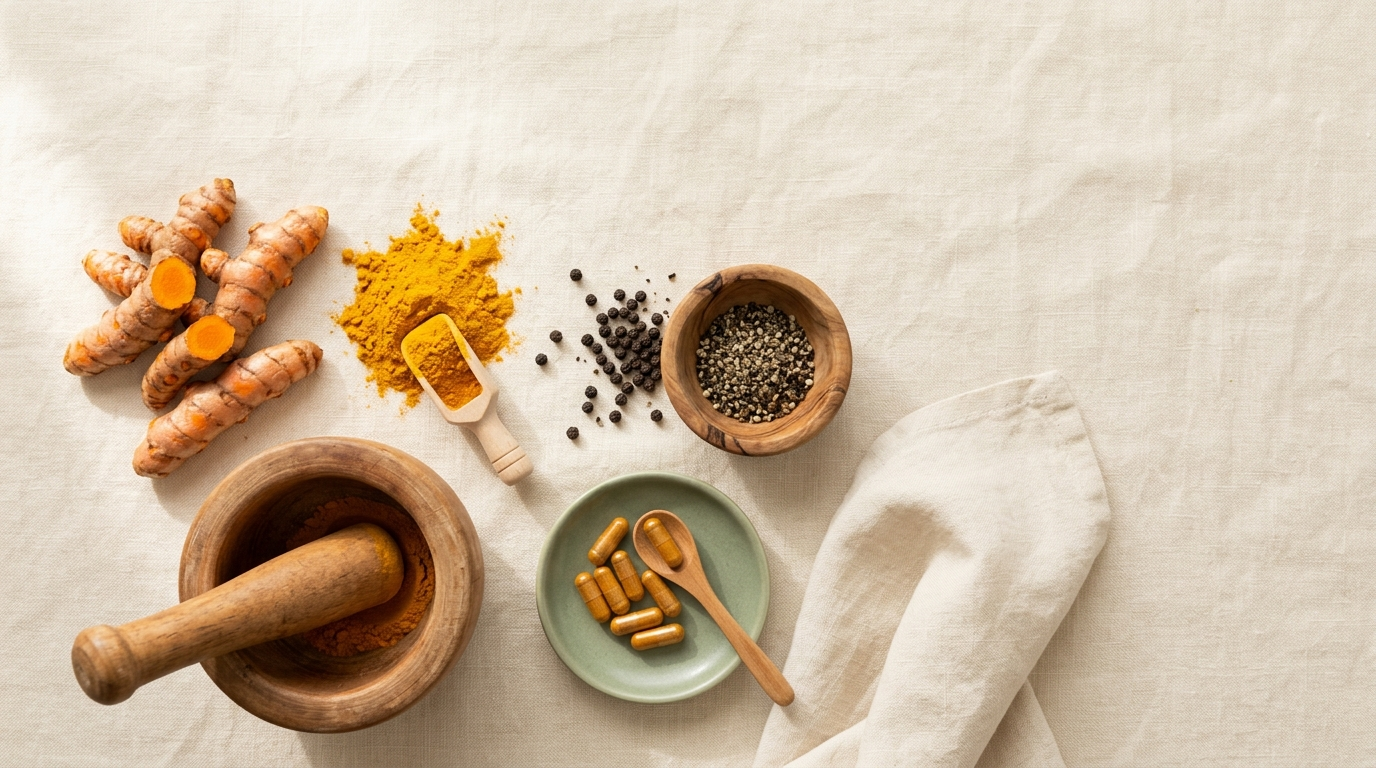
Turmeric paired with black pepper in the same capsule, not turmeric alone. A small amount of piperine (around 5mg) is all it takes to do the absorption job.
Ancient Nutra's Turmeric & Black Pepper pairs certified organic turmeric with black pepper for exactly this reason.
Who benefits most from the pair
This combination earns its place for specific people more than others:
- Anyone who trains hard. Curcumin has been studied for easing the muscle soreness that shows up a day or two after heavy exercise. Better absorption means the dose has a chance to matter.
- People with stiff, achy joints. Daily turmeric is a common starting point for joint comfort, and absorption is the difference between a token gesture and a real dose.
- Anyone already eating a lot of turmeric. If turmeric is a daily habit for you through food or tea, pairing it with pepper quietly multiplies what you are already getting.
And the honest other side: if you take turmeric once in a while in a curry and feel fine, you do not need a supplement at all. The pair is for people who want a consistent daily dose to actually land.
How to take turmeric and black pepper
A practical daily range is 500 to 1,000mg of turmeric, paired with a few milligrams of piperine from black pepper, taken with food. Curcumin is fat-loving, so taking it alongside a meal that contains some fat helps it along as well. Morning or evening both work. Consistency matters more than timing.
If you are cooking rather than supplementing, the old kitchen trick still holds: add a crack of black pepper to any dish with turmeric, and stir the turmeric into oil or coconut milk rather than water. That is the village version of the same science.
Turmeric and curcumin supplements have been linked to liver injury in reported cases, and the US National Institutes of Health LiverTox database lists turmeric as a well-documented cause of clinically apparent liver injury. High-absorption forms, including those combined with piperine from black pepper, are specifically named among the reported cases (NIH LiverTox, 2025). Cases have typically appeared after one to four months of use.
Turmeric used as a spice in cooking is not the concern here. This applies to concentrated daily supplements.
Do not take a concentrated turmeric or curcumin supplement if you have liver disease, or alongside other medicines or supplements known to affect the liver, without medical advice. Stop taking it and seek medical attention if you notice yellowing of the eyes or skin, dark urine, persistent nausea, unusual tiredness, or pain in the upper right abdomen.
The kitchen tradition that got there first
Sri Lankan and South Indian cooks have paired turmeric with black pepper for generations, long before anyone measured a single absorption curve. Turmeric and pepper land in the same pan, in the same tempering of oil, almost by reflex. Ayurvedic preparations did the same thing on purpose, pairing the two as a matter of course. The lab work of the last few decades did not discover the pairing. It explained why grandmothers were right.
What to stack it with
Turmeric and black pepper sit comfortably next to Ancient Nutra's Ginger, its close relative in the same plant family, for a warming daily pair that supports digestion and recovery together. If you want a higher, more targeted dose of curcumin for joint comfort specifically, Ancient Nutra's Turmeric Extract standardizes to 95 percent curcumin, and being a concentrated form, the liver-safety note above applies to it with particular force. This stack is for people who want daily anti-inflammatory support, not something everyone needs.
How long until you feel something
Turmeric is not a stimulant, so do not expect a same-day jolt. In the exercise-recovery research, curcumin with piperine was studied over days rather than months, and what tends to shift first is how you feel after hard training or a long day on your feet. If you are taking a concentrated supplement, keep the liver-safety note above in mind rather than treating a long unbroken run as automatically better: reported liver-injury cases have typically appeared between one and four months of continuous use. Review how you are doing with your doctor rather than simply continuing indefinitely.

Turmeric & Black Pepper
Certified organic turmeric paired with black pepper, so the curcumin actually gets absorbed.
Shop Turmeric & Black PepperThat is the whole case. Turmeric brings the curcumin. Black pepper makes sure your body can use it. Apart, they are two ordinary spices. Together, they are one of the few combinations in your kitchen where the science genuinely backs the tradition, and where knowing how well it works is also the reason to take the safety note seriously.
Sources
- Shoba G, et al. Influence of piperine on the pharmacokinetics of curcumin in animals and human volunteers. Planta Medica, 1998.
- Hewlings SJ, Kalman DS. Curcumin: A Review of Its Effects on Human Health. Foods, 2017.
- Delecroix B, et al. Curcumin and piperine supplementation and recovery following exercise induced muscle damage. J Sports Sci Med, 2017.
- NIH LiverTox. Turmeric. National Institute of Diabetes and Digestive and Kidney Diseases, updated 2025.
Medical disclaimer: This article is for educational purposes only and is not medical advice. Statements have not been evaluated by the FDA. Ancient Nutra products are not intended to diagnose, treat, cure, or prevent any disease. Speak with a qualified healthcare provider before starting any new supplement, especially if you take prescription medication or have a medical condition.
Written by the Ancient Nutra Wellness Team. The team researches, sources, and tests every ingredient before it earns a place in an Ancient Nutra blend. Questions? Email info@ancientnutra.com or message Ancient Nutra on Instagram.