Ancient Nutra Wellness Team · 14 August 2026 · 6 min read
Triphala: What Each of the Three Fruits Actually Does
- Triphala is three separate dried fruits: amla, bibhitaki and haritaki. Each was chosen for a different job, and only one of them is traditionally the bowel-regulating one.
- The strongest human evidence for triphala is not for digestion at all. It is for gum inflammation, from a meta-analysis of seven randomised trials of triphala mouthrinse.
- The famous equal-parts ratio is a modern pharmacopoeial standard as much as an ancient decree, and the rival 1:2:4 version is repeated far more confidently than its sourcing supports.
- Trials ran for weeks to months, most for two to three. Treat triphala as a bounded course, not a permanent fixture.
Triphala is one of the few Ayurvedic formulas that almost everyone has heard of and almost nobody can name the parts of. Ask what is in it and the answer comes back quickly: three fruits. Ask which three, and the room goes quiet.
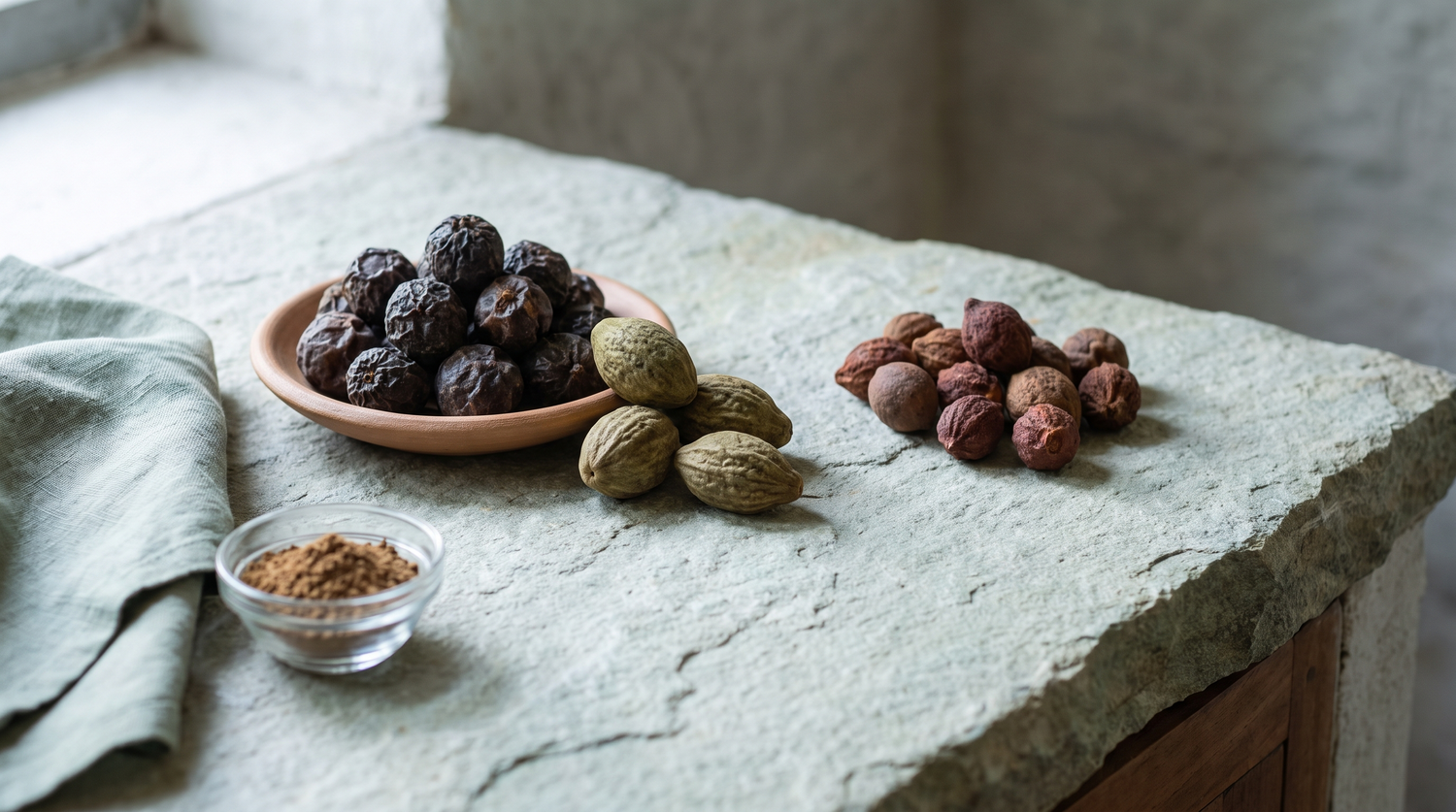
Triphala means "three fruits" in Sanskrit. It is a powder, or in Ancient Nutra's case a capsule, made from the dried fruit of Emblica officinalis (amla), Terminalia bellirica (bibhitaki) and Terminalia chebula (haritaki). The blend is documented in the Charaka Samhita and the Sushruta Samhita, which places its recorded use well past a thousand years. That is the whole heritage claim, and this article will not stretch it further.
The three fruits are not interchangeable. Each was chosen for something different, and the formula exists so those three different things arrive together.
How the three fruits divide the work
Haritaki is the one people are actually describing when they talk about triphala and digestion. In classical use it is the bowel-regulating fruit, the reason the blend has a reputation for keeping things moving. Worth saying plainly: no human trial has isolated haritaki's effect from the other two, so this remains a traditional attribution rather than a measured one.
Bibhitaki is the respiratory fruit in traditional practice, used where mucus and a heavy chest are the complaint. The ethnopharmacology literature records that use consistently. Human trials on it do not exist, so the honest framing is "traditionally used for," not "shown to help with."
Amla is the antioxidant one, and it comes with a correction attached. Amla is widely sold as one of nature's richest sources of vitamin C. Analytical work found that standard assays over-estimate its ascorbic acid, because tannins and mucic acid gallates in the fruit interfere with the measurement, and that the fruit's antioxidant activity is larger than its ascorbic acid alone can explain (Majeed et al., 2009). The antioxidant reputation holds. The vitamin C headline is shakier than the packaging suggests.
Put together, the blend is doing three jobs at once rather than one job three times. That is the design.
Read the evidence before you read the marketing
The best-evidenced use of triphala is one almost nobody buys it for. A systematic review and meta-analysis of seven randomised trials found triphala mouthrinse improved clinical measures of gum inflammation in plaque-induced gingivitis, with results comparable to chlorhexidine (AlJameel and Almalki, 2020). That is a topical use, not a swallowed one.
For taken-by-mouth triphala, the useful summary is a 2021 review of 12 randomised trials covering 749 people, which found triphala supplementation associated with reductions in LDL cholesterol, total cholesterol and triglycerides, and with lower fasting blood glucose in people with diabetes but not in people without it (Phimarn et al., 2021). The same authors are clear that larger, better-designed trials are still needed.
And for digestion, the thing triphala is most famous for, the human evidence is thin: small studies, and a placebo-controlled pilot that tracked gut microbiota shifts without a clear response pattern. No large, well-powered trial of oral triphala for constipation exists. For the practical, day-to-day version of that conversation, Ancient Nutra covered it separately in triphala for everyday digestion.
Take the dose the trials actually used
Across those 12 trials the doses ranged widely, from 250 mg to 24 g a day, but most clustered between 500 mg and 1,800 mg daily. Traditional churna dosing sits higher, around 3 g to 6 g at night with warm water, because loose powder and concentrated capsules are not the same thing by weight.
Evening is the conventional time, taken with warm water, away from a heavy meal. Start at the low end of the range. If the result is loose stools rather than regularity, the dose is too high, and that is the signal to come down rather than push through.
- All three fruits named on the label, in Latin as well as Sanskrit. "Triphala extract" with no species list tells you nothing.
- A stated ratio. If the maker will not tell you the proportions, they are asking you to trust a formula they have not described.
- Fruit, not fruit-and-seed. The classical preparation uses dried fruit pulp.
- Heavy metal testing. This is the real category risk in Ayurvedic supplements, not an exotic one, and reputable makers test for it.
Know where the equal-parts ratio really comes from
Here is the part that gets repeated wrongly almost everywhere. Most commercial triphala is 1:1:1, equal parts of the three fruits. A rival ratio of 1:2:4, weighted heavily towards amla, circulates widely and is usually attributed to a fourteenth-century Ayurvedic pharmacy text.
That attribution does not hold up well. The same text gets cited for the equal-parts reading too, and no verse-level scholarly citation settles which the Sanskrit supports. What is verifiable is that the Ayurvedic Formulary of India, a government pharmacopoeial standard, specifies equal parts. That is why nearly every triphala on the shelf is 1:1:1.
There is also a quieter explanation. Ayurvedic pharmacy applies a convention called samabhaga, equal parts, as the default whenever a classical formulation names its ingredients without stating proportions. Many of the classical verses simply name the three fruits. So equal parts may be less an ancient instruction than the rule that fills an ancient silence. Which explains what practitioners have always done: raise haritaki where the complaint is sluggish and dry, raise amla where it runs hot. The formula was built to be tuned.
Check who should leave it alone
Triphala has no entry in the NIH LiverTox database, which is a genuinely reassuring absence given how many popular botanicals do have one. Absence of an entry is not the same as proof of safety, and the following still apply.
Skip it in pregnancy and while breastfeeding: safety data for the two Terminalia species is insufficient. Skip it during any episode of diarrhoea, an inflammatory bowel flare, or bleeding haemorrhoids, since a laxative action makes all three worse. Talk to a doctor first if you take blood thinners such as warfarin or aspirin, because amla affects platelet aggregation, or if you take diabetes medication, since triphala lowered fasting glucose in the trials that included people with diabetes. Space it a few hours away from iron supplements, because the tannins bind minerals. Paediatric dosing is not established, so this is not a children's supplement.
Give it weeks, not days
The trials that exist ran from 25 days to 12 months, most for two to three months. That is the honest window. Nothing in the human literature supports taking triphala indefinitely, and long-term safety data is limited. A sensible course is eight to twelve weeks, then a stop, then an assessment of whether anything actually changed. Regularity, if it responds at all, tends to respond within the first two weeks. The metabolic markers in the trials took considerably longer.
There is a habit in Sri Lankan households, common enough that most people have seen it, of keeping the powder in a jar by the kettle rather than in a cupboard with the vitamins. It is not stored as medicine. It is stored as something you reach for at the end of a heavy week, the way you would reach for ginger. That instinct, use it when the week has earned it and stop when it has not, is closer to the classical intent than a daily-forever bottle.
For a wider look at which traditional herbs have held up to modern scrutiny and which have not, Ancient Nutra's guide to herbs that survived 3,000 years of testing is the place to start.
Is Triphala safe to take every day?
The trials ran from 25 days to 12 months, with most lasting two to three months, and reported no serious adverse events. Long-term safety data is limited, so triphala is better treated as a bounded course of roughly eight to twelve weeks than as a permanent daily supplement. Anyone on prescription medication should ask a doctor first.
What is Triphala actually proven to do?
The strongest evidence is for triphala used as a mouthrinse for gum inflammation, where a meta-analysis of seven randomised trials found results comparable to chlorhexidine. For swallowed triphala, a review of 12 trials found reductions in cholesterol and triglycerides, and lower fasting glucose in people with diabetes. Human evidence for digestion specifically is thin.
Who should not take Triphala?
Avoid it in pregnancy and while breastfeeding, and during diarrhoea, an inflammatory bowel flare or bleeding haemorrhoids. Take medical advice first if you use blood thinners or diabetes medication. Keep it a few hours apart from iron supplements, and do not give it to children, since paediatric dosing has not been established.

All three fruits, amla, bibhitaki and haritaki, in the classical equal-parts ratio, for a bounded evening course. The same capsule is the digestive third of the Liver & Detox System, where it sits alongside Heenbovitiya and Yaki Naran.
Shop TriphalaSources and further reading
- Phimarn W, Sungthong B, Itabe H. Effects of Triphala on Lipid and Glucose Profiles and Anthropometric Parameters: A Systematic Review, Journal of Evidence-Based Integrative Medicine, 2021.
- AlJameel AH, Almalki SA. Effect of triphala mouthrinse on plaque and gingival inflammation: a systematic review and meta-analysis of randomized controlled trials, International Journal of Dental Hygiene, 2020.
- Majeed M, Bhat B, Jadhav AN, et al. Ascorbic acid and tannins from Emblica officinalis Gaertn. fruits, a revisit, Journal of Agricultural and Food Chemistry, 2009.
- Peterson CT, Denniston K, Chopra D. Therapeutic Uses of Triphala in Ayurvedic Medicine, Journal of Alternative and Complementary Medicine, 2017.
- Ayurvedic Medicine: In Depth, National Center for Complementary and Integrative Health.
Written by the Ancient Nutra Wellness Team. The team researches, sources, and tests every ingredient before it earns a place in an Ancient Nutra blend. Questions? Email info@ancientnutra.com or message Ancient Nutra on Instagram.
This article is for general information only and is not medical advice. Ancient Nutra products are not intended to diagnose, treat, cure or prevent any disease. Speak to a qualified healthcare professional before starting any supplement, especially during pregnancy or breastfeeding, or alongside prescription medication.