Ancient Nutra Wellness Team · 21 July 2026 · 6 min read
Papaya leaf extract: platelet support during a dengue fever
Key takeaways
- Papaya leaf extract is a traditional Sri Lankan remedy that modern research links to a faster rise in platelet count during dengue.
- A meta-analysis of six randomized trials found a significant increase in platelet counts by days 3 to 5 of supplementation, though it is a support, not a cure.
- The extract works alongside medical care. It never replaces a doctor, hospital monitoring, or the fluids that actually keep a dengue patient safe.
When a dengue fever moves through a Sri Lankan household, one question follows the thermometer everywhere: what is the platelet count today. Families have reached for bitter papaya leaf juice for generations to hold that number up. The taste is unforgettable and the belief runs deep. What has changed recently is that the belief now has clinical trials behind it. Papaya leaf extract will not cure dengue, and nothing on this page should delay a hospital visit. But the concentrated capsule form has earned a real place in the supportive-care conversation, and it is worth understanding properly.
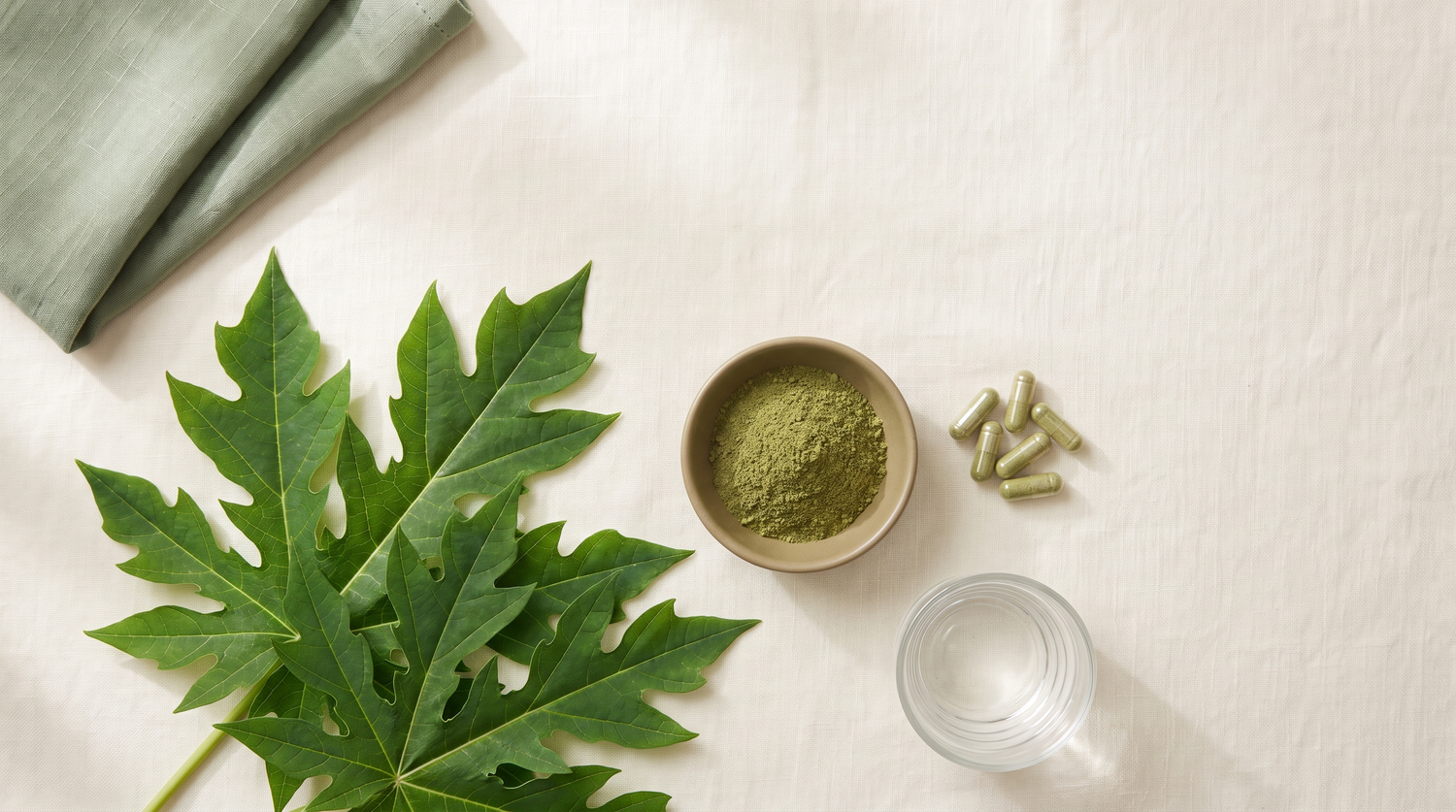
Papaya leaf extract is made from the leaves of the common papaya tree, Carica papaya, the same tree that fruits in gardens across the island. The fresh leaf is intensely bitter, so the traditional preparation was a pressed juice taken by the spoonful. A standardized capsule concentrates the active leaf compounds into a fixed daily amount, which removes the guesswork and the taste that made so many patients refuse the second dose.
What papaya leaf extract actually does
Dengue lowers platelets in two ways. The virus suppresses the bone marrow that manufactures new platelets, and the immune response destroys circulating ones. Papaya leaf appears to act on the first problem. Laboratory work points to leaf compounds that help protect and stimulate the megakaryocytes, the marrow cells that bud off platelets, so the body can rebuild its own supply faster.
The clinical picture is encouraging and honest at the same time. A systematic review and meta-analysis published in BMC Complementary Medicine and Therapies pooled six randomized controlled trials and found a statistically significant rise in platelet count among patients given papaya leaf extract, with the effect showing clearly by days 3, 4 and 5. What the same analysis was careful to say is that a faster-rising count is not the same as a proven change in the final outcome. The number climbs sooner, which reassures everyone watching the chart, but the extract is a helper, not the treatment.
That distinction is the whole point. Dengue has no specific antiviral drug anywhere in the world. Recovery is driven by fluid management and close monitoring, and papaya leaf extract sits quietly on top of that, supporting the marrow while the care team does the real work.
Who should consider it
Papaya leaf extract makes the most sense for a narrow group, and being honest about that is more useful than promising it to everyone.
- People recovering from confirmed dengue whose doctor is already tracking their platelet count and has no objection to a supportive herbal addition.
- Households in high-transmission seasons who want a recognized traditional support ready at home, used under medical guidance once a diagnosis is made.
- Those rebuilding after the fever breaks, when appetite is poor and platelet recovery still has a few days to run.
Who does not need it: anyone without dengue looking for a general immune booster, pregnant or breastfeeding women (the safety data does not cover them), and anyone on blood-thinning medication, who should clear it with a doctor first. Papaya leaf is a targeted support for a specific situation, not a daily multivitamin.
How to actually take it during dengue
Most clinical trials used a standardized leaf extract equivalent to roughly 1,100mg of dried leaf per day, usually split across the day for three to five days, taken with water. A capsule form follows the same rhythm: a consistent daily amount, with food to settle the stomach, continued through the platelet-recovery window rather than for weeks on end.
The rule that matters most is the one about company. Papaya leaf extract belongs beside medical care, not in place of it. Keep taking the fluids the care team advises, keep every blood-test appointment, and avoid ibuprofen, aspirin and other NSAID pain relievers during dengue, since they raise bleeding risk. If any warning sign appears, the supplement is not the answer.
Look for
A standardized Carica papaya leaf extract in capsules, giving a fixed daily amount so the dose is consistent instead of guessed. Ancient Nutra's Papaya Leaves capsules concentrate the bitter leaf into a measured form, which is far easier to keep down than fresh juice when a patient already feels unwell.
Where papaya leaf support comes from
In Sri Lanka, papaya leaf juice for fever is not a wellness trend, it is a kitchen memory. Grandmothers pressed the leaf and pushed the spoon, and the practice traveled quietly through every dengue season long before a single trial was registered. That lived tradition is exactly why researchers in South and Southeast Asia chose to test it, and why the results felt less like a discovery than a confirmation of something households already suspected.
What to pair it with
The recovery weeks after dengue, not just the fever itself, are where a wider immune support helps. Many people pair papaya leaf with Ancient Nutra's Guduchi, an Ayurvedic root with a long traditional link to fevers and post-illness recovery, to steady the immune system as strength returns. For general inflammation and recovery, Ancient Nutra's Turmeric & Black Pepper is a common companion. This pairing is for convalescence, not for the acute crisis, when the only priorities are fluids, monitoring and the hospital.
How long until platelets respond
The trial evidence is unusually specific for a herbal remedy. The measurable rise in platelet count showed up around day 3 of taking the extract and was clearest by days 4 and 5, which lines up neatly with the phase when dengue platelets are typically at their lowest and starting to turn. This is not a slow-building tonic you judge after three months. It is a short, situational support taken across the critical week, then stopped.
The bottom line
Papaya leaf extract is a genuine, research-backed support for platelet recovery during dengue, with a rise measurable by day 3 in pooled trial data. It is also, firmly, a supplement and not a treatment. Used with medical care, honest expectations and respect for the warning signs, it earns its place in the recovery kit. For a measured, easy-to-take form, families turn to Ancient Nutra's Papaya Leaves capsules. The science does not care which bottle they come in, only that the leaf is real and the dose is honest.
Frequently asked questions
Does papaya leaf extract increase platelet count in dengue?
A meta-analysis of six randomized trials found a significant rise in platelet count by days 3 to 5 of taking papaya leaf extract. It raises the count faster, but works as a support alongside medical care, not as a cure.
Can papaya leaf extract cure dengue?
No. There is no specific cure or antiviral for dengue anywhere in the world. Recovery depends on fluids and close monitoring. Papaya leaf extract only supports the body's own platelet rebuilding.
How much papaya leaf extract is used?
Trials used a standardized extract equivalent to roughly 1,100mg of dried leaf per day, split across the day for three to five days, taken with water and under medical guidance.
Is papaya leaf extract safe?
It is generally well tolerated in trials. It is not recommended in pregnancy or breastfeeding, or alongside blood-thinning medication without a doctor's clearance. Always tell your care team what you are taking.

Papaya Leaves, 60 capsules
The bitter leaf tradition in a measured capsule, for platelet support during dengue recovery.
Shop Papaya LeavesSources and further reading
- Sarker et al., Carica papaya extract in dengue: a systematic review and meta-analysis, BMC Complementary Medicine and Therapies (2019).
- Dengue management and warning signs, National Dengue Control Unit, Sri Lanka.
- Dengue overview and supportive care, World Health Organization.
Written by the Ancient Nutra Wellness Team. The team researches, sources, and tests every ingredient before it earns a place in an Ancient Nutra blend. Questions? Email info@ancientnutra.com or message Ancient Nutra on Instagram.
Medical disclaimer: This article is for educational purposes only and is not medical advice. Dengue is a serious illness that requires diagnosis and monitoring by a qualified doctor. Seek immediate medical care for warning signs such as severe abdominal pain, persistent vomiting, bleeding, or drowsiness. Statements have not been evaluated by the FDA. Ancient Nutra products are not intended to diagnose, treat, cure, or prevent any disease. Speak with a qualified healthcare provider before starting any new supplement, especially if you take prescription medication or have a medical condition.