Ancient Nutra Wellness Team · 3 September 2026 · 5 min read
Ceylon cinnamon three ways for a steadier week in the kitchen
By the Ancient Nutra Editorial Team
Key takeaways
- True Ceylon cinnamon (Cinnamomum verum) carries roughly 0.004 to 0.02 percent coumarin, while cassia carries 2 to 7 percent, which is why the Sri Lankan bark is the one that suits daily use.
- Three quiet uses cover an ordinary week: bloomed in the morning fat, dusted over set curd, and a whole quill dropped into the rice pot.
- Culinary amounts in food are a different exposure from concentrated capsules, and neither belongs on an open ended daily course.
There is a jar of ground cinnamon in almost every Sri Lankan kitchen, and most of the time it never leaves the shelf except at baking season. That is a waste of a good bark. Cinnamon earns its keep in small daily amounts rather than one heroic teaspoon in a cake, and it fits into food that is already being cooked without asking for a new routine. What follows is three quiet ways to move it through an ordinary week: once in the morning fat, once over something cold, once in the pot with the rice. None of them takes longer than a minute.
What you need for all three
Everything here uses one spice and things already in the kitchen. Quantities are per person, per use.
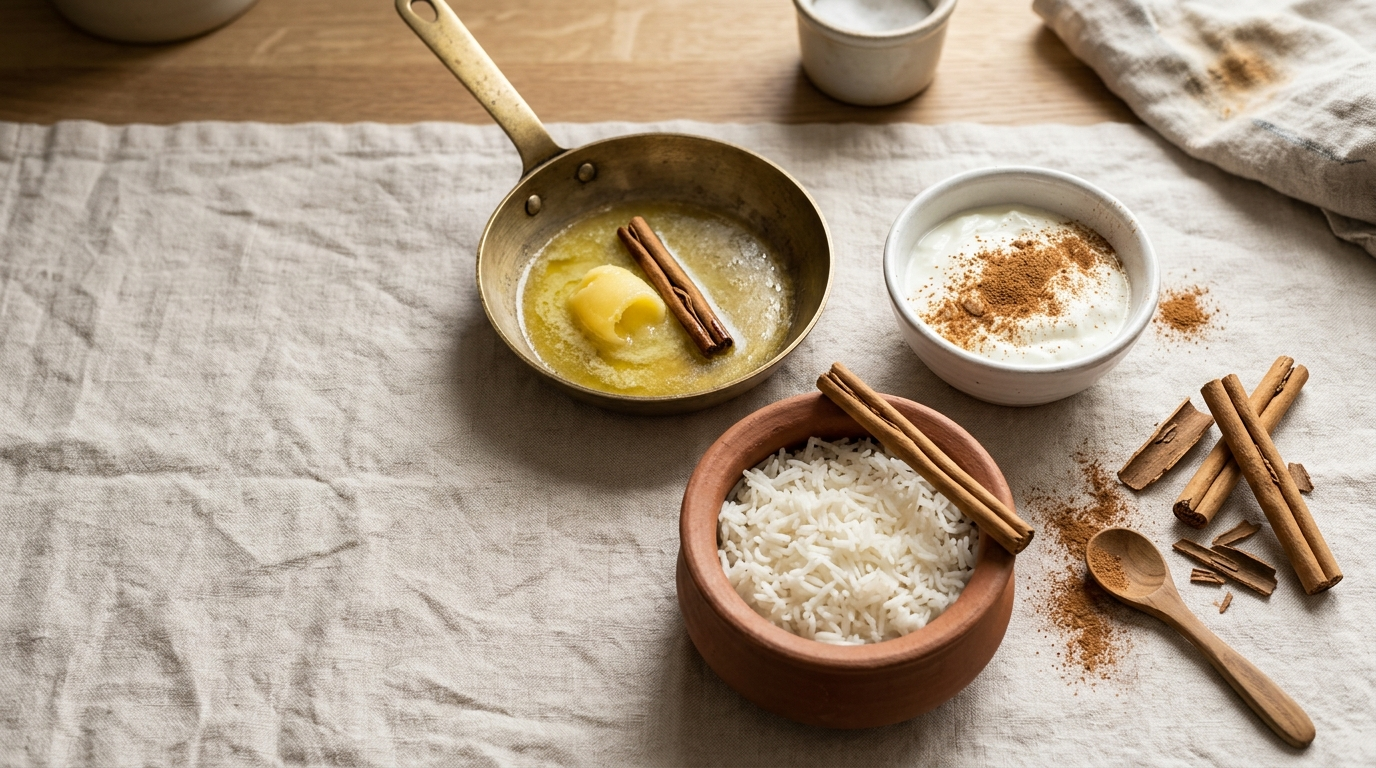
- 1 teaspoon Ancient Nutra's Cinnamon Powder, or 1 thin quill of true Ceylon cinnamon
- 1 teaspoon ghee, coconut oil or butter for the morning use
- 1 small bowl of set curd or thick yoghurt, roughly 150 g
- 1 cup uncooked rice and its usual water
- Optional: 1 teaspoon coconut sugar, or a little honey
Ceylon cinnamon is pale, soft and layered like a thin cigar. Cassia is one thick dark curl that resists the thumbnail. The difference matters, and the section below explains why.
Make each one in under a minute
One. Bloom it in the morning fat
- Warm 1 teaspoon of ghee or coconut oil in a small pan over low heat until it loosens, about 20 seconds. Do not let it smoke.
- Add half a teaspoon of cinnamon powder, or a short piece of quill, and stir for 20 to 30 seconds until it smells sweet and woody.
- Tip the whole thing over eggs, over kola kanda, over oats, or over the first toast of the day.
Fat carries the aromatic compounds in cinnamon much better than water does, which is why the same half teaspoon tastes stronger here than it does stirred into tea. Yields one serving. Best done while something else is already on the stove.
Two. Dust it over set curd
- Spoon roughly 150 g of set curd or thick yoghurt into a bowl.
- Dust a quarter to a half teaspoon of cinnamon powder across the surface. Do not stir it in straight away.
- Add a teaspoon of coconut sugar or a little honey only if the curd is sharp.
- Eat it slowly, letting the powder hydrate as it goes.
This is the easiest of the three and the one most likely to survive a busy week. Yields one bowl, and it works as a mid afternoon plate as readily as a dessert.
Three. Drop a quill in the rice pot
- Rinse 1 cup of rice as usual and add the water you always use.
- Lay one thin Ceylon quill, roughly 5 cm long, across the top before the lid goes on.
- Cook as normal. Do not chop the quill, and do not use powder here, which turns the rice grey.
- Lift the quill out before serving and discard it.
The result is not sweet. It is faintly warm and slightly floral, and it carries a plain plate of rice further than it has any right to. One quill is enough for a pot serving four.
Choose the Sri Lankan bark, not the cheaper one
Two different barks are sold as cinnamon. True cinnamon is Cinnamomum verum, native to Sri Lanka, harvested as the inner bark of the tree and rolled into fine layered quills. Cassia, the common supermarket alternative, comes mostly from China, Indonesia and Vietnam, and is a thicker, harder, darker bark.
The practical difference is coumarin, a naturally occurring compound that the European Food Safety Authority and Germany's Federal Institute for Risk Assessment (BfR) cap at a tolerable daily intake of 0.1 mg per kg of body weight. Cassia runs roughly 2 to 7 percent coumarin. True Ceylon cinnamon runs roughly 0.004 to 0.02 percent. The BfR notes that a 60 kg adult reaches that daily limit at about 2 g of cassia, which is close to a rounded teaspoon.
That is the whole argument for cooking with the Sri Lankan bark: it lets cinnamon be a daily habit rather than an occasional one. The blood sugar side of the story is covered separately in Ceylon cinnamon, the sweet bark that supports blood sugar, and for a cold drink rather than these three kitchen uses, there is the Cinnamon-Coconut Energy Drink for the 3 PM Slump.
Look for
Pale tan quills with many thin layers that snap and crumble easily, and a label naming Cinnamomum verum rather than Cinnamomum cassia. Ancient Nutra's Cinnamon Powder is pure ground Ceylon cinnamon, which is the form these three uses are written for.
Adapt them to the week in front of you
- Dairy free curd plate: swap set curd for thick coconut yoghurt and keep the same quarter teaspoon dusting.
- No added sugar morning: skip the sweetener and bloom the cinnamon in coconut oil instead of ghee, which reads sweeter on the nose on its own.
- Batch version: bloom two tablespoons of cinnamon powder in half a cup of ghee, cool it, and keep it in a small jar in the fridge for up to a week. One spoon goes onto anything hot.
- Travel version: for the ingredient without the kitchen, Ancient Nutra's Ceylon Cinnamon capsules carry the same species in a fixed daily amount, and cinnamon also sits alongside Gurmar and Venivel in the Sugar Balance System.
Space them out, and know when to stop
Spread the three across the week rather than stacking them into one day. One or two on any given day is plenty, and the morning bloom is the one worth keeping if only one survives a busy stretch.
This is food, not treatment. Culinary amounts of cinnamon in a meal are a different exposure from a concentrated capsule or extract, and neither is a reason to expect anything dramatic. Where cinnamon has been studied in people the work is on blood sugar rather than sleep or mood, and the trials that show anything tend to run two months or less, so there is no case for an open ended daily course of the concentrated forms.
Cinnamon is listed by NIH LiverTox as a possible rare cause of clinically apparent liver injury at supplement doses. Stop and speak to a doctor if yellowing of the skin or eyes, dark urine, persistent nausea or unusual tiredness appear.
The bottom line
Three uses, one spice, no new routine: bloom it in the morning fat, dust it over curd, drop a quill in the rice. If only one of them ever gets done, make it the morning bloom, because fat carries the flavour and the habit attaches to something that is already happening. The only thing worth being fussy about is the species. Pale, layered, Sri Lankan bark is the one that stands up to being used every week.

Cinnamon Powder 45g
Pure ground Ceylon cinnamon, low in coumarin, for everyday cooking.
Shop Cinnamon PowderSources and further reading
- Cassia cinnamon with high coumarin contents to be consumed in moderation, German Federal Institute for Risk Assessment (BfR).
- FAQ on coumarin in cinnamon and other foods, German Federal Institute for Risk Assessment (BfR).
- Cinnamon, LiverTox, National Institute of Diabetes and Digestive and Kidney Diseases (NIH).
Written by the Ancient Nutra Wellness Team. The team researches, sources, and tests every ingredient before it earns a place in an Ancient Nutra blend. Questions? Email info@ancientnutra.com or message Ancient Nutra on Instagram.
Medical disclaimer: This article is for educational purposes only and is not medical advice. Statements have not been evaluated by the FDA. Ancient Nutra products are not intended to diagnose, treat, cure, or prevent any disease. Speak with a qualified healthcare provider before starting any new supplement, especially if you take prescription medication or have a medical condition.