By the Ancient Nutra Wellness Team. Reviewed May 2026.
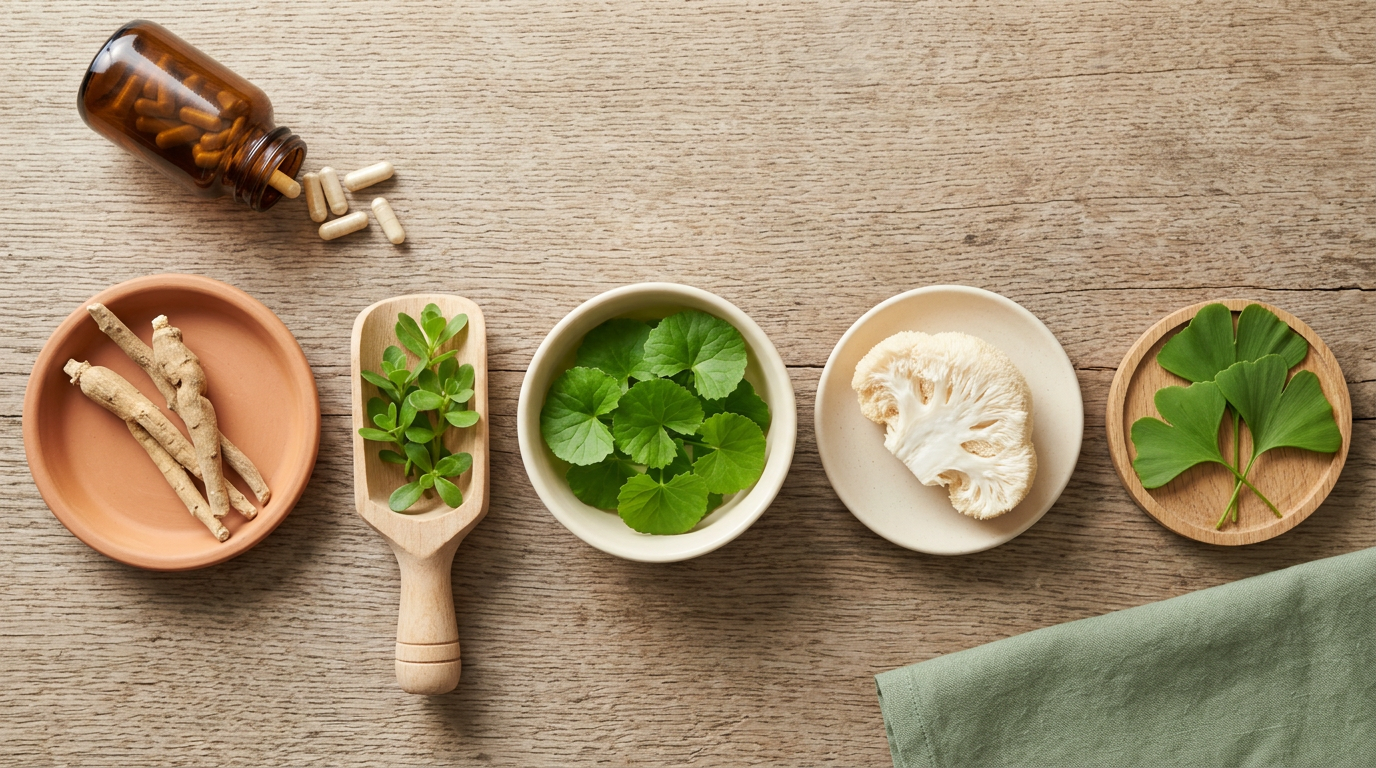
- Five herbs have real human evidence for focus and memory, none of them stimulants: Brahmi, Gotukola, Ginkgo Biloba, Lion's Mane, and Ashwagandha.
- The effect builds over weeks, not minutes. Most studies run 8 to 12 weeks before measurable change shows up.
- Pair the herbs with sleep, protein, and a midday walk. The herbs do less on a cracked foundation.
Most people reach for a second coffee at 3 p.m. and call it focus. What they actually feel an hour later is a faster heart rate and a sharper edge on whatever was already bothering them. The herbs in this list move in the other direction. They support clear thinking without spiking adrenaline, and the data on them goes back decades, not Instagram cycles.
Here are the five that earn their place, why they work, and how to actually use them.
1. Brahmi (Lunuvila), the Ayurvedic memory herb
Brahmi, called Lunuvila in Sinhala and known botanically as Bacopa monnieri, has been the most-studied memory herb in Ayurveda for centuries. A 2014 meta-analysis of nine randomized trials covering 437 adults found that Brahmi shortened decision time on cognitive tests and quietly improved attention, with the cleanest effect at 12 weeks of daily dosing.
What it actually does: the active compounds (bacosides) appear to support synaptic communication and protect brain cells from oxidative stress. It is the herb you take when the goal is steady recall, not a buzz.
How to take it: 300 to 600 mg of a standardized Bacopa extract, daily, with food. Most people notice the effect by week 4 to 6.
2. Gotukola, Sri Lanka's daily brain leaf
Gotukola (Centella asiatica) grows along Sri Lankan paddy edges and shows up in Sunday sambol the way kale shows up in California salads. The leaf has a long history in both Ayurvedic and Sinhala traditional medicine as a tonic for the mind. Modern work points to a triterpenoid called asiaticoside that supports microcirculation and may help the brain handle stress without dulling alertness.
The honest framing: Gotukola will not turn a tired brain into a sharp one. It is a foundation herb. Used daily, it adds a baseline of calm clarity that other adaptogens stack on top of.
How to take it: 1 to 2 capsules of Ancient Nutra's Gotukola Capsules daily, morning or early afternoon. Or eat the fresh leaf as a sambol two or three times a week if it is available.
3. Ginkgo Biloba, the circulation herb that feeds the brain
Ginkgo is the herb modern research keeps coming back to for cerebral blood flow. The standardized extract (EGb 761) is what most clinical trials use. The mechanism is mechanical, not magical: better small-vessel circulation means more oxygen and glucose reach brain tissue, particularly the regions involved in working memory and word retrieval. The full breakdown lives in this morning's deep-dive on Ginkgo Biloba.
How to take it: 120 to 240 mg of a standardized EGb 761-style extract, daily, with breakfast. Effects build over 4 to 8 weeks.
4. Lion's Mane, the mushroom that feeds nerve cells
Lion's Mane (Hericium erinaceus) is the cognitive mushroom every research group is currently working on. The interesting molecules are erinacines and hericenones, which appear to support nerve growth factor (NGF) in the brain, the chemical signal that helps neurons stay healthy and connected. In a 2009 Japanese double-blind trial, older adults with mild cognitive complaints who took 250 mg of Lion's Mane three times daily for 16 weeks improved on cognitive function tests compared with placebo. The effect faded after they stopped, which suggests the herb works while it is being taken, not as a one-shot fix.
How to take it: 1 to 2 capsules of Ancient Nutra's Lion's Mane Capsules with breakfast. Most people notice steadier focus by week 3 to 4.
5. Ashwagandha, the calm-focus herb stress drains away
Ashwagandha is on this list because cortisol is the most underrated memory thief. When stress runs high for weeks, working memory and attention go first. A 2017 double-blind trial of 50 adults with mild cognitive complaints found that 300 mg of Ashwagandha root extract, twice daily for 8 weeks, improved memory, executive function, and information-processing speed compared with placebo.
It will not feel like a stimulant. It feels like the noise quieting down. That is the whole point.
How to take it: 300 to 600 mg of Ancient Nutra's Ashwagandha Extract, daily, with food. Morning or evening, whichever is easier to keep. Run it for eight to twelve weeks, then take a break; longer only under a doctor's oversight. Avoid it in pregnancy or with thyroid medication or immunosuppressants without medical guidance. The NIH LiverTox database (Withania somnifera, likelihood B) links open-ended use to rare liver injury with onset between two and twelve weeks; stop and see a doctor for yellowing skin or eyes, itching, dark urine, or unusual tiredness (NIH LiverTox).
Standardized extracts, not raw powders. Bacosides on a Brahmi label, hericenones on a Lion's Mane label, EGb 761-style on a Ginkgo label, withanolides on an Ashwagandha label, asiaticosides on a Gotukola label. The spec matters more than the brand.
How to stack them without overcomplicating it
You do not need all five at once. A clean starter stack is three: one circulatory herb (Ginkgo), one Ayurvedic memory herb (Brahmi or Gotukola), and one nerve-growth herb (Lion's Mane). Add Ashwagandha if stress is the biggest blocker. The Focus & Cognition System packages Ginkgo, Brahmi, and Lion's Mane together at clinical doses for that exact reason.
Take Ginkgo and Lion's Mane with breakfast. Brahmi in the morning or early afternoon. Ashwagandha whenever it fits the day. Avoid stacking with prescription blood thinners (Ginkgo) or sedatives (Ashwagandha) without checking with a doctor first.
A team observation, two years in
The most consistent feedback the team at Ancient Nutra hears from customers on a focus stack is not "I feel smarter." It is quieter than that. People say they stopped reaching for a 3 p.m. coffee. They say they finished a long email without opening four other tabs. They say their Sunday-evening planning session takes 20 minutes instead of an hour. That is the realistic outcome. Sharper edges, not a different brain.
The foundation comes first
Supplements do not replace sleep, protein, hydration, or a 20-minute walk in daylight. Those four levers move focus and memory more than any herb. What the right herbs do is move the needle when the foundation is already in place. Start with sleep. Add the stack second.
The bottom line
Five herbs, no stimulant load: Brahmi for memory, Gotukola for daily clarity, Ginkgo for circulation, Lion's Mane for nerve growth, Ashwagandha for stress-blunted focus. Give any of them at least eight weeks before judging. Stack two or three, not all five. And do not skip the boring inputs while you wait.
Sources
- Kongkeaw C, et al. Meta-analysis of randomized controlled trials on cognitive effects of Bacopa monnieri extract. PubMed 24252493.
- Mori K, et al. Improving effects of the mushroom Yamabushitake (Hericium erinaceus) on mild cognitive impairment: a double-blind placebo-controlled clinical trial. PubMed 18844328.
- Choudhary D, et al. Efficacy and safety of Ashwagandha root extract in improving memory and cognitive functions. PubMed 28471731.
- Tan MS, et al. Efficacy and adverse effects of Ginkgo biloba for cognitive impairment and dementia: a systematic review and meta-analysis. PMC4259871.
- Puttarak P, et al. Effects of Centella asiatica on cognitive function and mood: a systematic review. PubMed 28735779.
Related reading
- Ginkgo biloba and memory: where the evidence is strong
- 5 mood and focus herbs: which one fits which kind of day
- 5 Ayurvedic herbs for the modern desk worker

Ancient Nutra Ginkgo Biloba Extract
A standardized daily capsule for cerebral circulation, memory, and mental clarity. Vegetarian capsules made in Sri Lanka.
Shop Ginkgo Biloba ExtractWritten by the Ancient Nutra Wellness Team. The team researches, sources, and tests every ingredient before it earns a place in an Ancient Nutra blend. This article is for general wellness information and is not intended to diagnose, treat, cure, or prevent any disease. Speak with a qualified healthcare provider before starting any new supplement, particularly if you are pregnant, nursing, on prescription medication, or managing a medical condition.