Ancient Nutra Wellness Team · 5 August 2026 · 8 min read
Ginkgo biloba and memory: where the evidence is strong
- The largest trial ever run on ginkgo, 3,069 adults aged 72 to 96 taking 240 mg daily for around six years, found it did not prevent dementia. Prevention is the one claim the evidence clearly does not support.
- Treatment is a different question. A 2025 meta-analysis of four trials in 782 people with mild dementia found 240 mg of standardised extract beat placebo on cognition, daily function, and quality of life.
- In healthy adults with no memory complaint, reviews have repeatedly failed to show a reliable boost. Ginkgo is not a study drug.
- Ginkgo is easy on the liver but not on the blood. It raises bleeding risk alongside warfarin, aspirin, and other blood thinners, and should be stopped before surgery.
- Dose and extract standardisation matter more than brand claims. The studied range is 120 to 240 mg daily of a leaf extract, given 22 weeks or longer.
Ginkgo is one of the few herbs on the shelf with a genuinely large evidence base, and that is exactly why it gets misquoted in both directions. One camp calls it a proven brain booster. The other calls it useless because a famous trial came back negative. Both are reading a single study and stopping there. The honest picture is narrower and more useful than either: ginkgo does very little for a healthy 30 year old who wants a sharper Tuesday afternoon, and it does something measurable for an older adult whose cognition has already started to slip. Knowing which side of that line you sit on is the whole decision.
What does ginkgo biloba actually do in the body?
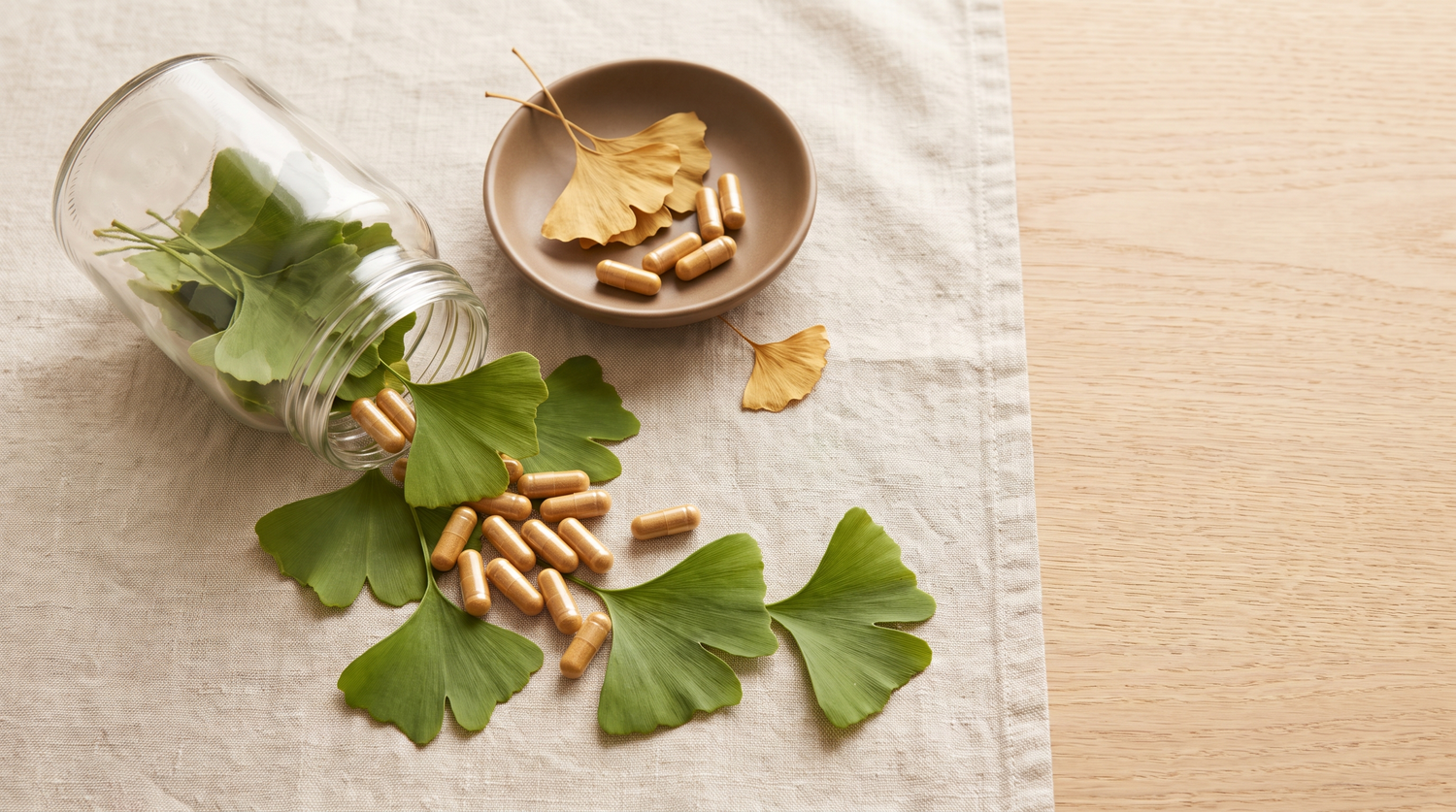
Ginkgo biloba L. is a single surviving species from an ancient tree family, and the part used in supplements is the fan-shaped green leaf, not the seed. The leaf is extracted and concentrated, and the two fractions that carry the activity are flavone glycosides and terpene lactones (ginkgolides and bilobalide). The standardised extracts used in almost every published trial hold those to roughly 24 percent and 6 percent respectively.
The mechanism most often cited is circulatory. Ginkgolides interfere with platelet-activating factor, which changes how readily blood platelets clump, and the extract has measurable effects on small-vessel blood flow. That same mechanism is the reason ginkgo carries a real bleeding caution, covered further down. Antioxidant activity in neural tissue is the second proposed route. Neither mechanism, on its own, tells you whether a person will notice anything. That question only trials can answer.
Does ginkgo improve memory in healthy adults?
On the current evidence, no, or at least not reliably enough to promise. An updated systematic review of randomised trials testing ginkgo as a nootropic in healthy people concluded plainly that it is not a smart drug, and the United States National Center for Complementary and Integrative Health states that it remains uncertain whether ginkgo extracts influence cognitive performance in healthy people, adding that much of the research on that question is low quality.
This is the single most common mismatch between what people buy ginkgo for and what ginkgo has been shown to do. A healthy adult with a busy calendar and poor sleep is not the population these trials studied. For that person, the boring levers still outperform any capsule: sleep length, protein at breakfast, iron and B12 status if energy has dropped, and a caffeine schedule that does not collapse at 3pm. Ancient Nutra's team says this to customers routinely, and it costs a sale more often than not.
Can ginkgo help people who already have cognitive decline?
Here the picture changes, and the two findings that look contradictory are actually answering different questions.
The Ginkgo Evaluation of Memory study, published in JAMA in 2008, remains the largest trial of its kind: 3,069 community-dwelling adults aged 72 to 96, randomised to 120 mg twice daily or placebo, followed for roughly six years across six academic medical centres. It found no reduction in the rate of all-cause dementia or Alzheimer's dementia. Ginkgo does not stop dementia from arriving.
A 2025 meta-analysis pooled four randomised trials covering 782 patients who already had mild dementia and asked a different question: does the extract help the symptoms that are already there? At 240 mg daily, it was significantly better than placebo on cognition, on global clinical assessment, on activities of daily living, and on quality of life, with medium to large standardised effects and an adverse-event rate no different from placebo.
Prevention and symptom treatment are not the same claim, and conflating them is how ginkgo ends up either oversold or dismissed. NCCIH lands in exactly this position: ginkgo has not been shown to prevent or slow dementia, while extract may have a modest benefit for dementia symptoms at relatively high doses, with evidence that is inconsistent.
Read the dose and the extract before you read the claim
Almost every positive ginkgo result sits in a narrow band of conditions, and products outside that band are not really being tested by the same evidence.
The studied daily dose is 120 to 240 mg of a standardised leaf extract, with the stronger dementia-symptom results clustering at 240 mg. The trials that showed benefit ran 22 to 26 weeks, not two weeks, so anyone judging ginkgo after a fortnight is judging nothing. And the extract has to be a leaf extract standardised on flavone glycosides and terpene lactones; raw powdered leaf at a token milligram count is not the same input.
A ginkgo label that names a leaf extract, states the milligrams per capsule, and gives a daily total you can push to 120 mg or higher without taking six capsules. If the label says only "ginkgo biloba" with no extract or standardisation detail, there is no way to line it up against the published trials. Ancient Nutra's Ginkgo Biloba Extract is a leaf extract in a vegetarian capsule, taken one to two daily with food.
Who should not take ginkgo?
Ginkgo's safety profile is unusual in that its liver record is clean and its blood record is not. The United States National Institutes of Health LiverTox database gives ginkgo a likelihood score of E, its lowest risk band, meaning an unlikely cause of clinically apparent liver injury, and notes that no cases in the major drug-injury registries have been attributed to it.
The bleeding question is the real one. LiverTox records several instances of excessive bleeding during ginkgo therapy attributed to interactions with antiplatelet medicines or anticoagulants, and NCCIH warns directly that ginkgo may increase bleeding risk in people taking anticoagulant drugs such as warfarin. Practically, that means ginkgo is not a casual addition for anyone on warfarin, clopidogrel, or daily aspirin, and it should be stopped well before planned surgery or dental extraction. NCCIH also flags that ginkgo may be unsafe in pregnancy. Reported side effects in ordinary use are mild and unremarkable: dizziness, stomach upset, headache. Anyone on prescription medication should clear it with their doctor rather than with a label.
Also worth stating plainly: unprocessed ginkgo seeds and raw leaf are not the same product as a standardised leaf extract, and the seeds in particular are not something to experiment with at home.
Where the leaf comes from changes what is in the capsule
Ginkgo is not a Sri Lankan herb, and pretending otherwise would be marketing rather than sourcing. China holds around 70 percent of the world's ginkgo resource and is the origin country for the species, with large dedicated plantations also established in Bordeaux in France and in Sumter, South Carolina, specifically to secure consistent raw material. Harvest timing follows the climate: green leaves come off in July in the United States, August in China, and September or October in France.
That variation is not trivia. Leaf chemistry shifts with growing region, harvest window, and drying method, which is why standardisation on the active fractions exists at all. Ancient Nutra has written separately on why a herb's origin changes what ends up in the capsule. For a herb sourced this far from home, standardised extract is the honest answer to that problem, not a provenance story.
The bottom line
Ginkgo is a well-studied leaf extract with one clear negative and one modest positive. It will not prevent dementia, and a 3,069-person trial settled that. In people who already have mild dementia symptoms, 240 mg daily of a standardised extract has repeatedly outperformed placebo across cognition and daily function. In healthy adults chasing a sharper afternoon, the evidence does not support the promise, and anyone selling it that way is going beyond the data.
For readers comparing several cognitive herbs rather than deciding on ginkgo alone, Ancient Nutra's guide to 5 herbs for focus and memory covers how ginkgo sits alongside Brahmi, Gotukola, Lion's Mane, and Ashwagandha. If the goal is memory support specifically in the Ayurvedic tradition rather than circulation, Ancient Nutra's Brahmi Capsule is the closer fit.
Does ginkgo biloba improve memory in healthy people?
Not reliably. Systematic reviews of randomised trials in healthy adults have failed to show a dependable cognitive benefit, and NCCIH states it is uncertain whether ginkgo influences cognitive performance in healthy people, with much of that research being low quality.
Can ginkgo biloba prevent dementia?
No. The Ginkgo Evaluation of Memory study followed 3,069 adults aged 72 to 96 on 240 mg daily for about six years and found no reduction in all-cause dementia or Alzheimer's dementia.
How much ginkgo biloba should you take, and for how long?
Published trials use 120 to 240 mg daily of a standardised leaf extract, with the clearest dementia-symptom results at 240 mg, and they run 22 to 26 weeks. Judging ginkgo after two weeks is judging nothing.
Who should avoid ginkgo biloba?
Anyone taking anticoagulant or antiplatelet medication such as warfarin or daily aspirin, anyone approaching surgery or dental extraction, and anyone pregnant. Ginkgo can increase bleeding risk. Speak to a doctor before combining it with prescription medicine.
Is ginkgo biloba hard on the liver?
The NIH LiverTox database rates ginkgo E, its lowest likelihood band, meaning an unlikely cause of clinically apparent liver injury, with no cases attributed to it in the major drug-injury registries.

Ginkgo Biloba Extract, 60 capsules
A daily leaf-extract capsule traditionally used to support memory and healthy circulation.
Shop Ginkgo Biloba ExtractSources and further reading
- Ginkgo: Usefulness and Safety, National Center for Complementary and Integrative Health (NIH).
- DeKosky ST et al., Ginkgo biloba for Prevention of Dementia: A Randomized Controlled Trial (GEM study), JAMA 2008, PubMed Central.
- Meta-analysis of Ginkgo biloba extract EGb 761 in the treatment of mild dementia, 2025, PubMed Central.
- Ginkgo, LiverTox, National Institute of Diabetes and Digestive and Kidney Diseases (NIH).
- Canter PH and Ernst E, Ginkgo biloba is not a smart drug: an updated systematic review of randomised clinical trials in healthy people, NCBI Bookshelf.
- Cultivation of Ginkgo biloba L. on three continents, International Society for Horticultural Science.
Written by the Ancient Nutra Wellness Team. The team researches, sources, and tests every ingredient before it earns a place in an Ancient Nutra blend. Questions? Email info@ancientnutra.com or message Ancient Nutra on Instagram.
Medical disclaimer: This article is for educational purposes only and is not medical advice. Statements have not been evaluated by the FDA. Ancient Nutra products are not intended to diagnose, treat, cure, or prevent any disease. Speak with a qualified healthcare provider before starting any new supplement, especially if you take prescription medication or have a medical condition.