Ancient Nutra Wellness Team · 8 August 2026 · 6 min read
Six Questions to Ask Before You Take a Herb for Stress
Key takeaways
- A common name is not an identification. Ask for the botanical or fungal species name before anything else.
- Ask how many people were in the trials. For Lion's Mane the entire human literature is roughly eight clinical studies and about 312 participants.
- The two questions people skip are what the herb interacts with and what happens when they stop taking it.
Most advice about herbs for stress argues about which herb. That is the least useful question you can ask, because the answer changes nothing about whether the bottle in front of you is worth buying. These six questions do change something. They are the ones a good practitioner or pharmacist will ask you, and they are answerable from a label, a product page and twenty minutes of reading. Work through them before you spend money, and take the ones you cannot answer to a professional rather than to a search box.
1. Which species is it, by its scientific name?
Common names are regional and they overlap. In Sri Lanka the name Brahmi is applied to Bacopa monnieri, while Gotukola is Centella asiatica, and in parts of India the word Brahmi is used for both plants (Gamage et al., 2021). Two different species, two different bodies of research, one shared name on a shelf. Lion's Mane has the same problem in reverse: it is one species, Hericium erinaceus, in the family Hericiaceae, sold under at least four common names. If a label gives you only the common name, you cannot look up the research on it, which is usually the point.
2. Which part of the plant or mushroom is in the capsule?
This sounds pedantic until you look at the chemistry. In Lion's Mane, the compounds called hericenones are found in the fruiting body, the visible white mushroom, while a different group called erinacines are found in the mycelium, the root-like network it grows from (hericenones review, 2024; erinacines review, 2018). Two parts of the same organism, two different sets of compounds. The small human trial most often quoted for mood used fruiting body powder specifically. So "Lion's Mane" on a label is not enough information, and neither is "root" or "leaf" left unstated on a plant product. Our own guide to reading a herbal extract label covers where this information should appear.
3. How many people were in the trials, and for how long?
Ask for the size and the duration together, because either one alone flatters. A 2025 systematic review of Hericium erinaceus gathered 26 studies of all kinds and found the human side amounted to roughly eight clinical studies and about 312 participants in total, with the authors noting plainly that the research is limited by small samples, short durations and inconsistency between studies (Menon et al., Frontiers in Nutrition, 2025). The two trials that carry most of the mood and cognition story had 30 people each and ran four weeks and sixteen weeks respectively (Nagano et al., 2010; Mori et al., 2009).
That is not a reason to dismiss the herb. It is a reason to hold your expectations at the size of the evidence, and to be suspicious of anyone selling it with more certainty than 312 people can support. It also sets your own review window: if the trials ran four to sixteen weeks, judging your bottle in week two is judging it early. Keeping a written diary over the first thirty days is the cheapest way to make that judgement honestly.
4. What does it interact with?
This is the question that actually sends people to hospital, and the standard worked example is St John's Wort. It induces the liver enzymes CYP3A4 and CYP2C9 and affects the drug transport protein P-glycoprotein, which means it can lower the blood levels of a long list of medicines: birth control pills, transplant rejection drugs, antiretrovirals, digoxin, warfarin and several psychiatric medicines among them (LiverTox, National Institute of Diabetes and Digestive and Kidney Diseases). The same monograph's bibliography points to a systematic review collecting 18 reported cases of serotonin syndrome when it was combined with SSRI antidepressants. None of that makes it a dangerous plant in isolation. It makes it a plant that has to be declared to whoever prescribes for you.
So the question is not "is this herb safe", it is "is this herb safe alongside what I already take". If you take any prescription medicine, that question belongs to your doctor or pharmacist, and the honest answer for many herbs is that nobody has studied the combination at all.
5. Who should not take it, and what is the stop signal?
Every product should be able to tell you both. For Lion's Mane the NIH LiverTox database rates it an unlikely cause of liver injury and records that mild digestive complaints, discomfort, nausea or loose stools, appear in under ten percent of people in trials. It also records one case of an acute hypersensitivity reaction to taking it by mouth (LiverTox, 2024), and the 2025 review notes one reported case of acute respiratory distress. Those are rare events, not typical ones, but they give you a clear stop signal: a rash, swelling, or any difficulty breathing means stop and get medical advice the same day. Mushrooms are a common allergen, so anyone who reacts to mushrooms in food has an obvious reason to be careful. Pregnancy, breastfeeding and existing medical conditions are always a practitioner question rather than a label question.
Look for
On a mushroom supplement, look for the species written as Hericium erinaceus and a clear statement of which part is inside, fruiting body or mycelium, plus the milligrams per capsule. Ancient Nutra's Lion's Mane Capsule is the product this article uses as its worked example, and the same three details are what you should demand from any brand, including this one.
6. What happens when you stop?
Almost nobody asks this and it is the most practical question of the six. In the sixteen week trial in older adults with mild cognitive complaints, the improvements measured during supplementation declined after participants stopped taking it (Mori et al., 2009). That tells you something a benefits list never will: whatever the herb was doing, it was doing while it was being taken, not building something permanent underneath. Knowing that in advance changes how you budget, how you plan a course, and whether you treat a supplement as a fix or as one input among sleep, load and everything else. If you want the herb-by-herb comparison rather than the method, our roundup of Ayurvedic herbs for stress and the evidence behind them is the place to start.
The bottom line
None of these questions require you to know any chemistry. They require a label that names a species, a brand willing to say which part is inside, a habit of checking trial sizes rather than benefit lists, and one honest conversation with whoever manages your prescriptions. Write down the answers you cannot find, and take that short list to a pharmacist or an Ayurvedic practitioner rather than guessing. A herb you can answer six questions about is a much better purchase than the one with the best packaging.

Lion's Mane Capsule
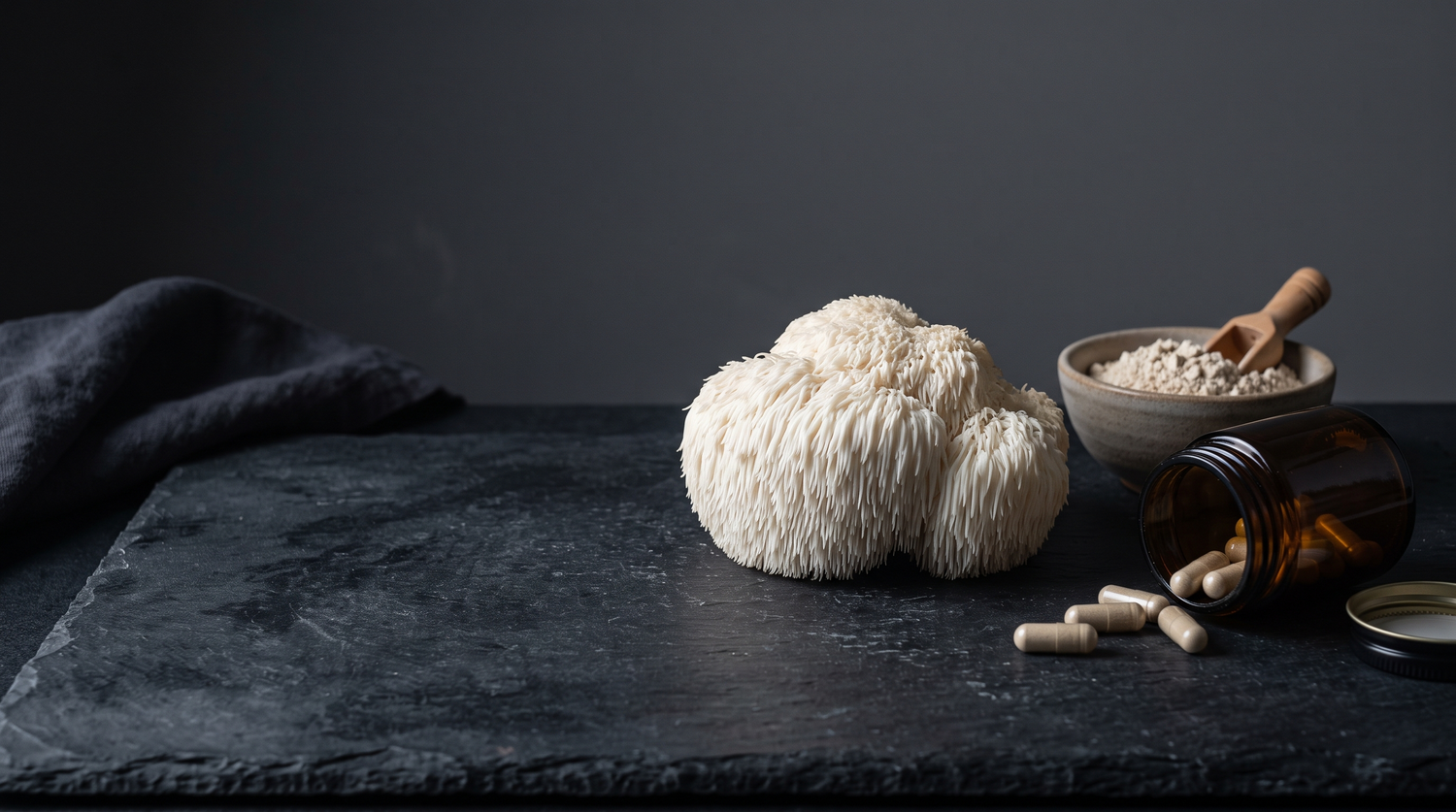
Hericium erinaceus, the mushroom used as this article's worked example for all six questions.
Shop Lion's Mane CapsuleSources and further reading
- Lion's Mane, LiverTox, National Institute of Diabetes and Digestive and Kidney Diseases, 2024.
- St. John's Wort, LiverTox, National Institute of Diabetes and Digestive and Kidney Diseases.
- Menon A, et al. Hericium erinaceus: a systematic review, Frontiers in Nutrition, 2025.
- Mori K, et al. Improving effects of the mushroom Yamabushitake on mild cognitive impairment, Phytotherapy Research, 2009.
- Nagano M, et al. Reduction of depression and anxiety by 4 weeks Hericium erinaceus intake, Biomedical Research, 2010.
- Gamage DGND, et al. Ethnobotanical survey of medicinal plants in Sri Lanka, Evidence-Based Complementary and Alternative Medicine, 2021.
Written by the Ancient Nutra Wellness Team. The team researches, sources, and tests every ingredient before it earns a place in an Ancient Nutra blend. Questions? Email info@ancientnutra.com or message Ancient Nutra on Instagram.
Medical disclaimer: This article is for educational purposes only and is not medical advice. Statements have not been evaluated by the FDA. Ancient Nutra products are not intended to diagnose, treat, cure, or prevent any disease. Speak with a qualified healthcare provider before starting any new supplement, especially if you take prescription medication or have a medical condition.