Ancient Nutra Wellness Team · 16 August 2026 · 7 min read
Probiotics and Triphala: What the Timing Evidence Actually Says
Key takeaways
- No published trial has compared taking Triphala before a probiotic against taking it after, so any strict running order you read online is opinion, not evidence.
- The timing rule that does have support is about food, not herbs. In a laboratory digestion model, probiotic survival was highest when the dose was taken with or about 30 minutes before a meal containing some fat.
- Probiotics are mostly transient. Scientific consensus holds that they pass through rather than settle in, and that a benefit does not require permanent colonisation.
- Triphala's human research runs to roughly 45 days at the long end, so judge a gut practice over about six weeks rather than leaving it open ended.
- A simpler stack beats a complicated one: pick a fixed hook in the day, keep the two things separate enough to notice what each is doing, and change one variable at a time.
Ask the internet when to take a probiotic alongside an Ayurvedic digestive blend and you will get a confident answer within seconds. Take the probiotic first. No, take the herb first. Leave two hours between them. Never take them on the same day. The confidence is impressive. The evidence behind it is thin to non existent. Digestive complaints are one of the largest reasons people see a doctor at all, with United States data recording tens of millions of ambulatory visits a year for digestive disease, so it is worth being precise about what is actually known here rather than repeating a rule someone invented for a blog post.
Does the order of probiotics and Triphala actually matter?
There is no trial that answers this. Not a small one, not a poor one, none. Triphala has been studied for oral health, metabolic markers and bowel regularity, and probiotics have been studied extensively on their own, but the specific question of sequencing one against the other inside a single day has not been put to a controlled test. Anyone who tells you otherwise is filling a gap with intuition.
That matters because the intuitive story sounds so reasonable. Triphala is traditionally used to encourage bowel movement, therefore it must flush the probiotic through faster, therefore you should take the probiotic well before it. Every step in that chain is plausible and none of it has been demonstrated. In fact, the broader literature on transit time and probiotics tends to point the other way, with probiotic supplementation studied as something that may help regularity rather than something regularity destroys. The honest position is that the mechanism is unproven in both directions.
So rather than invent a rule, it is more useful to work from the two things that are established: what a probiotic does after you swallow it, and what food does to its odds of surviving the trip.
What does a probiotic actually do once it is swallowed?
Mostly, it visits. The International Scientific Association for Probiotics and Prebiotics, the body that authored the consensus definition of the term, is direct about this: probiotics generally do not colonise the digestive tract, and the health effects attributed to them do not require colonisation. Detectable levels typically fall away within days to a couple of weeks after the last dose.
That single fact reframes the whole timing debate. If a probiotic were building a permanent settlement, protecting the founding population from anything that might disturb it would be worth obsessing over. Because it is a transient passenger, consistency of dosing matters far more than the minute at which the dose lands. Missing a day costs more than taking it an hour later than usual.
It also explains why probiotics and prebiotics are not interchangeable, a confusion that shows up constantly in supplement conversations. A probiotic is a live organism. A prebiotic, by the same association's updated definition, is a substrate that the microbes already living in you selectively use, which then confers a benefit. One is a guest. The other is groceries.
When should a probiotic be taken relative to food?
This is the one timing question with a real answer attached, and it is worth knowing precisely what kind of answer it is. A 2011 study using a laboratory model of the human stomach and upper intestine tested probiotic survival across different feeding conditions. Survival was best when the dose was given with, or roughly 30 minutes before, a meal that contained some fat. It dropped when the dose was given about 30 minutes after eating.
The important caveat: that was a simulated digestive model, not people, and it measured surviving organisms rather than any health outcome. It is a reasonable rule of thumb and a poor foundation for anxiety. Taking a probiotic with breakfast is sensible. Taking it with breakfast on Monday and with lunch on Tuesday is not a crisis.
Where Triphala fits in a daily gut practice
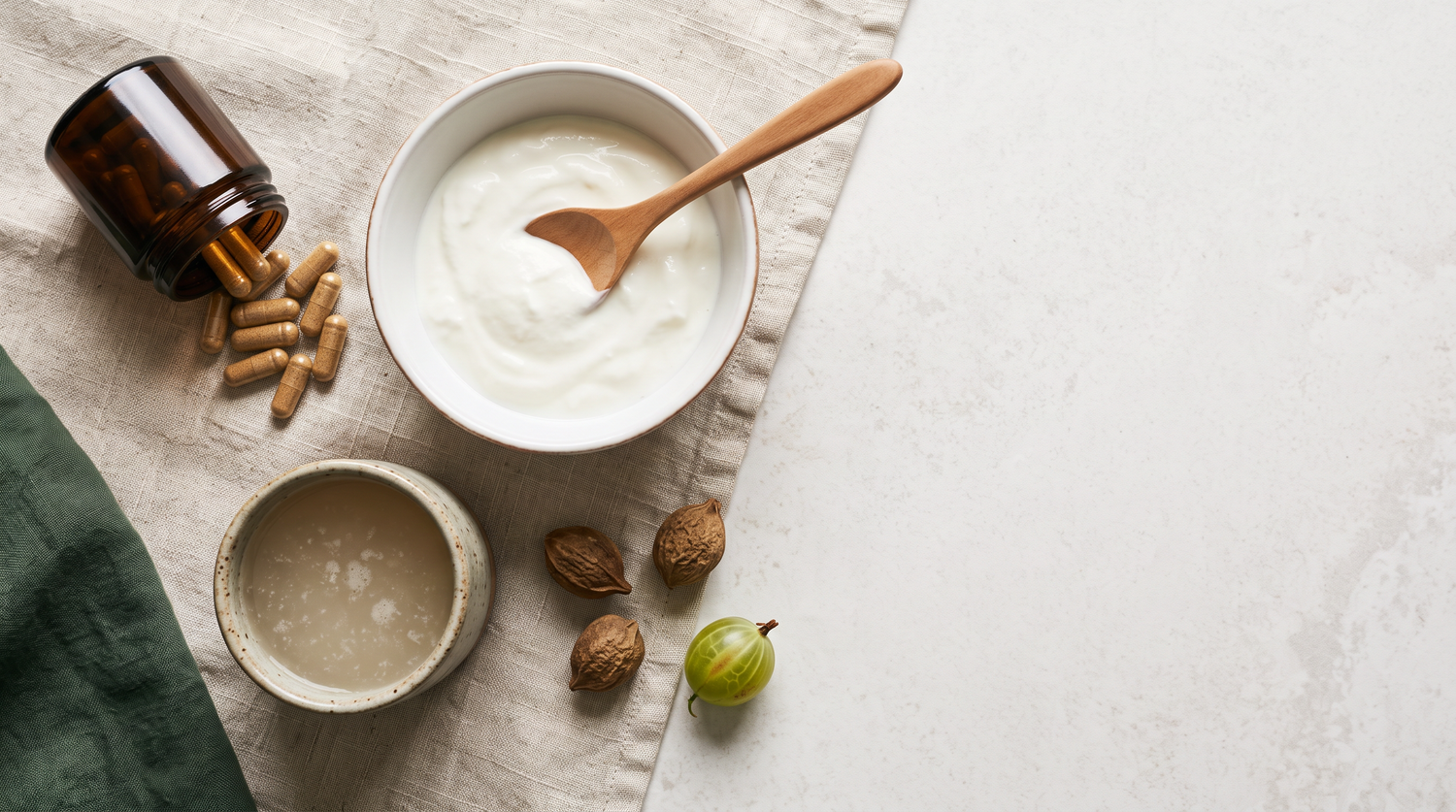
Triphala is not a probiotic and does not pretend to be. It is a fixed blend of three dried fruits from the Indian subcontinent, where all three species are commercially grown: amla (Emblica officinalis, also written Phyllanthus emblica), haritaki (Terminalia chebula) and bibhitaki (Terminalia bellirica). The fruit is the part used in each case. For what each of the three contributes individually, the breakdown of the three fruits covers that ground in detail.
Its traditional role is regularity and general digestive tone, taken as a daily habit rather than a rescue remedy. Research into whether it shifts the gut microbiome itself is genuinely early: the most relevant work is a small four week pilot randomised trial with nine participants. That is a signal worth following, not a conclusion, and it should be described that way by anyone selling it.
The practical takeaway is that Triphala and a probiotic are aimed at different jobs. One is a live culture passing through. The other is a plant material taken for daily bowel comfort. Treating them as rivals competing for the same slot in the morning is the wrong frame entirely.
Look for
A Triphala product that names all three fruits and the plant part used, in a fixed capsule dose you can actually repeat daily, rather than a loose powder blend with an undisclosed ratio. Ancient Nutra's Triphala is a 60 capsule format for exactly that reason. For a gentler, more traditional Sri Lankan option aimed at everyday gut comfort, Ancient Nutra's Beli sits in the same part of the routine.
How long should a gut practice run before judging it?
Long enough to be fair, and no longer than the evidence supports. For Triphala, the human trials that exist run in the range of four weeks to about 45 days, with the 45 day mark sitting at the upper end of what has actually been tested. That is a sensible review point: roughly six weeks in, decide whether it stays.
Open ended daily use of any botanical, continued indefinitely because nothing obviously went wrong, is not something research supports and not something worth defaulting to. Build in a stopping point where the habit gets reassessed instead of quietly running forever. Anyone taking prescription medication, pregnant or breastfeeding, or managing a diagnosed digestive condition should be having this conversation with a clinician rather than with an article.
Build the routine around habit, not sequence
A practice that survives contact with a normal week looks like this. Anchor the probiotic to a meal, ideally the same meal every day, taken with it or shortly before. Put Triphala at whichever fixed point in the day you will genuinely repeat, which for most people is evening. Leave a comfortable gap between the two simply because it is easier to remember two separate hooks than one crowded moment, not because a study demands it. Then change nothing else for six weeks so that if something shifts, you have some idea what caused it.
That last part is where most self experiments fall apart. Three new things started in the same week produce a result nobody can interpret. One thing at a time is slower and considerably more informative.
The bottom line
The order of probiotics and Triphala is the least important decision in this routine, and it is the one that gets all the attention. Take the probiotic near a meal, take Triphala at a time you will not forget, run it for about six weeks and review honestly. Consistency is the variable that has evidence behind it. Sequencing is the variable that has confidence behind it, which is not the same thing.
Frequently asked questions
Should Triphala be taken before or after a probiotic?
No published trial has compared the two orders, so there is no evidence based answer. Choose the arrangement you will repeat daily and keep it consistent.
Does Triphala kill or flush out probiotics?
There is no evidence that it does. The idea comes from an assumption about transit time that has not been tested, and the wider literature does not support treating regularity as something that cancels a probiotic.
Is it better to take a probiotic on an empty stomach?
A laboratory digestion model found survival was highest with, or about 30 minutes before, a meal containing fat, and lowest around 30 minutes after eating. That is simulated data rather than a human outcome trial, so treat it as a reasonable default, not a rule.
Do probiotics permanently repopulate the gut?
Generally no. Scientific consensus is that probiotics usually do not colonise the digestive tract and that benefits do not require colonisation, which is why regular dosing matters more than perfect timing.
How long should Triphala be taken before deciding if it works?
Human trials run to roughly 45 days at the longest, so about six weeks is a fair review window. Avoid treating it as an indefinite daily habit without reassessment.

Triphala, 60 capsules
The traditional three fruit blend in a fixed daily capsule dose, for a routine you can actually repeat.
Shop TriphalaSources and further reading
- Is probiotic colonization essential?, International Scientific Association for Probiotics and Prebiotics.
- Tompkins TA et al., The impact of meals on a probiotic during transit through a model of the upper gastrointestinal tract, Beneficial Microbes, 2011 (PubMed).
- Gibson GR et al., Expert consensus document: the updated definition of prebiotics, ISAPP consensus statement.
- Effect of Triphala on the gut microbiome: a pilot randomised controlled trial, PubMed.
- Triphala: a review of its phytochemistry, pharmacology and clinical evidence, PubMed Central.
- Burden of digestive diseases in the United States, National Institute of Diabetes and Digestive and Kidney Diseases.
Written by the Ancient Nutra Wellness Team. The team researches, sources, and tests every ingredient before it earns a place in an Ancient Nutra blend. Questions? Email info@ancientnutra.com or message Ancient Nutra on Instagram.
Medical disclaimer: This article is for educational purposes only and is not medical advice. Statements have not been evaluated by the FDA. Ancient Nutra products are not intended to diagnose, treat, cure, or prevent any disease. Speak with a qualified healthcare provider before starting any new supplement, especially if you take prescription medication or have a medical condition.