Ancient Nutra Wellness Team · 4 July 2026 · 6 min read
Papaya leaf and platelets: a Sri Lankan herb for dengue recovery
Key takeaways
- Papaya leaf is a traditional Sri Lankan remedy used during dengue, and small trials suggest it can speed up how fast platelet counts climb back.
- The evidence is promising but still limited, so papaya leaf is a supportive measure, never a replacement for a doctor, hospital care, or platelet monitoring.
- Dengue is a medical emergency. Warning signs like persistent vomiting, bleeding, or severe stomach pain mean go to a hospital now, not to the kitchen.
Every household in Sri Lanka has a papaya tree story. When someone gets dengue and the platelet count starts sliding, an aunt or a neighbour appears at the door with a small, bitter glass of green juice pressed from papaya leaves. It is one of the most trusted home remedies on the island. The honest question is not whether people use it. They do. The question is what it actually does, and where the kitchen ends and the hospital has to begin.
What papaya leaf actually does for platelets
Dengue is a huge problem, and it is getting bigger. 2024 was the worst year on record, with more than 14.6 million cases and over 12,000 deaths reported to the World Health Organization. One of the things that makes dengue dangerous is thrombocytopenia, a sharp drop in platelets, the tiny cells that help your blood clot.
This is where papaya leaf comes in. A Malaysian trial of 228 dengue patients found that the group given papaya leaf juice had a significantly faster rise in platelet count at 40 and 48 hours compared to those who did not (Subenthiran et al., 2013). The researchers also saw the juice switch on genes tied to platelet production. In plain terms: it did not magically cure anyone, but it appeared to help the body rebuild platelets a little sooner.
The likely reason is in the leaf itself. Papaya leaves carry an alkaloid called carpaine, along with flavonoids like quercetin and the enzymes papain and chymopapain. Lab work suggests carpaine may nudge the bone marrow to make more platelets, while the flavonoids and antioxidants help protect existing platelets from being destroyed.
Be honest about the evidence
Here is the part most articles skip. A 2019 review that pooled nine trials and roughly 1,200 patients did find faster platelet recovery and slightly shorter hospital stays with papaya extract. But the same authors flagged that most of these trials were small and of low to moderate quality, and concluded the evidence is not yet strong enough to routinely recommend it (Rajapakse et al., 2019).
So the fair summary is this: a real signal, promising, worth respecting, but not proven the way a prescription drug is proven. Papaya leaf is a supportive tradition with early science behind it, not a treatment that replaces medical care.
When papaya leaf is not enough
Dengue can turn serious fast. Go to a hospital immediately if there is persistent vomiting, bleeding from the gums or nose, blood in vomit or stool, severe stomach pain, restlessness, or extreme tiredness. Papaya leaf does not stop dengue and does not remove the need for medical monitoring. It sits alongside proper care, never in place of it.
Who should consider papaya leaf
Papaya leaf makes the most sense for a few specific situations, always with a doctor in the loop:
- People recovering from dengue whose doctor is already tracking their platelet count and is comfortable with a supportive herb alongside treatment.
- Households in dengue season who want a traditional, gentle option on hand as part of general recovery care.
- Anyone who prefers whole-plant remedies and finds fresh leaf juice too bitter to swallow, where a standardised capsule is easier to take consistently.
And who does not need it: healthy people with normal platelet counts do not need to take papaya leaf as a daily supplement. It is best thought of as a short-term support during illness, not a forever pill. Pregnant women should avoid it, and anyone on blood thinners or other prescription medicine should ask a doctor or pharmacist first.
How to actually take papaya leaf
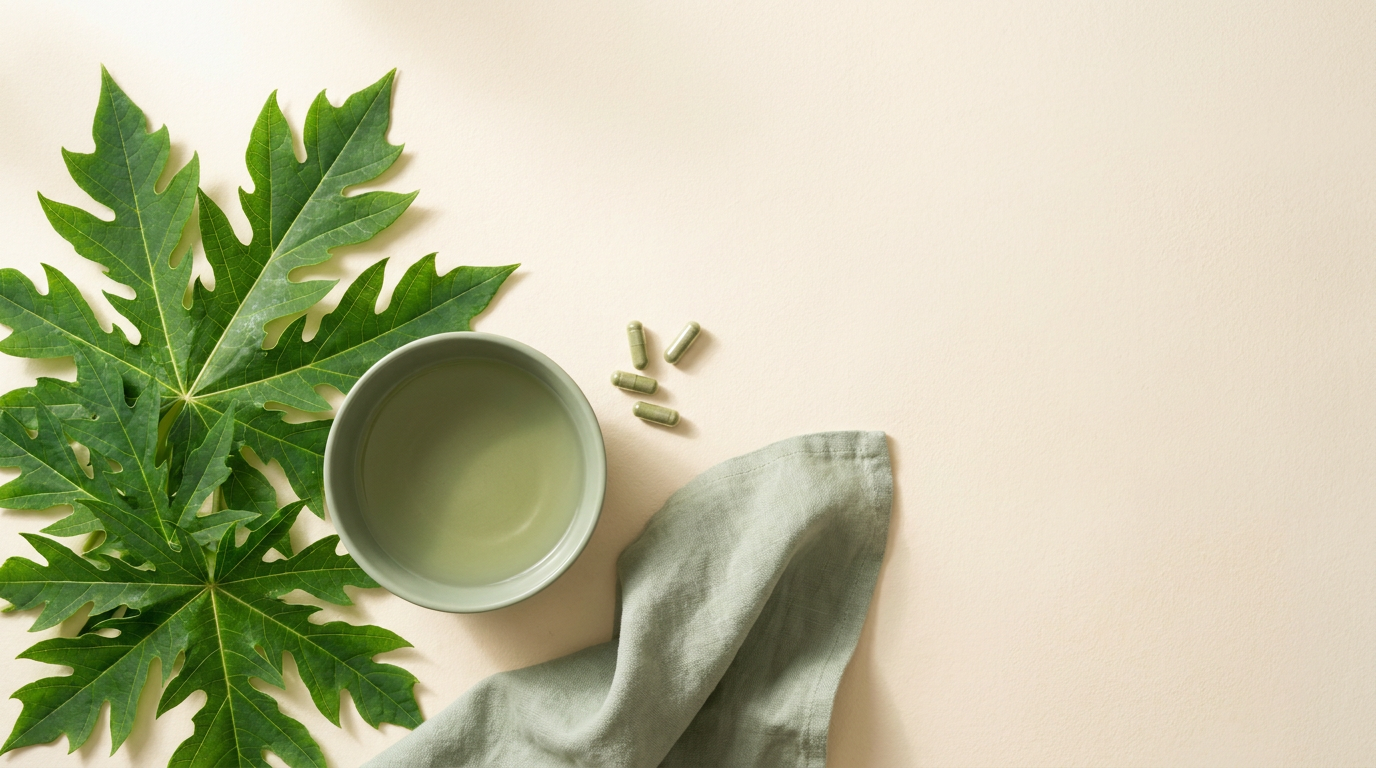
The traditional form is fresh leaf juice, usually a small amount, around 10ml to 25ml once or twice a day for a few days during recovery. It is famously bitter, which is why many people cannot keep it down when they are already nauseous. Capsules made from dried papaya leaf solve that problem: same plant, no taste, and a consistent amount each time.
Take it with water, ideally after food to be gentle on the stomach. Use it as a short course during and just after illness rather than every day indefinitely. If you are taking it because of dengue, keep going to your platelet checks. The lab number, not how you feel, is what tells you where you actually stand.
Look for
Papaya leaf sourced from clean, organically grown leaves and dried to preserve its natural compounds, in a simple capsule with no fillers. Ancient Nutra's Papaya Leaves are made from organic Sri Lankan papaya leaf, capsuled so you get the plant without the bitterness.
Where papaya leaf comes from
Papaya grows in nearly every garden across Sri Lanka and South Asia, and its leaves have been used in home care for generations, long before anyone measured a platelet. That is the honest order of things: the tradition came first, and the modern lab work is now catching up to what grandmothers were already doing. What the science adds is a reason to respect the remedy without overselling it.
What to pair papaya leaf with during recovery
Dengue recovery is really about the basics: rest, fluids, and letting the body rebuild. A couple of Ancient Nutra herbs fit naturally around papaya leaf during that window. Ancient Nutra's Guduchi is a traditional Ayurvedic herb long used after fevers and illness to support the immune system as strength returns.
For the nutrition side, Ancient Nutra's Moringa adds a dense daily green when appetite is low and eating properly is hard. This trio is for the recovery stretch, not for everyone, and none of it replaces the fluids and rest that do the real work.
How long papaya leaf takes to work
In the trials where papaya leaf helped, the difference in platelet counts showed up quickly, within roughly two days rather than weeks. That said, platelet recovery in dengue follows its own curve as the illness runs its course, so it is hard to credit any single thing. The practical takeaway: use papaya leaf as a short support over the illness and the days after, judge nothing by how you feel, and let the platelet lab results and your doctor guide the decisions.
The bottom line
Papaya leaf is a genuine piece of Sri Lankan wellness heritage with early science suggesting it can help platelet counts recover a little faster. It is worth keeping on the shelf for dengue season, as long as it stays in its lane: a support during recovery, used with medical care, never instead of it. For an easy, no-bitterness way to keep it on hand, that is what Ancient Nutra's Papaya Leaves are for.

Ancient Nutra Papaya Leaves
Organic Sri Lankan papaya leaf in a simple capsule, for platelet and recovery support without the bitter juice.
Shop Papaya LeavesSources and further reading
- Dengue and severe dengue, World Health Organization (2024 data).
- Subenthiran et al., Carica papaya Leaves Juice Significantly Accelerates the Rate of Increase in Platelet Count, Evidence-Based Complementary and Alternative Medicine, 2013.
- Rajapakse et al., Carica papaya extract in dengue: a systematic review and meta-analysis, BMC Complementary Medicine and Therapies, 2019.
- Sharma et al., Therapeutic Potential of Carica papaya Leaf against Thrombocytopenia, Molecules, 2022.
Written by the Ancient Nutra Wellness Team. The team researches, sources, and tests every ingredient before it earns a place in an Ancient Nutra blend. Questions? Email info@ancientnutra.com or message Ancient Nutra on Instagram.
Medical disclaimer: This article is for educational purposes only and is not medical advice. Dengue is a serious illness that requires medical care. Statements have not been evaluated by the FDA. Ancient Nutra products are not intended to diagnose, treat, cure, or prevent any disease. Speak with a qualified healthcare provider before starting any new supplement, especially if you are pregnant, take prescription medication, or have a medical condition.