Ancient Nutra Wellness Team · 21 September 2026 · 6 min read
Cocoa flavanols: what a mug of hot chocolate really gives you
By the Ancient Nutra Editorial Team
Key takeaways
- The large cocoa trials used concentrated extracts, not drinks. The 21,442-person COSMOS trial gave 500 mg of cocoa flavanols a day in a capsule.
- Measured flavanol content in cocoa powder ranges from about 34.6 mg per gram in natural cocoa down to about 3.9 mg per gram in heavily alkalised cocoa, so processing matters more than the word cocoa on the front of a pack.
- A mug of drinking chocolate is a comfort habit that carries some flavanols. It is not a clinical dose, and it is fair to enjoy it for what it is.
Most writing about cocoa borrows its authority from research that was never done on drinking chocolate. The headline trials used measured extracts in capsules, at doses a home kitchen does not reach, and the honest version of the story is more useful than the flattering one. Cocoa does something real to blood vessels. The amount that does it is larger than what sits in an evening mug. Both of those facts can live together, and knowing where the line falls makes it easier to drink hot chocolate without pretending it is medicine.
Start with what a flavanol actually is
Flavanols are a family of plant compounds found in the seed of Theobroma cacao, the cocoa tree. The bean is the part used, and most of the world's supply grows in West Africa, with Côte d'Ivoire and Ghana the two largest producing countries according to International Cocoa Organization figures. In the body, cocoa flavanols are studied mainly for what they do to the lining of blood vessels rather than for anything they do in the gut or the brain.
One flavanol gets named more than the others: epicatechin. When researchers standardise a cocoa supplement, epicatechin is usually the number they standardise against, which is a clue that the research world treats cocoa as a delivery vehicle for a specific compound rather than as a food with general goodness.
Follow the mechanism to the blood vessels
The proposed route runs through nitric oxide. Cocoa flavanols appear to increase the formation of nitric oxide in the endothelium, the single layer of cells lining every blood vessel, and nitric oxide relaxes the vessel wall. A relaxed vessel is a slightly wider vessel, and a slightly wider vessel carries the same blood at slightly lower pressure. That chain of reasoning is why almost every cocoa study measures blood pressure or vascular function rather than mood or energy.
The pooled evidence is real and small. A Cochrane review of 35 trials, covering 1,804 mainly healthy adults across 40 treatment comparisons lasting two to 18 weeks, found flavanol-rich cocoa lowered systolic blood pressure by 1.76 mmHg (95% confidence interval minus 3.09 to minus 0.43) and diastolic blood pressure by the same 1.76 mmHg (minus 2.57 to minus 0.94) against control. The reviewers downgraded their own certainty from high to moderate because the differences between trials could not be explained, and a sensitivity analysis that removed trials with industry-employed authors shrank the effect further.
Two details inside that review deserve more attention than the headline. First, the effect showed up in people who already had high blood pressure, where systolic pressure fell by about 4 mmHg across nine comparisons, and it did not reach significance in people with normal blood pressure. Second, the average daily dose across those trials was 670 mg of flavanols, delivered in anything from 1.4 to 105 grams of cocoa product.
Compare the trial dose with what lands in a mug
This is where the arithmetic gets interesting. Researchers at a manufacturer's own laboratory measured total flavanol content across commercial cocoa powders and published the ladder: natural, non-alkalised cocoa averaged 34.6 mg of flavanols per gram, lightly alkalised cocoa 13.8 mg per gram, medium-processed 7.8 mg per gram, and heavily alkalised cocoa 3.9 mg per gram.
Run ten grams of cocoa powder through those numbers. Natural cocoa gives roughly 346 mg of flavanols. Heavily alkalised cocoa gives roughly 39 mg. The Cochrane trials averaged 670 mg a day, and the COSMOS trial used 500 mg a day in capsule form. So ten grams of the best-case cocoa powder lands at about half the COSMOS dose, and ten grams of the worst-case powder lands near 8 percent of it. A normal mug of drinking chocolate uses well under ten grams of cocoa, because a drink mix also carries milk solids and sweetness.
COSMOS is worth knowing in full, because it is the largest test cocoa has ever had. It randomised 21,442 older adults in the United States to either a cocoa extract supplying 500 mg of flavanols a day, including 80 mg of epicatechin, or a placebo, and followed them for a median of 3.6 years. The primary outcome, total cardiovascular events, did not reach statistical significance (hazard ratio 0.90, 95% confidence interval 0.78 to 1.02). Cardiovascular death, a pre-specified secondary outcome, was 27 percent lower (hazard ratio 0.73, 0.54 to 0.98). The authors reported no safety concerns and called for more research before drawing conclusions. That is a promising signal from a capsule, not a promise from a drink.
Check how the cocoa was processed
Alkalisation, also called Dutch processing, exists for taste and colour. It raises the pH of the powder, darkens it, and softens the sharpness, which is why so many commercial cocoas are treated. The same process is what strips the flavanols, in a straight line: the more alkali, the fewer flavanols left. Natural cocoa sits at a pH of 5.3 to 5.8, and the flavanol count falls steadily as that number climbs.
Labels rarely make this easy. Very few packs print a flavanol figure, and most do not say whether the cocoa was alkalised. What a label can tell you is the length of the ingredient list and whether cocoa leads it.
Look for
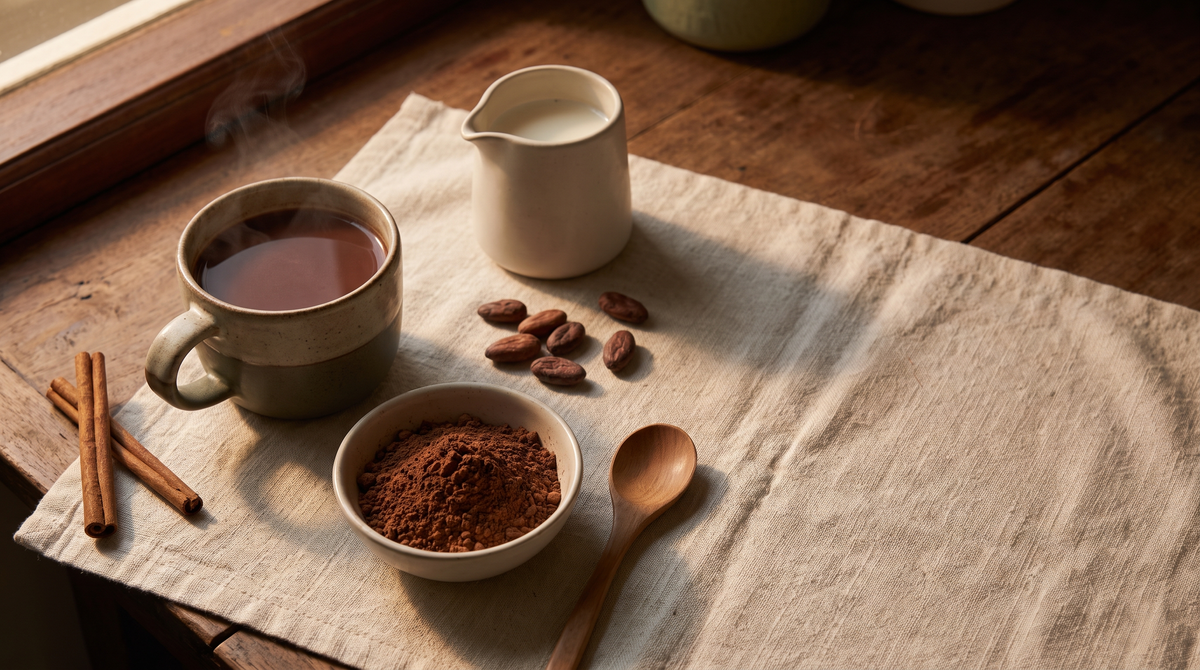
Cocoa named first, a short ingredient list, and sweetness you control at the cup rather than sweetness fixed in the pack. Ancient Nutra's Hot Chocolate Mix is built from cocoa and coconut milk powder with no artificial colours, flavours, or preservatives, and it does not print a flavanol figure, because no honest drinking cocoa can promise a trial dose.
Keep one caffeine caveat in view for evenings
Cocoa is not a neutral bedtime drink for everyone. Theobromine, the cacao bean's principal alkaloid, makes up roughly 1.5 to 3 percent of the bean, and cocoa carries a smaller amount of caffeine alongside it. Most people notice nothing from a single cup. Anyone who is sensitive to caffeine, or who already sleeps lightly, is better off moving cocoa to the afternoon and keeping the late hour for something without either compound.
Cocoa was also well tolerated across the Cochrane trials, with gastrointestinal complaints and nausea reported by 1 percent of participants taking cocoa and 0.4 percent taking control. If a cup regularly leaves you queasy, that is worth respecting rather than pushing through.
The bottom line
Cocoa flavanols relax blood vessels through nitric oxide, and the measured benefit in pooled trials is a small blood pressure reduction that shows up mostly in people whose pressure is already high. Three things follow from that:
- The trial doses, 500 to 670 mg of flavanols a day, come from extracts and are higher than a drink delivers.
- Processing decides how much a cocoa powder holds, and natural cocoa holds close to nine times what heavily alkalised cocoa does.
- A mug of hot chocolate is worth drinking as comfort and routine, and it belongs in the same honest category as what collagen supplements can and cannot do.
If the evening cup is already part of how the day ends, keeping that ritual alive through a loud week matters more than the flavanol count. Ancient Nutra's Hot Chocolate Mix is there for the cup, and the research above is there so nobody has to oversell it.

Hot Chocolate Mix
Cocoa and coconut milk powder, moderately sweet, with no artificial colours, flavours, or preservatives.
Shop Hot Chocolate MixSources and further reading
- Sesso HD, Manson JE, Aragaki AK, et al. Effect of cocoa flavanol supplementation for the prevention of cardiovascular disease events: the COSMOS randomized clinical trial. American Journal of Clinical Nutrition 2022;115(6):1490-1500, PubMed. Retrieved 21 September 2026.
- Ried K, Fakler P, Stocks NP. Effect of cocoa on blood pressure. Cochrane Database of Systematic Reviews 2017;4:CD008893, PubMed. Retrieved 21 September 2026.
- Miller KB, Hurst WJ, Payne MJ, et al. Impact of alkalization on the antioxidant and flavanol content of commercial cocoa powders. Journal of Agricultural and Food Chemistry 2008;56(18):8527-8533, PubMed. Retrieved 21 September 2026.
- Theobromine, in Coffee, Tea, Mate, Methylxanthines and Methylglyoxal, IARC Monographs, NCBI Bookshelf. Retrieved 21 September 2026.
- Production of cocoa beans, International Cocoa Organization. Retrieved 21 September 2026.
Written by the Ancient Nutra Wellness Team. The team researches, sources, and tests every ingredient before it earns a place in an Ancient Nutra blend. Questions? Email info@ancientnutra.com or message Ancient Nutra on Instagram.
Medical disclaimer: This article is for educational purposes only and is not medical advice. Statements have not been evaluated by the FDA. Ancient Nutra products are not intended to diagnose, treat, cure, or prevent any disease. Speak with a qualified healthcare provider before starting any new supplement, especially if you take prescription medication or have a medical condition.